

Siri AI Finally Expands Beyond English – But It Still Has One Huge Problem
A couple of months after officially releasing (in beta) Siri AI with iOS 27, Apple updated the personal assistant experience with more languages in iOS 27.2, including French, Japanese, Korean, Portuguese, and Spanish. While users who speak these languages can celebrate a more inclusive Siri, which now understands on-screen information, can tap user's data, and more, they will still find a very annoying issue that no other AI chatbot experiences, which is no bilingual support when you're speaking with Siri.
For example, if you're using the new Siri AI in English, in order to use it in a new language, you have to go to Settings > Siri > Language and select one of the new languages that support Siri AI. Your iPhone also needs to be in the same language, otherwise you'll be downgraded to a previous Siri experience. Switching between languages can be frustrating as even with a supported language, Siri AI still needs to download the on-device models, so the transfer isn't immediate, and then the personal assistant will only understand that specific language when you talk to it.
Rather than use your voice however, you can type to Siri, and the personal assistant can understand some of the languages available in the Translate app. So, you can start a conversation in English, and switch to Portuguese, French, and more — with the personal assistant even answering the question in that specific language. But, if you ask something as "translate this to Hungarian," Siri can't use its local model, and you need to ask it to search the information online.
Other AI chatbots behave very differently
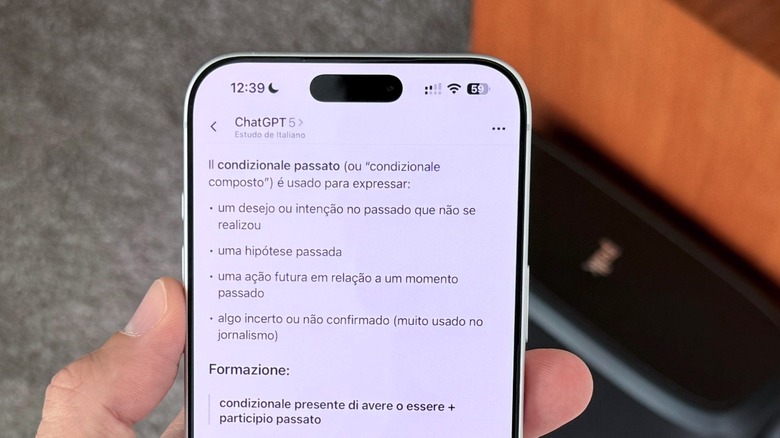
For anyone constantly using OpenAI's ChatGPT or Google's Gemini, they've probably never had to think about switching languages. After all, you can ask a query in whatever supported language you feel like, and the assistant will give you the answer in the same language. More importantly, even if your device's language is set to English, you can still ask questions in Portuguese, Italian, or Spanish, and the answer will come instantly — even in voice mode.
If you're trying to do the same with Siri using your voice, you'll get a very funny answer, as the personal assistant will think you're still using the predetermined language. While it's unclear why Apple limits the Siri AI experience to a single language in voice, it's important to note that it can affect the personal assistant's understanding for tasks such as playing that latin song you like, giving directions, saving events to the calendar, and more.
Even though Siri AI is already a lot better than it was, it still fails to address customers who speak multiple languages, meaning that you'll still hear the assistant mispronouncing all the names when you're traveling abroad. In that sense, third-party AI chatbots, although a lot more data-hungry, can make the conversation flow, while Siri, even after learning new languages, still sticks to the one you choose.