

8 Forgotten Tech Sounds That Will Bring The Glory Days Rushing Back
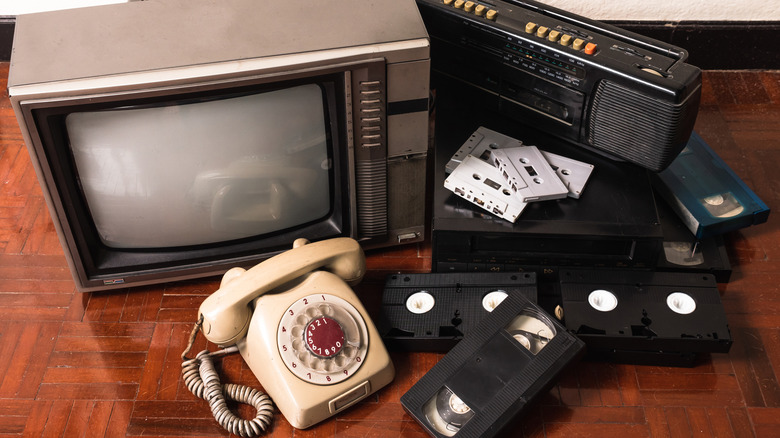
Technology has come a long way and is still at an unprecedented level of evolution as we regularly achieve new breakthroughs. Unfortunately, with all these advancements, the tech graveyard has been piling up higher and higher each year, and over time, we've forgotten a lot about how things used to work — and sound.
While we've managed to pack so much raw power into modern hardware, the digital era still seems quite sterile, especially since it's gone practically soundless. In comparison, machines from a few generations ago vocally articulated each process through complex mechanisms that produced distinct movement and noises, making us appreciate the marvels of engineering behind their inner workings.
Even if you don't get to hear these sounds anymore, memories of those old times will forever linger, and sometimes hearing them again evokes nostalgia and takes you back to simpler times. As such, we've compiled a list of forgotten tech sounds that will bring the glory days rushing back.
PlayStation 2 intro sound
The PlayStation 2 is regarded by some as the pinnacle of consoles, and it's safe to assume it was the first gateway into the gaming world for many. One of the core memories of the PlayStation 2 experience was its startup screen. The intro voice was a sequential blend of piano and bells, followed by a swoosh effect, with the video background of virtual boxes and three different-colored lights roaming. It was almost as if this comforting blend of different sounds was telling a story.
As a cool Easter egg, those virtual boxes eventually became towers, representing how much time you've spent booting each game. However, if the startup took too long, it was also an omen of bad things to come in the console's failure to read the inserted disk. In such a case, you were greeted by a red screen of death, which used to give quite a startle compared to the soothing, futuristic startup. The intro sound still gives goosebumps and reminds us of what the first actual next-gen gaming experience felt like.
Static sound from old speakers when a call was incoming
While modern-day setups have mostly shifted towards a headphone configuration, desktops in the early 2000s and before mostly relied on external speakers for audio output. These speakers are also used to produce a static or glitchy sound during an incoming phone call. Back in the day, this was pretty common, and some even used this sound as a precursor that their phone was about to ring.
The real reason for this disturbance was electromagnetic interference (EMI), which is created by consumer electronics (including your phone). The EMI generated by 2G networks interfered with the speakers' amplifiers, causing that static buzz. Now that 5G has become the new standard and is even phasing out 4G, mobile networks operate at much higher frequencies and cause far less interference with speakers, which are now also better shielded against such disturbances. As much as it used to be annoying, sadly, we won't be able to experience this distortion ever again, and just an echo of this sound is a trip down memory lane.
CRT TV whine
CRT monitors were the standard for decades before becoming rapidly irrelevant as flat screens began to replace them in the late 2000s. They may fall into the category of gadgets you'd regret throwing away, as they still hold value in certain niche markets. One notable thing about owning these monitors was that they emitted a high-pitched whine at around 15 kHz, which is difficult for individuals over 40 to hear. The noise was extremely irritating and would even persist after the sets were closed, giving a tinnitus-like effect. Hearing this electronic squeal reminds us of the old days and tells a story of how far technology has come.
Aside from generating such noise, CRT TVs also had one other peculiarity. They used phosphor displays, and there wasn't a way to tell whether they were on or off, since a display would take a few seconds to output. As such, this whining sound was a good way to tell if the appliance was powered on or off.
As for the high-pitched noise, CRTs use a flyback transformer to power the electron gun, and at such high voltages, the coil can rapidly vibrate, generating high-frequency noise. Display types like OLED, LCD, and QLED are now the baseline, and they use a backlight to illuminate the screen, so you no longer hear that whine.
Windows XP startup sound
Windows XP represented a revamp of the concept of an operating system, with Microsoft doubling down on making computers even more user-friendly through an entire visual and sonic overhaul. With the tech giant aiming for a professionally themed experience, it needed a perfect intro sound to welcome users. Bill Brown, a famous video game, movie, and television composer, was commissioned for the task, and he used orchestral recordings to stage the short four-second intro. The result was a soft melody that rang with optimism, a chord that struck millions of PC users.
Hearing that startup jingle every time brings back tons of memories, like booting up "GTA: Vice City" on a Saturday morning or browsing the web on Internet Explorer, which is sadly no longer supported. Over the years, the chime has become an essential part of pop culture and is even prevalent across the meme scene. Bill Brown has an interesting story about how the boot sound actually came into being. You can check out a two-episode podcast for the full context.
Floppy disk sound
Preceding CDs and DVDs, floppy disks paved the path for modern-day removable storage, but the march of technology has made them a thing of the past, forgotten by many. Those who have used these storage means firsthand may recall how loud they can get. The inner magnetic disk of a floppy rotated at 300 or 360 RPM, and the metal head reading the data would be the one making those pronounced screeches. Reading and writing actions could create a recognizable pattern, which sometimes resembled that of a musical beat. However, when a sector goes bad, it can become terrible with repeated clicking, grinding, and stuttering.
Even inserting a floppy disk would produce a calming click as the drive's metal latch gripped the disk. Floppy disks have long been obsolete, but the decline of physical media has pushed them further into the deep hole of forgotten tech, along with those hardware spins and clicks we won't ever hear again. While gone, floppy disks certainly aren't forgotten. There are those who refuse to let this vital piece of tech history go, and still use it as their go-to option for removable storage.
VHS tape rewinding
VHS tapes paved the way for modern home cinema, being an affordable and easy means to watch movies in your living room without requiring bulky equipment. Played via VCRs, this setup is still relevant to certain cinephiles today. In fact, VCRs can connect to Smart TVs without an HDMI cable.
The film recording was kept on an inner magnetic tape that ran through two different reel sections. As you played the tape, the reel would roll from the supply to the take-up section. To rewind, you'd have to scroll the tape back from the take-up reel to the supply reel to make it ready to play again.
In the early days of VCRs, rewinding VHS tapes was a manual process and could be done by sticking a pen into the spool and turning it backward. However, with a rewind button introduced in the players, the process became automated, creating a whirring sound that gradually increased in pitch and, at times, sounded frightening. Scary or not, the whole process gave you enough time to reflect and savor a movie before eventually returning it.
Modem dial-up connection sound
During the era when the internet was still transmitted over telephone lines, you could actually hear the data travelling back and forth. Just to establish a connection, a modem was required to communicate with the ISP to complete a data handshake. Since the internet and phone line shared the same channel, data travelled in audio form, and the modem demodulated and converted the information. These modems had speakers installed on the board so users could tell if the connection was successful.
Hearing the data being transmitted wasn't necessarily a pleasant experience, yet it still showcased the complexity of establishing a connection amid bursts of high-pitched noise and squeaks. Also, if you used a phone in the meantime, you'd hear data transmitted over the line, depending on whether your line isolated both connections.
As technology has advanced, internet connections now use dedicated channels, and dial-up modems are no longer required. It's a pity we no longer hear raw data sound like a glitched robot or a traveling UFO, though many are probably happy never to listen to that screech again.
Rotary phone sound
Over the past century or so, the way we communicate has drastically changed, and phones have evolved so much that most may not even be familiar with the old-style rotary sets that existed. You'd have to insert your finger into a hole and scroll the dial until it reached the desired number to register. As the dial returned to its resting position, it emitted a series of clicks that were music to one's ears. In case of an inbound call, the phone would create a metallic bell sound similar to an alarm.
As for how they work, the dial landing at the desired number location would send an electric impulse and register that digit. For the number sequence, if any digits were wrong, you'd have to start again. Ironically, even this complex setup was a huge advancement for telephones at the time, since rotary phones were the first of their kind to allow self-dialing, whereas before, human operators connected both ends.
Unfortunately, rotary phones have been out of commission for decades, and the world has long since shifted to mobile gadgets, a more convenient form of communication. Nowadays, rotaries have found a second life as forms of Wind Phones or in thrift stores, where they're primarily sold as vintage curiosities. Still, the complexities and clicking sounds involved in a mere call created a unique feeling that nothing else can replicate.