

How Do Electronic Parking Brakes Work?

Electronic parking brakes have quietly become one of the most common features in modern cars, including the best electric vehicles, replacing the familiar handbrake lever with a small button tucked near the center console. It's a subtle upgrade, but it dramatically changes how your vehicle handles something as fundamental as staying locked in place. Instead of relying on a long cable you physically pull, today's cars use sensors, electric motors, and onboard computers to hold your car steady on steep hills.
For drivers, the experience feels almost effortless: Just tap a switch and the brake engages with a reassuring click. Behind that simplicity, however, is a surprisingly complex bit of engineering. An electric brake has to apply the correct amount of force, monitor whether the car is still rolling, and communicate with the traction control system, ABS, and the transmission to prevent accidental movement. In many cars, the brake can activate automatically when you shift into park or release on its own when you press the accelerator.
Understanding how electronic parking brakes work can help you spot issues early, avoid unnecessary wear, and make sense of the warning lights that occasionally pop up on the dashboard. Whether you're driving a game-changing Eli micro-EV or a traditional gas-powered SUV, this technology plays a bigger role in your car's everyday safety than you may realize.
The benefits of electronic parking brakes

Switching from a mechanical handbrake to an electronic parking brake isn't just a cosmetic upgrade; it brings practical advantages that improve everyday driving and long-term safety. The most immediate benefit is consistency. Traditional handbrakes rely on physical force, and not everyone can pull the lever with the same strength. Electric systems use calibrated motors to apply an exact amount of clamping pressure every time, reducing the risk of under- or over-tightening the emergency brakes.
Interior design is also less cluttered when using electronic parking brakes, as the bulky handbrake lever is eliminated, which means extra room in the center console. That space is can be repurposed into storage trays, wireless charging pads, or additional cupholders. For drivers, it simply makes the cabin feel cleaner and more modern. Electronic parking brakes also integrate with a vehicle's safety systems in ways a mechanical lever never could. Features like automatic hill-hold, auto-release, and auto-engage when you shift into park make driving smoother, especially in hilly cities or heavy traffic.
In many newer models, the electronic parking brake ties into traction control and advanced driver-assistance systems, allowing the car to prevent rollback or apply emergency braking if sensors detect unintended motion. Lastly, electronic parking brakes can enhance security. If someone attempts to drive off without the key or with the doors open, modern systems can automatically activate the parking brake. It's an extra layer of safety that could deter thieves.
Common electronic parking brake problems
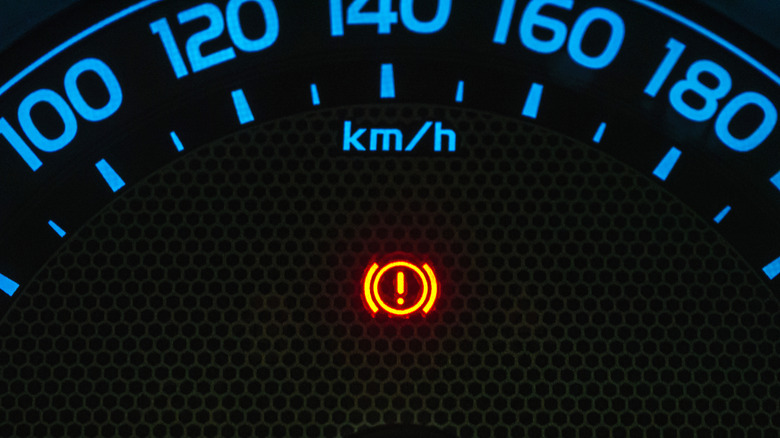
Despite the convenience, electronic parking brakes aren't immune to issues. When something goes wrong, your vehicle will usually alert you with a warning light or message on the dashboard. One problem that can arise is low battery voltage. Because electronic parking brakes rely on electric motors and control modules, a weak battery can prevent the system from engaging or releasing properly. If you see a parking brake malfunction warning after your car has been sitting for a while, a dead battery may be to blame.
Faulty wheel-mounted actuators are another potential issue, including with EVs that perform well in the snow. Road salt, moisture, and dirt can all cause an actuator to seize, preventing the rear brakes from clamping or releasing. When this happens, the car may display warnings reading: "Parking Brake Service Required" or "Brake Hold Unavailable." Sensor problems can also trigger alerts on your dashboard. The electronic parking brake works closely with ABS and wheel-speed sensors, so if any of those components fail, the parking brake system may disable itself as a precaution.
You might notice ABS or traction-control lights coming on alongside the parking brake warning in this scenario. Some drivers also experience the electronic parking brake refusing to release when the seatbelt isn't fastened or if the door is ajar. These aren't malfunctions, though; they're safety interlocks designed to prevent accidental movement. If a warning light appears and the brake won't disengage, most cars provide an override procedure in the owner's manual.