

NASA's Escapade Mars Mission Will Be Completely Different - Here's How
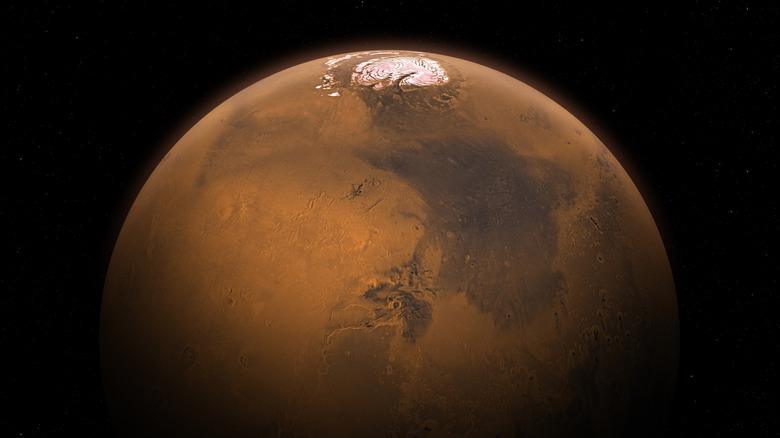
On November 13, NASA launched a new unmanned mission to Mars under the name ESCAPADE, short for Escape and Plasma Acceleration and Dynamics Explorers. The launch was met with fairly little fanfare in the press; unmanned Mars missions aren't exactly novel, as the American space agency has sent over a dozen satellites and rovers to the red planet, most notably the Perseverance rover (which takes some really nice photos). However, ESCAPADE is unlike any of those previous endeavors. For the first time in its history, NASA will be operating not one, but two spacecraft simultaneously on a single mission. They are a pair of orbiters that will circle Mars over the course of a full year, and by doubling up on spacecraft, NASA will be able to survey opposing sides of the planet at once.
By placing eyes at multiple points around Mars, ESCAPADE is poised to reveal a vision of the red planet more thorough than anything we've seen before, although it will take more than two years before the orbiters start sending data back to NASA. The intrepid orbiters are nicknamed Blue and Gold, after the school colors of the University of California, Berkeley, where they were designed. This collaboration is another first for NASA, and it points towards something even more fascinating about the mission. Despite being the first extraplanetary mission to use two spacecraft at once, ESCAPADE is actually poised to be one of NASA's cheapest projects in years, and it's all thanks to a controversial gamble that the agency has undertaken.
NASA's bold plan to explore space for cheap
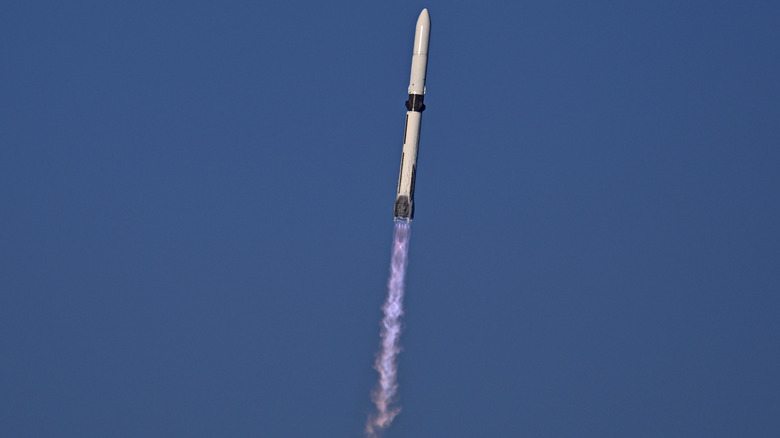
The ESCAPADE mission will cost NASA $94.2 million. That's objectively a lot of money, but in the context of space travel, it's actually an incredible bargain. Space travel is the most expensive endeavor that humanity has ever undertaken, best exemplified by the $100 billion dollar price tag of the International Space Station, which is enormous and is the most expensive object ever made. However, even small-scale unmanned projects regularly push the billion dollar budget. The last orbiter that NASA sent to Mars was MAVEN (Mars Atmosphere and Volatile EvolutioN) in 2013, which cost almost $600 million dollars. For ESCAPADE, NASA managed to slash that cost significantly, and they're hoping it sets a precedent for cheaper space travel going forward.
ESCAPADE is part of a broader NASA program called SIMPLEx which stands for Small, Innovative Missions for Planetary Exploration. Launched in 2018, the SIMPLEx program aims to launch space missions for $55 million or less. ESCAPADE has eclipsed that, but the agency has said it is flexible on the price cap at this point due to SIMPLEx being in its very early stages. The truth is, NASA will be grateful to get this mission done at all, because SIMPLEx hasn't yielded many successes so far, and they could really use a break. The low-cost initiative has had several issues, and the ESCAPADE program was no exception to this. In fact, the daring duet of Blue and Gold almost didn't make it off the launch pad.
ESCAPADE almost didn't happen
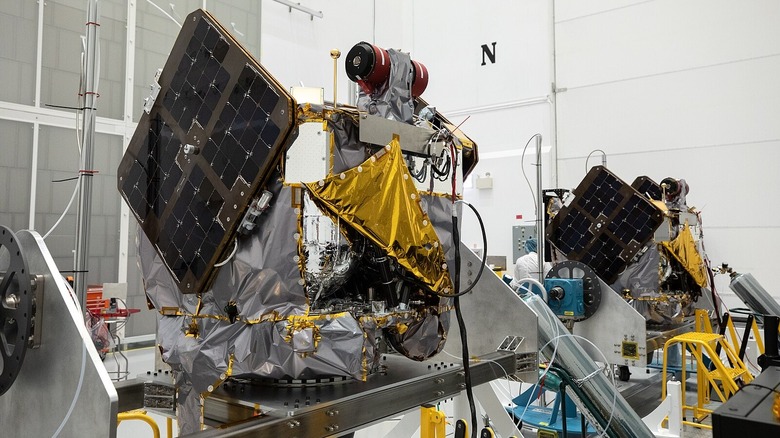
Blue and Gold are small, about the size of a mini fridge, which saves a lot of money. However, it's going to take something much bigger to launch them out of Earth's atmosphere. The SIMPLEx budget can't cover the cost of the rocket, which means the orbiters have to hitchhike on another NASA mission. The original plan was for NASA's 2022 Psyche mission to drop Blue and Gold off at Mars on its way to the asteroid belt, but this changed with the rise of NASA's partnership with SpaceX. At the last minute, the agency decided to switch Psyche to a SpaceX Falcon Heavy rocket, which Blue and Gold were not equipped for.
After that, NASA decided that the orbiters should ride along with another private contractor: Blue Origin's New Glenn rocket. Unfortunately, the orbits of Earth and Mars only get close every two years, and 2022 was that moment. By delaying ESCAPADE to 2025, NASA has to make Blue and Gold travel a lot farther. Their solution is to have the New Glenn rocket drop the orbiters off at a Lagrange point, which is a point in space where gravitational forces are balanced just right for objects to hold in place. Blue and Gold are set to hang tight at a Lagrange point 1 million miles away, and then next year, Mars will pass close enough for the orbiters to slingshot towards it. Assuming that all goes to plan, ESCAPADE's real work can get underway.
What exactly is ESCAPADE's purpose?

There's a lot riding on ESCAPADE's success in terms of proving that the SIMPLEx initiative's goals are achievable, but we haven't yet gotten into the actual scientific work that Blue and Gold will be doing. An ever-growing body of research tells us that Mars once looked much more like Earth, with liquid water and a thick atmosphere, but astronomers have puzzled over exactly how the Martian atmosphere changed to the point that it has virtually vanished today. It is likely that solar winds were responsible for stripping that atmosphere away, and Blue and Gold are equipped with instruments to record solar winds and their effects in real time.
The orbiters will also record magnetic data. Like its atmosphere, Mars' magnetic field has degraded around most of the planet, but a few regions in its southern hemisphere strangely seem to have maintained strong magnetism. Blue and Gold will travel across both hemispheres in the hope of finding answers to this mystery.
Once the orbiters disengage from the Lagrange point, they will maneuver into orbit around Mars. At first, Blue and Gold will orbit in the same direction, one following the other, but then they will diverge, with one orbiter getting close to the planet and the other pulling away. This will give NASA a close-up and wide-angle shot of Mars at the same time. The potential for gathering data is unprecedented, but unfortunately, we'll have to be patient. The orbiters won't start sending their findings back to NASA until 2028.