

China Just Launched Their Most Advanced Aircraft Carrier With Electromagnetic Catapults
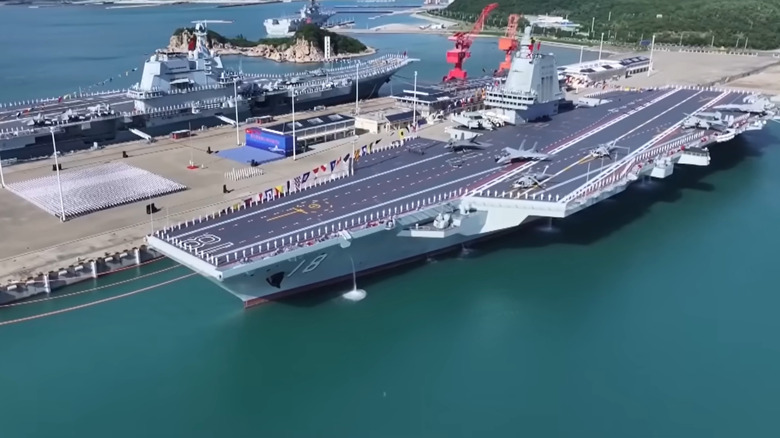
China took a major step in realizing its regional and global military ambitions when it launched its third aircraft carrier since 2012. Commissioned during a November ceremony at the People's Liberation Army Navy's (PLAN) Yulin Naval Base on Hainan island, the Type 003 carrier, dubbed the Fujian, is the largest non-nuclear warship in the world. It is also the world's most advanced non-American aircraft carrier, representing a major leap in Beijing's naval capabilities. Equipped with the country's first Electromagnetic Aircraft Launch System (EMALS), the Fujian greatly improves the PLAN's combat lethality by increasing the rate at which the carrier can launch aircraft, while also allowing larger jets to be deployed in the first place. The domestically-built launch system is the first time a non-U.S. nation has developed the technology. Before the Fujian hit the South China Sea, the U.S. Navy's USS Gerald R. Ford stood as the only other ship equipped with the new catapult system.
The launching of the Fujian takes on larger significance when viewed within the context of China's increasingly antagonistic naval strategy. Since the turn of the century, the PLAN has steadily grown its fleet from a ragtag band of Soviet-era cast-offs into the largest naval fleet in the world. Although technologically behind its Western rivals, China's capabilities are quickly rising. The addition of the Fujian is another milestone for a naval program looking to not just establish regional dominance, but extend its global reach. And while China's carrier advancements might be mitigated by the U.S. Navy's next nuclear supercarrier, observers caution that the addition of the Fujian will inch the world's largest navy closer towards challenging its Western competitors' global military presence.
PLAN takes a technological leap
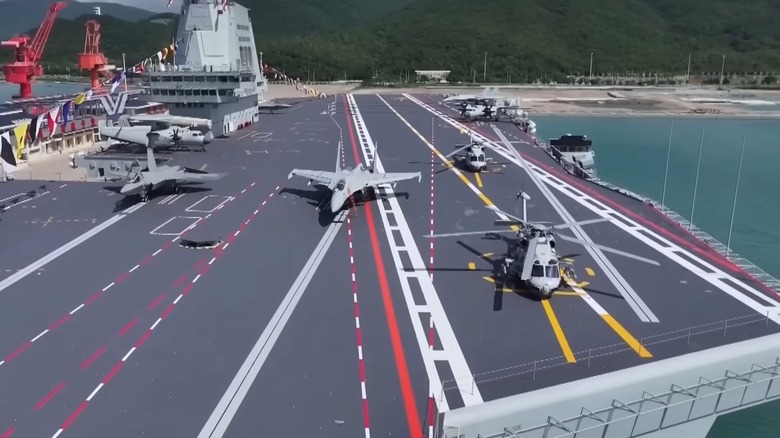
Chinese officials hope the Fujian will usher in a new phase of its naval, aerial, and ground capabilities. Displacing an estimated 80,000 tons, the steam-powered Fujian is the third largest aircraft carrier class in the world, behind the Gerald R. Ford and soon-to-be-retired USS Nimitz, and topping the United Kingdom's HMS Queen Elizabeth by 15,000 tons. The roughly 1,036-foot hull can support up to 60 aircraft, a major leap in China's carrying capacity. It also brings an upgraded arsenal, which satellite imaging shows to include advanced missile defense and close-in weapon systems.
While these improvements are noteworthy, what sets the Fujian apart is its three EMALS. The two previous iterations of Chinese aircraft carriers utilized short take-off but arrested recovery (STOBAR) launch systems. Modeled after Russian systems, these ski jump-style launchers are limited in the types of aircraft they can handle. Electromagnetic catapults, on the other hand, can launch both fixed-wing and rotary aircraft, including China's Z-20 helicopters, J-35 and J-15 fighter jets, and the KJ-600 airborne early warning aircraft. The latter is particularly noteworthy, as it transforms the Fujian into a roving intelligence hub. In addition to expanding both the type and number of aircraft, EMALS can also launch aircraft with heavier payloads and fuel tanks, greatly expanding the range and firepower of PLAN's aerial defenses. Furthermore, EMALS may enable Beijing to launch deck-loaded strikes, in which carriers launch swarms of aircraft in a single sortie, leading to decisive strike and first mover capabilities. En masse, these improvements will pay major dividends, with Lyle Goldstein, director of Asia engagement at Washington thinktank Defense Priorities, telling the Washington Post that adding an electromagnetic catapult is "doubling or tripling — maybe even quadrupling — the combat lethality" of China's aircraft carriers.
A global mindset
In an interview with The Washington Post, Tian Shichen, president of the Global Governance Institute and a retired PLAN captain, likened Beijing's latest carriers to NASA's Apollo program, noting that its lasting impact will likely be how its underlying technologies update China's fleet. Malcom Davis of the Australian Strategic Policy Institute previously echoed similar top-level sentiments to the South China Morning Post, predicting that the greatest advancement may not be any singular technology, but the development of China's ability to operate "big deck" carriers. This is particularly poignant as Beijing embarks on developing its fourth carrier. Likely the country's first nuclear-powered carrier, the Type 004's near-limitless range – alongside the country's buoyed store of logistical support ships, destroyers, and cruisers – will likely augment Beijing's expanded geopolitical ambitions. PLAN has also made significant investment in the firepower common to these strike groups, adding YJ-21 hypersonic "carrier killer" anti-ship missiles to its cruisers, electromagnetic catapults to its amphibious assault ships, and deploying a plethora of new fighter jets and early warning aircraft.
Concerns regarding this buildup are underscored by the PLAN's recent training missions, which saw Chinese carriers probe disputed waters in the South China Sea. The controversial move was the latest in a string of sea training exercises and deployments in which China looks to establish itself as more than a regional naval player. Paired with Beijing's mounting economic and military investments in Latin America and Africa, the implications of the Fujian's November commissioning may see the PLAN ready to challenge its rivals on a global stage. And while the United States military is more technologically advanced than its Eastern neighbor, the Fujian may become a decisive step in Beijing closing a gap many once thought insurmountable.