

Norway Is Changing Travel With The World's Longest Undersea Road Tunnel

It'll only be a matter of time before Norway is home to the world's deepest and longest undersea road tunnel. The tunnel is billed as "Rogfast," which is short for "Rogaland fastforbindelse" — named after the region the tunnel resides in, and the Norwegian word for "fixed link." Upon completion, Rogfast is expected to be 17 miles long and 1,286 feet below sea level. As it stands, the longest passenger tunnel in the world is the Gotthard Base Tunnel in Switzerland.
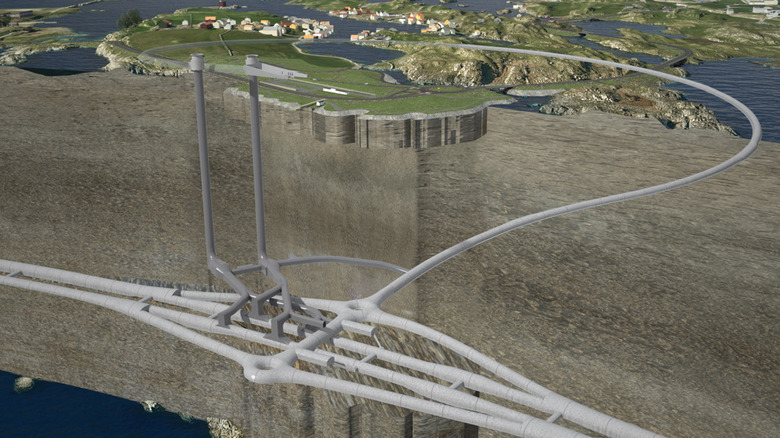
One of the main goals of the construction project is to vanquish the need for ferry transportation between the Norwegian cities of Bergen and Stavanger. The tunnel is meant to reduce travel time by about 40 minutes, and will consist of two unique tube structures — each with two traffic lanes — and a centralized roundabout connecting drivers to a separate tunnel leading to the island of Kvitsøy.
Rogfast is just one piece of a larger E39 coastal highway revamp project. Right now, it takes about 21 hours to travel the 684-mile E39 roadway, a trek which also involves seven ferries. At some point before 2050, engineers plan to eliminate ferries altogether by constructing tunnels and bridges.
According to CNN, Anne Brit Moen, a project manager at Skanska — the international construction firm that's responsible for building the northern portion of the tunnel — made the following remarks: "The tunnel will significantly improve connectivity along the Norwegian west coast, by creating a faster and more reliable link between the Stavanger and Haugesund regions."
Engineering Norway's Rogfast tunnel
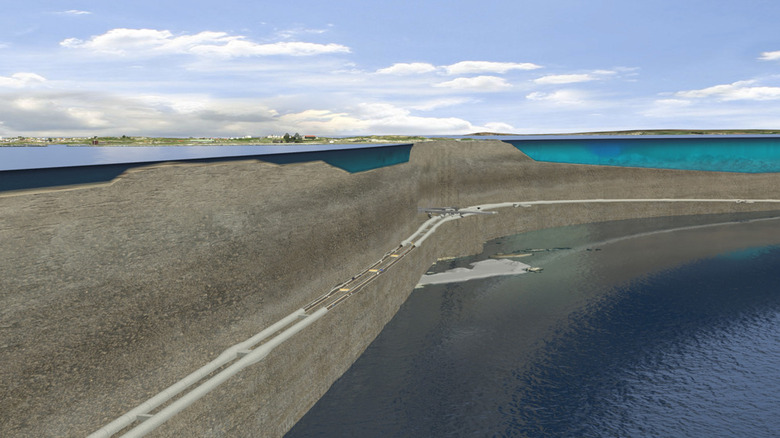
Building Rogfast has been an interesting challenge thus far. The project actually started back in 2018, but hit a roadblock in 2019 due to cost overruns, which necessitated a project restructure and the termination of several contracts. Work picked back up again in 2021, and now the tunnel system is scheduled to be completed by 2033. Costs are anticipated to reach 25 billion Norwegian kroner, or roughly $2.4 billion.
Rogfast is being built by two construction firms: the aforementioned Skanska company in the north, and a joint venture between Implenia and Stangeland Maskin for the southern and middle sections. The northern and southern-designated construction firms are building simultaneously, with a goal of meeting in the middle.
The teams only have a 1.97-inch margin of error to work with, so engineering has to be precise. Such high levels of accuracy require cutting-edge construction equipment, including a rotating laser scanner that's programmed to gather data points along the tunnel. This allows for a digital clone of the tunnel to be created, one that contractors can check against building plans for errors.
The project has already encountered some obstacles, including a slew of saltwater leaks. Builders also need to worry about preventing air pollution from affecting motorists, and are actively engineering a complex ventilation system powered by jet fans to eject all the bad air out of the tunnel.
That said, we're wondering if this may encourage more drivers to switch over to one of the best electric vehicles, which would keep the tunnel airway even cleaner.
Where innovation meets the ocean floor
Norway's knack for innovation isn't just relegated to underwater projects: The city of Bergen figured out a brilliant way to deal with trash by employing vacuum tubes that literally suck garbage out of the town, which helped to cut down diesel emissions by up to 90% as fewer garbage trucks were required.
While it's expected that the construction of Rogfast will spell the end for a number of ferry-centric occupations, the new roadway may have a positive impact on other career types, education, and public services. Rogfast should also be a boon for the seafood industry and local economy, as vendors will be able to operate across a wider area.
The Rogfast project is progressing at a steady clip. By 2033, all the hours of careful planning, measuring, and re-measuring will culminate in an effective means of getting Norwegians from A to B faster than ever before. Perhaps the ingenuity will be contagious, and other congested cities and coastlines will start building underwater highways of their own.