

The Most Scientifically Accurate Sci-Fi Movies, According To NASA

When Hollywood creates compelling entertainment, it cranks up the storytelling to add intrigue and suspense. That can make a movie seem far-fetched and unbelievable, especially when based on scientific or technical topics. If you've ever watched pseudo-hackers on screen breaking into a mainframe, you know real hacking is nothing like it. And in some of the action scenarios we see, no one would ever survive. Experts can help us figure out the balance between implausibility and realism. Sometimes, it's about context — like in the medical drama "The Pitt," which accurately portrays the physical and mental struggles of healthcare workers.
Regarding science fiction, NASA scientists have listed unrealistic and realistic movies while attending a meeting at NASA's Jet Propulsion Laboratory (via Smithsonian Magazine). They would know, right? Here's the full list of the most realistic and plausible films:
- "Gattaca" (1997)
- "Contact" (1997)
- "Metropolis" (1927)
- "The Day the Earth Stood Still" (1951)
- "Woman from the Moon" (1929)
- "The Thing from Another World" (1951)
- "Jurassic Park" (1993)
The top realistic movie is "Gattaca," from 1997, which is so good in its depiction of contemporary genetics scientists have expounded upon the idea with a thoughtful 2022 paper. Also notable, "Contact," with Jodie Foster, is based on a novel by Carl Sagan, who is a real astronomer and scientist. Apparently, he slowed down production because he wanted it to be extremely accurate (via Far Out). At that rate, it was always going to be realistic. Seeing "Jurassic Park" on the list, maybe it's time to crack open fossilized amber to see how much of it is real?
If you're curious, Neil deGrasse Tyson's approved sci-fi list also features several of these titles. Others he called out are "The Matrix," "The Martian," "Interstellar," the ever-classic "Back to the Future," "Deep Impact" from 1998, and Kubrick's "2001: A Space Odyssey" released in 1968.
What are the least realistic sci-fi movies on NASA's list?
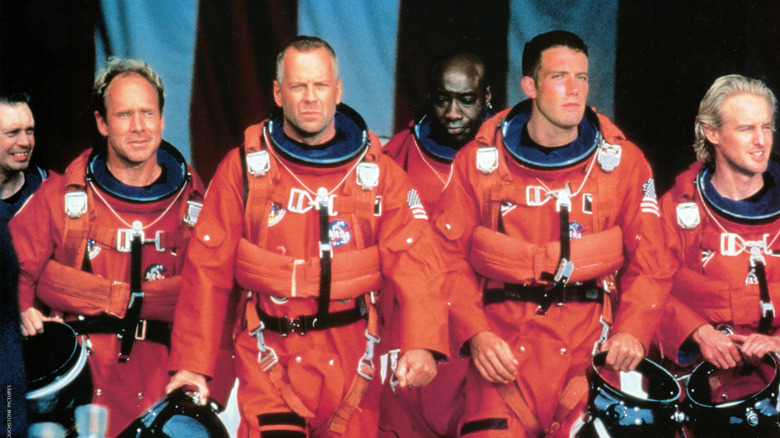
NASA's list also explores the least plausible movies by science standards. The worst offender is "2012," actually made in 2009. If you want to know all the reasons why "2012" is dumb, refer to NASA's Donald Yeomans, the head of the Near Earth Asteroid Rendezvous mission, who emphasized the Earth's core could never heat up as quickly as it did in the movie, which is the entire cause of the disasters depicted (via The Times). The runner-up is 2003's "The Core," which seems to ignore even the basic concepts of geology.
All movies on NASA's "least believable" list include:
- "2012" (2009)
- "The Core" (2003)
- "Armageddon" (1998)
- "Volcano" (1997)
- "Chain Reaction" (1996)
- "The 6th Day" (2000)
- "What the Bleep Do We Know?" (2004)
Honestly, it's surprising not to see "Total Recall," or any of the "Terminator" flicks. Besides what's on this list, there are some excellent '70s sci-fi movies everyone needs to watch at least once. It would be interesting to see how realistic some of these movies are, and an analysis of "THX 1138" would certainly be interesting. One also can't help but notice a lack of the compelling "A for Andromeda" in either the original show or the remake, starring Kelly Reilly and Tom Hardy.