

5 Obscure Windows Apps You Didn't Know You Needed
When you think of Windows apps, the first ones that probably come to mind are Notepad, Microsoft Excel, and Paint. They're some of the most popular and convenient apps people use on their PC, so they've pretty much cemented themselves as icons at this point. But while they're undoubtedly handy for everyday tasks, they're not the end-all-be-all of what you can install on Windows.
In fact, there's a quiet bunch of obscure Windows apps that might not be on everyone's favorites list but are actually just as useful. These apps give you access to a host of functionality on your PC you might not even know is possible. From an app that adjusts your screen color temperature based on the time of day to a versatile toolkit packed with all sorts of niche utilities, here are five of the obscure Windows apps you should try today. They're mostly from third-party sources and are free to download and use.
To change wallpapers dynamically: WinDynamicDesktop
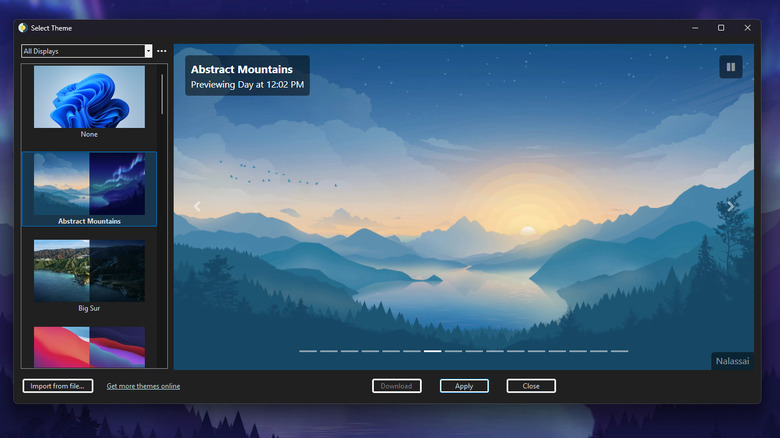
When it comes to desktop customization, Mac computers come complete with so-called Dynamic Wallpapers. These are wallpapers that generally look the same, but they appear brighter or darker depending on the time of day. For instance, you have a sunny mountainside in the morning, a mountainside with a sunset glow in the afternoon, and a mountainside under the Aurora lights at night. These dynamic wallpapers bring your computer to life, and you get a subtle visual variety without the jarring transitions of a photo slideshow.
Unfortunately for Windows users, there isn't a built-in Dynamic Wallpaper feature on PCs yet. The next best thing you can use is the obscure Windows app WinDynamicDesktop. WinDynamicDesktop creates a macOS-inspired dynamic wallpaper setup on Windows. Like macOS' Dynamic Wallpapers, it also automatically changes the wallpaper based on your local time. You can even opt to sync it with your local sunrise and sunset, which are determined either automatically using your location or manually as set by you. The app comes with a couple of themes you can download and use right away. These include the default wallpapers of macOS versions like the Big Sur Abstract and Mojave Desert. There's an option to import a theme you got elsewhere, though.
WinDynamicDesktop is open-source, so it's free to download and use. But the downside is that the in-app theme options are limited, so you'd have to hop online to find new ones you like. Adding more features to the app also means working with PowerShell scripts, which could be too technical for some users.
To adjust your screen color temperature: f.lux
Studies show that blue light from electronic devices has a negative impact on sleep quality. So if you work on your computer late into the night, then you probably aren't getting the best sleep. Plus, your eyes get so strained from the bright screen light that it becomes harder to focus. That's why one of the essential Windows apps you should install first is a screen color-temperature tool like f.lux.
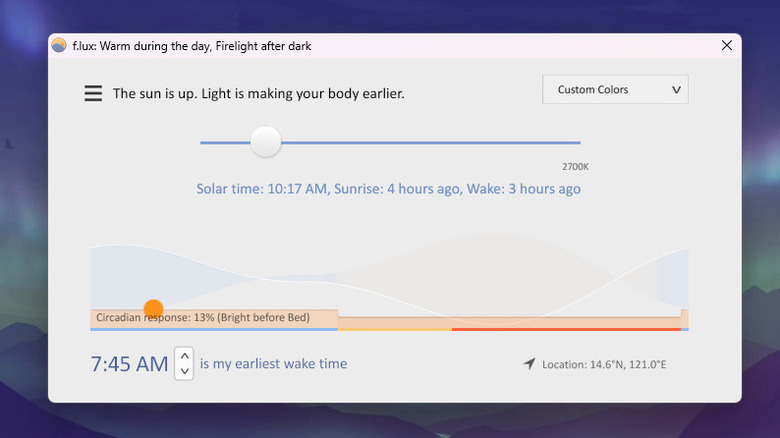
What f.lux does is adjust your screen's color temperature from cool to warm, similar to Windows Night Light. But instead of turning on abruptly and making the transition feel jarring, f.lux changes the color temperature gradually. This automatically happens in the background throughout the day and is barely noticeable. But by the time you're ready for bed, your screen actually looks warm and comfortable enough to use.
Compared to Windows' Night Light, which only offers a basic intensity slider and scheduler, f.lux has more integrated features. For one, you can choose from modes and effects like Movie Mode, Darkroom Mode, Recommended Colors, and Soft White (applies a soft glow to your screen without lowering the color temperature). If you want a more custom look, you can opt to choose the temperatures yourself too. The app works system-wide just like Night Light, but with more flexibility. You can turn it off for certain apps, disable it until sunrise, or let it pause when using full-screen apps. F.lux can even pair with Philips Hue smart lights. This way, your smart bulbs also change colors depending on what your screen looks like.
Some downsides to f.lux are that it doesn't have brightness control and can only change the screen's color. It might also look different from one monitor to the next.
To automatically switch between light and dark modes: Auto Dark Mode
Everybody loves dark mode, and it has become one of the top features people look for when using any modern software. But dark mode has its time and place, and for comfort, you might prefer to turn on light mode in the morning and dark mode at night. The problem, though, is that Windows doesn't come with a feature to automate such a switch — you have to commit to either light mode or dark mode at all times, no in-between. One simple solution to this is a lesser-known Windows app called Auto Dark Mode.
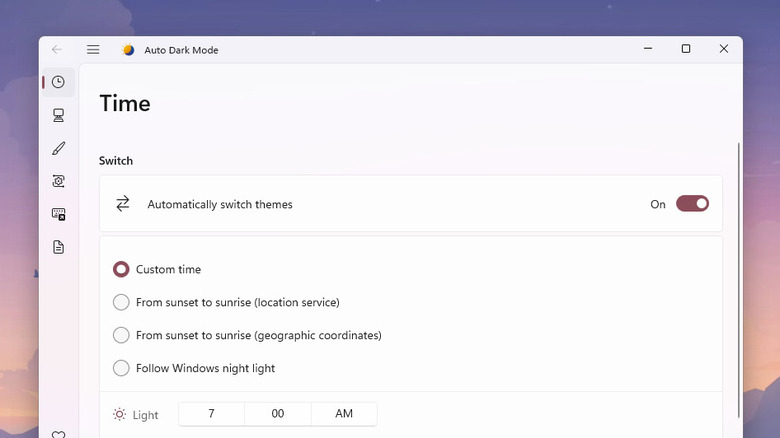
Just as its name suggests, Auto Dark Mode automatically turns on dark mode or light mode depending on the time of day. It lets you pick a custom schedule to activate the modes, but it can also use your location (if you have it on), a geographic coordinate you manually input, or the schedule for Windows Night Light.
Other than these basic options, the app gives you finer control over when the switch happens. For one, you can prevent it from changing modes while you're playing games (with a specific threshold for GPU usage) or using certain apps. You can also set it up to switch only when the system is idle, so the transition wouldn't be too visually disruptive on your end. Auto Dark Mode even comes with some hotkeys, where you can set up keyboard shortcuts to force light/dark mode or toggle modes manually. If you want to further personalize how Windows looks for each mode, there's a Personalization tab in-app for changing wallpapers, accent color, and even mouse pointers.
To manage your clipboard better: Rememory
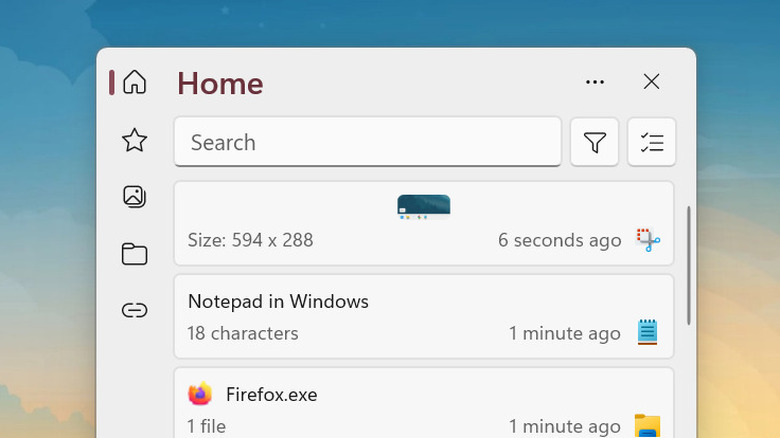
The Clipboard Manager is arguably among the best secret Windows features users often rave about, and for good reason: it speeds up copying and pasting text, images, and links. But while it's handy, there are a couple of feature gaps that make the app inconvenient to use. There's no search functionality for the clipboard history, the pinned items don't move to the top of the list, and all your clips — except for the pinned ones — get deleted every time you reboot or shut your PC down. If you're looking for a better way to manage your clipboard, try Rememory instead.
Design-wise, Rememory closely resembles Windows Clipboard Manager and even opens with a similar keyboard shortcut (Win + Shift + V instead of simply Win + V). The only difference is that Rememory comes complete with the features the native clipboard manager lacks. For one, it includes a search bar with a filter functionality. Just type a keyword and filter the results by the apps where you copied the item. Besides the clipboard history tab, you can find four other tabs in the app: Favorites for your "pinned" items, and individual tabs for Images, Files, and Links.
Rememory lets you do more with each copied item as well. You can paste it as different styles (e.g., lower case, capitalized case), save it as a TXT or HTML file (or PNG for copied images), edit it, or open it in the browser (for copied links). The best part is that Rememory doesn't lose your clips after every reboot or shutdown. They can stay in your history until you choose to delete them.
Unlike some clipboard managers, Rememory doesn't have cloud sync yet. You can't rearrange the items in the history tab too.
To access all sorts of hidden utilities: Microsoft PowerToys
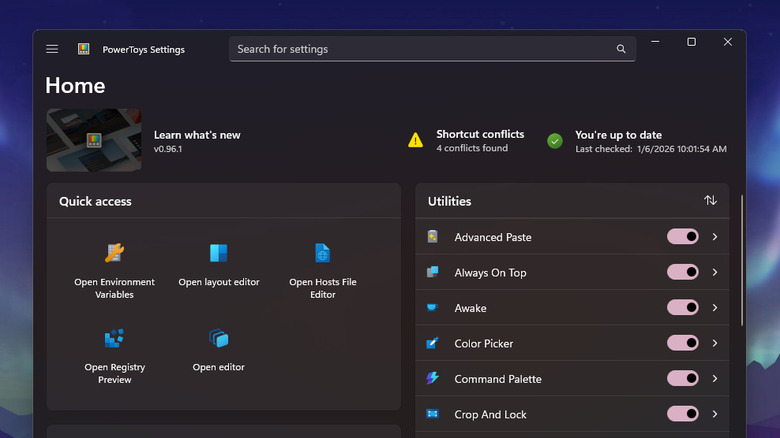
Microsoft PowerToys is a multi-purpose app that features a collection of handy utilities that make Windows 11 work better. There are currently under 30 tools in the app, divided into five categories: System Tools, Windowing and Layouts, Input and Output, File Management, and Advanced. The System Tools are random utilities for interacting with the interface and fine-tuning the system behavior. For instance, this is where you can find the Text Extractor that can scan and copy text from anywhere on your screen and Awake that lets you keep the computer awake for however long you want.
On the other hand, the Windowing and Layouts tools are designed for managing windows and helping you lay out your apps. It includes utilities like Always On Top that allow you to pin a specific window above everything else, and Crop and Lock that crops a window so only a specific portion is visible. For the Input and Output category, you'll see tools that work with your input and output devices. There's the Keyboard Manager that can remap your shortcut keys and Quick Accent that makes it easier to type letters with accents.
Meanwhile, the File Management category is packed with modules for handling files. You get an Image Resizer for changing the size of your photos automatically and Peek for previewing files quickly. Finally, the Advanced category is built for power users. It has tools like Hosts File Editor for when you're using the hosts file and Command Not Found for when you're troubleshooting errors in your PowerShell commands.
Although Microsoft PowerToys gives users the power to improve their Windows 11 experience, one downside is that the app can overwhelm beginners with its multitude of options and the steep learning curve.
How we chose these Windows apps
To curate this list, we had a few criteria in mind. First is meaningful quality-of-life improvement. The apps have to solve a low-friction problem that you might be encountering daily. They should also be easily accessible, complete with an official Microsoft Store page, where you can install them directly. Affordability and quality matter as well. The app (or at least its major features) should be free to help you install and try them right away. And although obscure, these Windows apps must be usable and of reliable quality. The apps we chose are highly rated on the Microsoft Store, with at least 4.3 stars.