

CES 2026: Humanoid Robots Won't Replace You Yet, But They're Trying
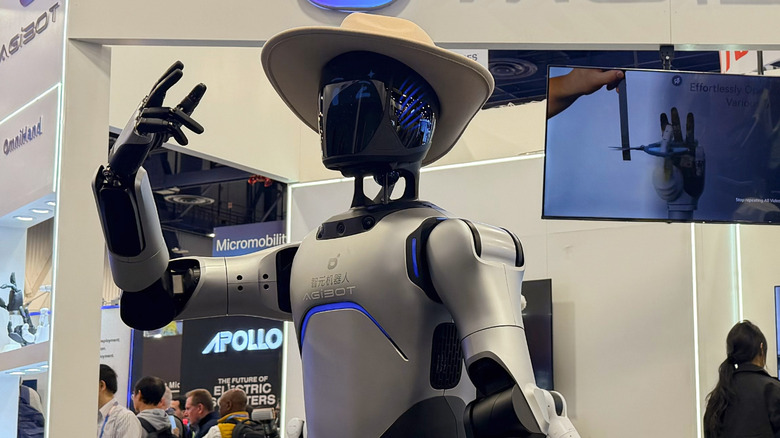
At CES 2026, I've seen humanoid robots doing almost everything. They can confidently dance, craft paper windmills, serve you drinks, clean your house mirror, fold your laundry, access the internet to give you information as if they already knew everything, entertain your children, play chess, take photos for you, and even play Blackjack. Honestly, is there something these robots can't do? As a matter of fact, plenty.
All of these robots, made by several different companies and displayed at the Las Vegas Convention Center, are trained to do very specific tasks. They're far from Isaac Asimov's "I, Robot," or any other science fiction book you might be thinking about. However, these brands are evolving their technologies at a fast pace.
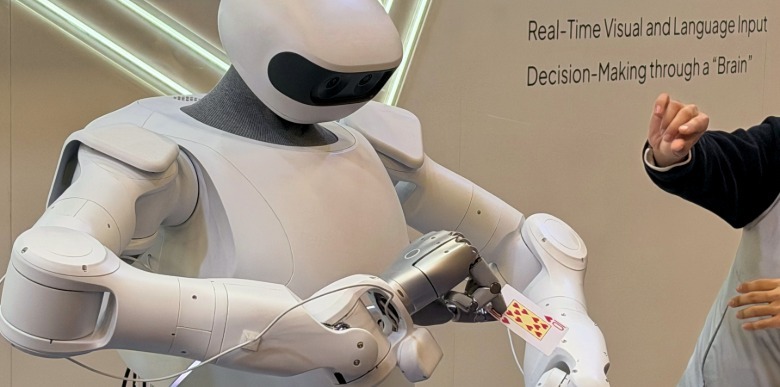 José Adorno/BGR
One of them is Agibot, which unveiled its new lineup of humanoid robots focused on the B2B market, with possible expansion to consumers in the future. With the new A2 Series, the company offers full-sized humanoid robots that are perfect for guided presentations and showroom spaces, something similar to what XPENG introduced a few months ago. The company also has the X2 Series, made of short king robots that can dance, and are perfect for entertaining, research, and education. There's also a G2 Series with a focus on factories, as instead of legs, it offers wheels to save battery.
Neura continues its work on the 4NE1 humanoid robot
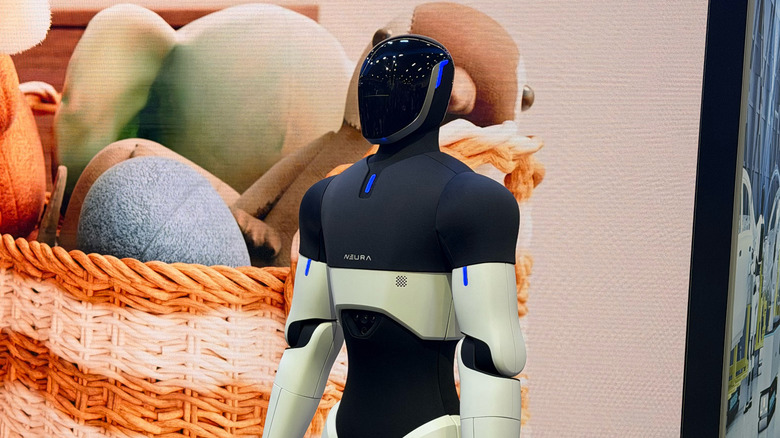
I got to know Neura during IFA 2025. The German brand, whose focus is to "serve humanity," continues to evolve its 4NE1 humanoid robot, now on generation 3.5. Among the changes from the previous model, the new robot features high-torque joints, the capability of lifting up to 100 kg, and an artificial skin to detect proximity with other objects and people to avoid collision.
However, the greatest advance comes in the format of the "Neuraverse," a platform to connect robots, people, and data. According to the company, this operating system offers real-time skill transfer across robot fleets for both industrial and household tasks. This means that if a single robot learns how to close a door, all the other robots will instantly learn that as well. The seamless shared learning comes from a partnership with NVIDIA technology for multimodal AI.
Neura says this open architecture can help connect developers, integrators, and partners wanting to improve this future with humanoid robots. With that, Neura will be able to quickly develop new skills to its robots, as the limitations are not necessarily on the hardware, but on the software, and how the robot performs tasks.