

Are There Any Other Space Stations Like The ISS?

The familiar silhouette of the International Space Station (ISS) is the first thing we think of when it comes to a habitat in space. But the ISS is not the only one. Space habitation has evolved into a broader stage where multiple nations bring their own orbital ambitions to life. The Chinese space station, known as Tiangong, is already orbiting Earth. Also, in the next decade, we'll see more stations from different countries and companies, each with a different purpose.
One of the most ambitious space station projects currently being planned is Haven-1. This will be the first commercial station in space, and it's designed to launch this year. This first private space station, not attached to any government, will help pave the way for future, larger habitats like Haven-2. Then there are companies such as Axiom Space, Orbital Reef, and Starlab that are also working towards commercial habitats in low Earth orbit.
Beyond Earth's orbit, multiple nations are building Gateway, the first lunar space station. As part of NASA's Artemis program, Gateway is conceived as the base for missions on the Moon's surface, but also as the hub for deep space exploration. Countries like India and Russia are also planning their own orbital stations in the 2030s. Together, these plans mark a shift towards a multipolar future in space. Governments, companies, and international projects all contribute to keeping humans present in Earth's orbit, with their eyes on deep space.
Tiangong, the heavenly palace
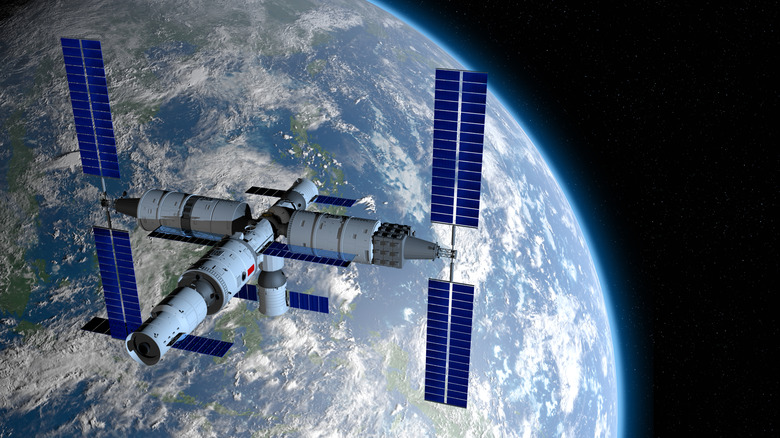
China's Tiangong space station is the country's flagship orbital outpost and a major milestone in its rapidly advancing space program. Built in low Earth orbit, at around 340–450 km (200–280 miles) altitude, Tiangong is a modular station just like the ISS. It consists of a core living hub (Tianhe) and two science modules (Wentian and Mengtian). It's designed to host continuous human presence and support scientific experiments for at least 10 to 15 years. It can hold three crew members for long missions, and up to six during the crew handovers.
Taikonauts (what Chinese astronauts call themselves) live and work in a carefully regulated environment inside Tiangong. Adjustable lighting simulates a 24-hour day to mimic sunrise, daylight, and sunset. The station's life support system provides Earth-like air, while the special zero-g oven provides the crew with grilled food so they can have a sense of home while on prolonged space missions. The crew participates in a wide range of research, such as biotechnology, materials science, space medicine, and fluid physics. Tiangong even hosts biological passengers such as mice to study the effects of microgravity.
Recent missions aboard Tiangong have highlighted operational challenges. After minor space debris damage to a crew return vehicle, two crews had to stay aboard the Tiangong longer than planned. China eventually launched a backup spacecraft to bring the stranded crew back home. Tiangong illustrated perfectly how complex life in orbit is.
Haven-1 could be the first commercial space outpost
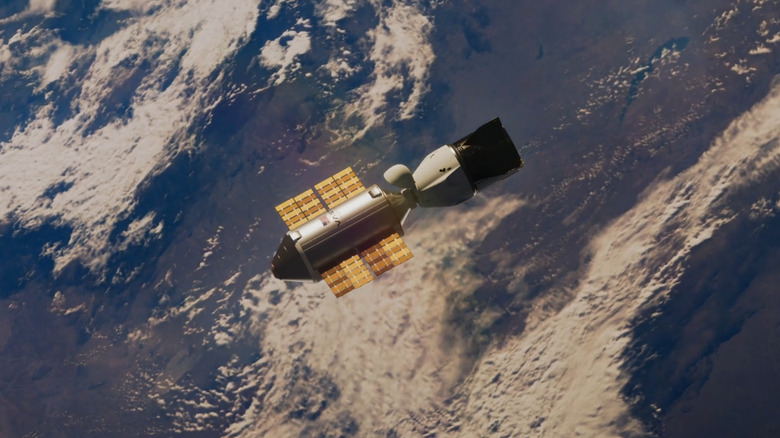
A new chapter in human spaceflight is about to begin with Haven-1, the first commercial space station, with a launch date set for no earlier than May 2026. California-based aerospace startup Vast is behind this project. It designed a single-module orbital habitat that will occupy a similar orbital region as the International Space Station, but on a smaller scale. The roughly 45-cubic-meter (~1,600 cubic feet) space station will be able to support four astronauts at a time, for missions that last anywhere from 10 days to a month.
Vast contracted SpaceX to launch the habitat module on the Falcon 9 rocket, while SpaceX's Crew Dragon is set to ferry crews to and from the station. Unlike the ISS and Tiangong, which are long-term space habitats, Haven-1 is set to serve as a demonstration for a larger, next-generation space station, Haven-2. Vast's vision is to use Haven-1 to demonstrate the company's capabilities in hopes of winning a contract with NASA and potentially outgrow the International Space Station once it goes into retirement.
Haven-1 is a compact environment. Researchers, private astronauts, and commercial partners will all be welcome to use it in order to conduct science experiments, manufacturing, and microgravity research. A dedicated Haven-1 lab will be outfitted with multiple payload racks for biotechnology, materials science, and pharmaceutical experiments. International partners are already signing on to contribute with research.
Gateway to the moon
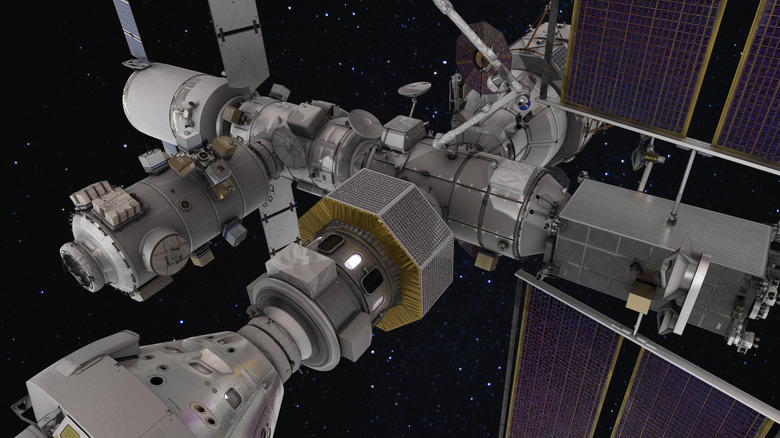
An entirely new kind of space outpost is taking shape beyond Earth's orbit. Gateway is designed to be a lunar space station, which means it will orbit the moon and support humanity's return to Earth's only natural satellite. Gateway is part of NASA's Artemis mission program, but it isn't a standalone project. Just like the ISS, Gateway is planned as a multinational collaboration. Partners from Europe, Canada, Japan, and the United Arab Emirates will work alongside the United States to build the lunar station.
The plan is to position Gateway in a near-rectilinear halo orbit (basically, a big ellipse), which will offer stable access to both the lunar surface and space. But Gateway will be much smaller than the ISS with only two key elements. The habitat and the logistics outpost module will provide living and work space for astronauts, while the power and propulsion element will hold the station in its lunar orbit. These two pieces will be launched together with the SpaceX Falcon Heavy rocket, no later than late 2027. Additional modules are planned to be added over time.
Once operational, Gateway will serve as the central hub for lunar exploration, enabling science, communication, and logistics for missions on the moon's surface. It will also act as a stepping-stone project for future human journeys to Mars, making it a gateway not just to the moon, but to the entire solar system.