

Nvidia Will Soon Be Competing With Elon Musk's Tesla - Here's Why
Nvidia CEO Jensen Huang announced that the company is accelerating the development of software and technology for self-driving cars with the Alpamayo AI models. The announcement was made at CES 2026 in Las Vegas on January 5. CES is a convention centered on technology innovation, and this announcement from Nvidia shakes up the AI-vehicle game and comes as a surprise, since the company is known for producing computer hardware and chips.
This Nvidia announcement puts it in competition with Elon Musk's Tesla, an established automaker that prioritizes modern technology and seeks continual innovation. Tesla's electric vehicles use proprietary software for full self-driving capabilities. The company has recently launched an autonomous robotaxi service, which is already operating in Austin, Texas, while other U.S. cities are covered by robotaxi services from Waymo. With Nvidia offering its self-driving technology to multiple automakers, it could sail past Tesla in growth.
Nvidia is certainly having a good time. The boom in artificial intelligence has created a massive demand for Nvidia's computational products. However, given that Nvidia invests in AI startups, which then use that money to buy the company's products, this circular investment raises the question of what might happen when the AI bubble pops, which could include business economic collapse and layoffs. Nvidia's vehicles rely on AI for their autonomy, and while the technology is fascinating, safety remains a big issue for the future of its development.
The technology behind Nvidia's autonomous vehicles
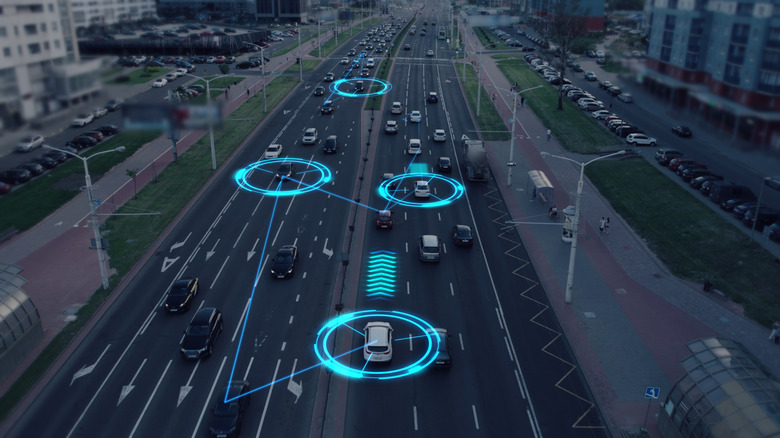
Nvidia is relying on AI innovation and expertise for the development and training of its autonomous vehicles. The models are trained on the NVIDIA DGX, a complex platform for AI development at scale. Nvidia relies on AI simulations to train its autonomous vehicles using real-world data. Nvidia believes its robust AI solution architecture, programs, and resources will enable faster autonomous vehicle development and deployment that could attract potential business partners. Nvidia's autonomous vehicle safety page claims engineers have collectively worked hours equivalent to 15,000 years developing this technology.
Nvidia's autonomous vehicle technology encompasses cars, trucks, and robotaxis, but it doesn't intend to stop there. It offers AI simulations, sensors, software, and mapping technology to automakers and other developers, as well. The company sees 2026 as the year its global DRIVE Hyperion ecosystem becomes an attractive option for businesses, and Nvidia positions itself as a key player in this arena.
Nvidia is increasingly viewed as a rival to Tesla in the self-driving space because it is supplying the AI infrastructure behind autonomous systems for multiple automakers, rather than Tesla's single, closed ecosystem. For example, its new robotaxi alliance involving Lucid, Nuro, and Uber could have more self-driving cars across the U.S. than Tesla's Austin-only rollout. By focusing on advanced AI chips and software that help tackle the challenges self-driving vehicles face, such as safety concerns, Nvidia is positioning itself as an industry-wide alternative to Tesla's self-driving approach.
Nvidia should worry about the safety of self-driving vehicles
As Nvidia is riding high on the growth it has reaped with the AI boom, taking advantage of its AI technology to accelerate autonomous vehicle development certainly makes its future seem exciting. It could position itself as a direct competitor to Tesla, depending on how things go. That is the problem, though, as fully self-driving vehicles have had a rocky road the past handful of years.
In late 2025, Waymo issued a self-driving vehicle recall after one of its vehicles illegally drove past a stopped school bus. The National Highway Traffic Safety Administration investigated Tesla's self-driving technology in late 2025 due to cars with this technology running red lights and violating other laws multiple times, occasionally resulting in car crashes. In 2023, one of Cruise's self-driving taxis hit a pedestrian and proceeded to drag her under the car as it continued to drive. According to data from Craft Law Firm, autonomous vehicle accidents have increased dramatically since 2021 as this technology becomes more prevalent on the roads.
As Nvidia looks to become a major player in this space, these incidents and statistics loom heavily over it. Though Nvidia emphasizes its focus on safety, all eyes will still be on the company's innovation as it looks to make its mark in autonomous AI vehicles.