

HDMI Has One Big Change Coming In 2026

CES 2026 wasn't marked only by cool humanoid robots, smart AR glasses, and AI companions. During the trade show, the HDMI Forum announced version 2.2 of the HDMI specification, which will launch later this semester. The announcement comes nine years after the HDMI Forum introduced version 2.1 of the HDMI spec.
While the current standard is now broadly available on smart TVs, computers, projectors, and other products, the organization behind the HDMI standard is now moving forward with a more up-to-date version. "The HDMI Forum's continuing mission is to develop specifications to meet the HDMI eco-system's growing demand for high-performance capabilities and features," said Chandlee Harrell, president of the HDMI Forum. "This new specification supports the fast-evolving landscape for amazing new technologies and products entering the markets now and in the future."
In general, the new specification offers improved resolution, higher refresh rate, and a lot more bandwidth. However, this new spec plans to go even further than just providing better picture quality, as it's aiming at augmented reality (AR), virtual reality (VR), and mixed reality (MR) applications. Here's everything you need to know about this big HDMI change coming in 2026.
The HDMI 2.2 standard focuses on the future
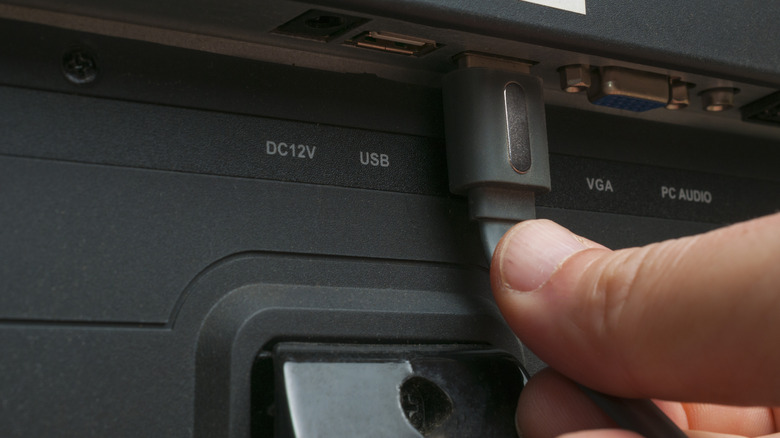
Even though the HDMI Forum is announcing the new standard with 96Gbps bandwidth — and next-gen HDMI Fixed Rate Link tech for improved audio and video in a wide range of applications — you shouldn't rush to purchase new equipment based on this standard. After all, these sorts of transitions happen slowly, and several device changes will be required to make the new technology worth it. Still, this is a clear sign that the industry is ready to move forward on more demanding image and audio transfer.
For comparison, HDMI 2.2 will support up to 10K resolution, with improved refresh rates for 8K at 240Hz, and even 4K at up to 480Hz. Bandwidth-wise, HDMI 2.1 offers 48Gbps, while the new standard will provide double the amount.
This new spec will offer great immersion for AR, VR, and MR devices, besides making gaming, watching content, and so on more reliable and smooth on all display formats. That said, the average consumer might have to wait a few years before getting full advantage of this technology, as it will likely be rolled out to high-priced enthusiast products first.