

Physicists Converted Lead Into Gold - Here's How
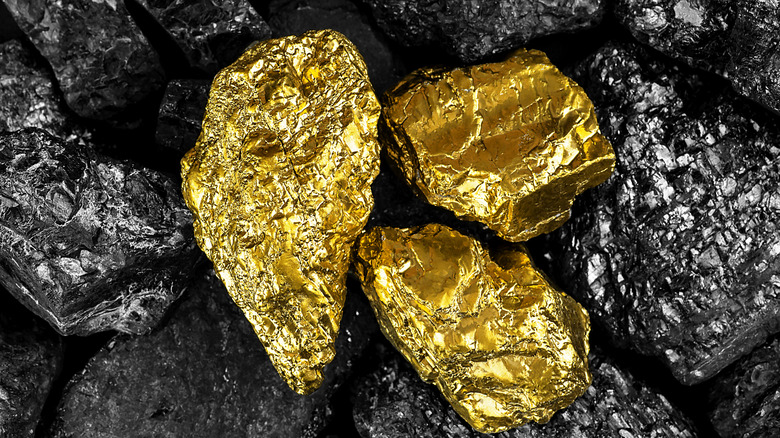
The science we know today is different from the alchemy that infatuated scholars in the past, but the underlying drive to learn more about the world remains the same. While today's scientists spend their lives researching new types of astronomical objects and how the universe began, alchemists from old yearned for much simpler goals, one of which was transmuting gold. The word "Chrysopoeia" refers to the artificial creation of gold, and despite even the most brilliant alchemists failing in their lifelong endeavors in achieving this, transmuting gold is surprisingly easy for scientists today, at least in theory. All you need is a particle accelerator, tons of energy, and a seemingly infinite amount of funds.
CERN has most of these, and so this unrequited desire of ancient alchemists was achieved by physicists at CERN's Large Hadron Collider conducting the ALICE experiment — meant to observe heavy-particle collisions to simulate conditions immediately following the Big Bang. This happened while shooting near-lightspeed particles of lead at one another, which produced a whopping 86 billion gold nuclei. An impressive number, but an amount that can't even be called negligible, as it totals up to only trillionths of a gram of gold.
It's also important to note that this gold cannot be used as normal. The amount is so minuscule that you can't observe it with any normal physical means, requiring the use of a zero-degree calorimeters that calculate the slightest change in neutrons and protons. The gold atoms produced were also so unstable that they existed no more than a microsecond before devolving into other particles to hitting apparatus, making this alchemical marvel no more than a nuisance for the physicists involved.
How this works
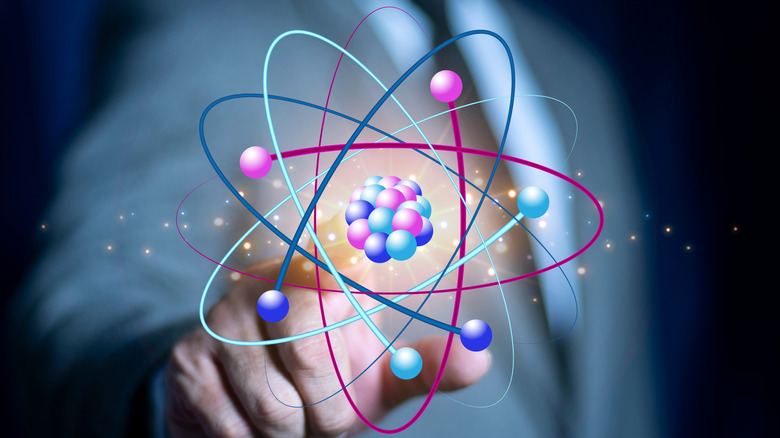
Lead differs from gold at the chemical level, making the two seem almost as different as physically possible. However, at the atomic level, the difference ends up being of just the number of protons inside their atoms' nuclei. Lead has a total of 82 protons compared to gold's 79. This means that if there was a way to somehow remove exactly three protons from the lead nucleus, you'd have a surefire way of producing gold. Unfortunately, we still can't accurately control the number of protons lost, but it is possible to brute force the removal of protons until a few instances result in three being removed, which is what happened with the physicists at CERN.
Removing protons still isn't easy, though, as lead has an incredibly strong electromagnetic force keeping its nucleus stable. In order to counteract this force, the physicists used the power of near collisions. When two particles pass each other near the speed of light, their individual electromagnetic fields affect one another for a moment. This field can strip the protons from a lead particle, turning it into either thallium, mercury, and yes, gold, depending on the number of protons removed.
As you might expect, this method still boils down to shooting particles at each other at high speeds and resorting to chance for gold to be produced. The immensely small amount produced paired with the high costs and low reliability of this means gold isn't becoming abundant just yet.
Times scientists have created gold in the past
CERN's ALICE physicists aren't the first ones to artificially produce gold. In fact, there's a Guinness World Record for most gold produced from lead (though it's outdated). The first instance of artificial gold being created was in 1941 by transmuting mercury with fast-traveling neutrons, but this gold was an unstable, highly-radioactive isotope.
The next properly documented instance occurred in 1980 by a team including Glenn T. Seaborg (whom the element seaborgium is named after) using bismuth isotopes. The scientists working on this said that it was possible to create gold from lead as well, but this wasn't done at the time due to how unstable the produced gold would be, meaning it would be a lot more complicated to separate and observe the produced gold from the lead. Similarly, in 2022, scientists at CERN produced an immensely small amount of gold nuclei — just 18 — from bombarding a uranium target.
Another group of CERN scientists, this time the Super Proton Synchrotron team, was the first to document transmuting lead into gold in 2002 and then again in 2004. They used the same process of near-miss collisions, albeit with less power. This was repeated later, this time with a much larger scale. Even if the amount produced more recently is too low to be worth much, it's still an immense improvement over past results. Unless China continues its stopped production of the world's largest particle accelerator, this will likely be the closest we get to producing gold for a while.