

4 Smart TV Settings That Can Fix Dark Scenes
Movies and TV series can have really dark scenes, as in there's barely any lighting. As a result, it can be challenging to see the setting, the characters, or even the details of what's going on. Some content might be shot with terrible lighting, which might be the actual reason your Smart TV can't display the scene properly. But other times, it has to do with your TV picture settings. You could be using settings that make your screen look dimmer, or modes that sharpen shadows. As such, you can turn off HDR and switch to Filmmaker mode to keep the pixels better illuminated during those crucial scenes.
Just keep in mind that even with all the software fixes, such as turning off auto-brightness settings, manually adjusting brightness, and changing the picture mode, you might still be dealing with a hardware issue rather than a software one. If you notice dark patches in specific spots on the screen, it is usually a sign that there's something physically wrong with your screen and that your TV might be on its last legs. But dumping money into a problem you aren't sure about is not great. That's why you should exhaust all your TV software settings before you call in a costly repair service.
Increase the brightness
Tuning the brightness might be an obvious solution, which is why it should always be one of the first things to try. Just remember that you might need to handle dynamic brightness settings beforehand, since they might override your manual settings. Your TV will have auto-brightness enabled if options like Ambient Light Sensor, Eco Sensor, or Auto Luminance Level are available on the TV. You can turn those off by going to the TV's general settings option and selecting Power and Energy Saving (or a similar mode depending on the brand). From there, you should find Brightness Optimization or Eco solution settings for the Ambient Light Sensor, Eco Sensor, or Auto Luminance Level options. If you spot Motion Lighting, ensure that is also off. Motion Lighting will automatically dim your TV during darker scenes.
On some TVs, you can control OLED TV brightness using the backlight and OLED light settings (it may be labeled as OLED Pixel Brightness). To adjust the OLED light settings, navigate to the TV settings, select Picture settings, then choose Brightness to get OLED Pixel Brightness. Use the slider to increase it to 100.
For other TVs, you can control the manual brightness. Some TVs will have the Picture/Display settings' brightness option tucked away under Advanced settings, Custom, or Expert settings. Use the slider to adjust the brightness and move it toward the right.
Turn off HDR
Your screen might appear darker because it isn't displaying HDR content correctly. When you turn on HDR on your smart TV, you enable a wider color palette and higher nits to your display, but it can also make darker parts appear darker and lighter parts appear whiter. It's supposed to make the picture appear more realistic and vivid, since you are no longer necessarily restricted to just 8-bit color with lower nits; HDR can utilize 10-bit or more (HDR10) and show content at higher peak brightness. If you find the color appears washed out or too dim for your liking, consider turning off HDR to restore standard color mapping.
To address the HDR problem, you need to fiddle with your Picture settings. On your TV, open Settings, select Picture or Display settings, then go to Advanced or Expert settings (the exact option depends on the brand), and look for HDR Mode, HDR+ Mode, HDR Tone Mapping, or HDR Effect; set it to off.
Change the picture mode
A quick fix to illuminating darkened content is changing the picture mode. For example, if your TV supports Filmmaker, Cinema, or Vivid, try switching to one of them to see if that helps with the problem. You can change the mode by going directly into the Picture or Display settings when you're on your Smart TV.
If you find that using these modes doesn't help or makes the picture look more washed out or too bright, consider creating a custom display mode. When you change the picture mode, look for a custom option inside the Picture or Display settings. From there, you can usually change the brightness, color, contrast, and sharpness. Sometimes, these settings can also be changed in Movie/Cinema and Filmmaker modes, and it might be easier for you to manually adjust a preset than a custom one.
However, if you do choose to make a custom picture mode, don't tweak too many options at once. You'll also want to be safe with your changes. For example, it's better to stick to warm color temperature options to keep colors more accurate. You will also want to stick to low sharpness settings. Even if your TV includes extra options to enhance your picture quality, sometimes it is a good idea to avoid enhancements that might add artificial filters to correct the picture — add-ons like noise reduction, dynamic contrast, don't always help and could end up interfering with the intended image.
Adjust your TV's gamma
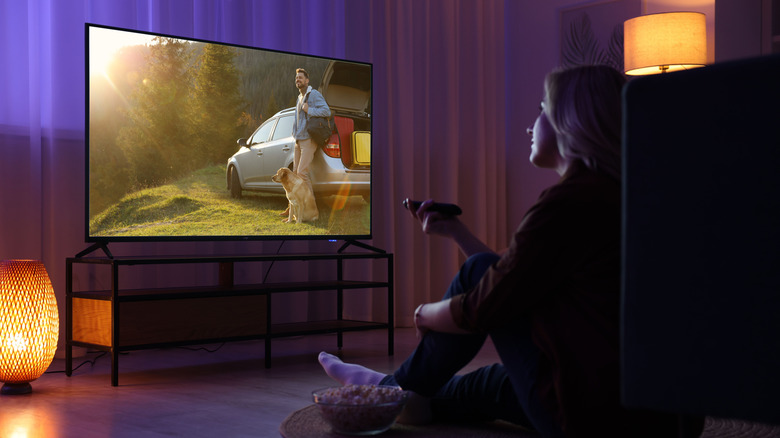
Gamma controls display brightness transitions. It enables smooth black transitions into white by adjusting a display's mid-tones. Gamma is also considered a correction factor for light when converting an image's signal to RGB data based on the gamma value. This factor fixes how humans perceive light without changing the absolute white and dark levels. For HDR content, gamma gets replaced by the Electro-Optical Transfer Function to determine the real-world brightness level.
If you can adjust the gamma on your TV, you should consider doing so. Lower gamma settings help reduce glare in bright rooms, while higher gamma settings help produce deeper blacks in darker rooms. If you find the scenes look too saturated and dark, try adjusting the gamma by 0.2 or 0.3; set it to a slightly lower value than the standard (2.2 or 2.4). Be careful not to lower the gamma value too much, or the colors may appear washed out. To change gamma on your smart TV, go to Settings > Picture or Display settings > Expert settings (it might be labeled as Advanced settings) > Gamma. From there, select another gamma value or use the slider.