

This Sci-Fi US Navy Destroyer Is $8 Billion Of Military Tech Floating At Sea
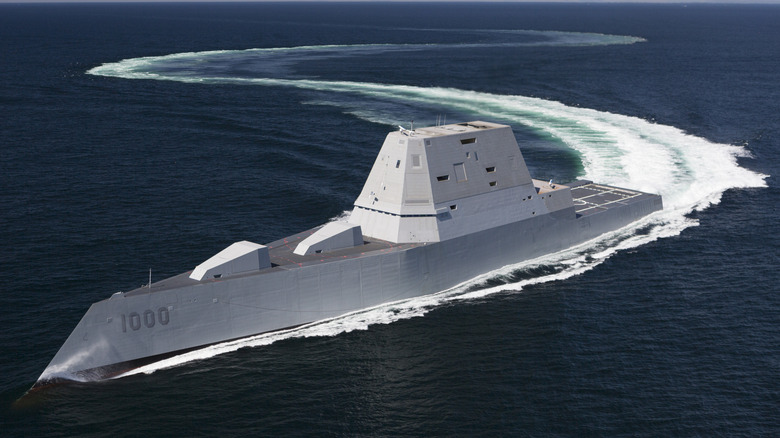
When the U.S. Navy commissioned its Zumwalt-class destroyer (DDG-1000) in 2016, it hailed the warship as the most advanced surface combatant in the world. Equipped with a state-of-the-art stealth design, revolutionary electric propulsion and integrated power mechanisms, and twin Advanced Gun Systems, the 16,000-ton Zumwalt was touted as being larger, more advanced, and more difficult to detect than any destroyer the world had ever seen.
However, several shortcomings, including runaway costs and underwhelming performance, caused the Navy to reduce order numbers from the proposed 32 to three, raising doubts in the Navy's ability to deliver advanced warships. Ultimately, the Zumwalt suffered from two major problems. The first was its incredible cost, as the $8 billion per-ship price tag made it impractical for largescale manufacturing and deployment. Second, its advanced designs were poorly suited for the Navy's intended usage as a land support ship, where stealth features are less important. As such, U.S. leadership determined the Zumwalt was an expensive square peg for the Navy's shore-support round hole, rendering it a floating money pit without a definitive mission.
This disconnect prompted the U.S. Navy to begin the arduous task of updating its most expensive destroyer, replacing the 155mm guns with hypersonic missiles. The first ship of its kind to sport an intercontinental missile system, the Zumwalt is one of a host of global destroyers adding high-tech weapons systems to address a changing threat landscape. The update recasts the Zumwalt as part of the U.S.'s long range strike operations, an increasingly important strategic priority, perhaps best exemplified by the nuclear missile test in November 2025. Having completed a round of post-modernization sea trials in January 2026, this sci-fi stealth ship may finally be ready to take its place at the head of U.S. Naval strategy.
America's most advanced destroyer
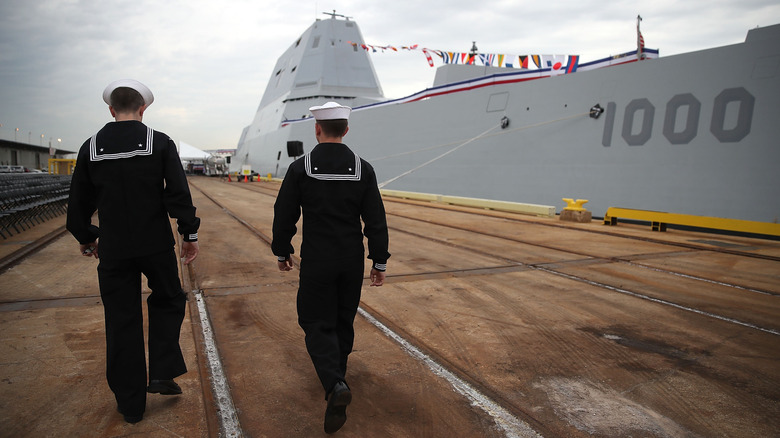
When the DDG-1000 was commissioned, it was lauded for its novel stealth designs. Despite constituting an approximate 40% jump in size from its Arleigh Burke-class predecessor, the 610-foot Zumwalt's radar cross section matches that of a 50-foot fishing vessel. Employing many of the same stealth design principles of fighter jets, the Zumwalt eschewed typical design structures, instead using an angular, wave-piercing tumblehome hull and a deckhouse constructed of electromagnetic wave-absorbing composite materials to lower the ship's radar footprint.
Add acoustics that more closely resemble a submarine, and the Zumwalt is roughly 50 times more clandestine than the Arleigh Burke destroyers. Another major development was the Zumwalt's electric propulsion system. Powered by a revolutionary integrated power network, it's capable of generating 78 megawatts, nearly as much as a nuclear aircraft carrier.
The massive size allows the Zumwalt to host a diverse array of aircraft, including Joint Strike Fighters, drones, and MV-22 Osprey, initially seen as a boon for its position alongside amphibious and littoral combat ships. To support these near-shore operations, the ship was equipped with two 155mm Advanced Gun Systems (AGS). With a range of 62 nautical miles, the Navy intended the AGS' Long-Range Land Attack Projectiles to fill the Naval Surface Fire Support void left by the 1992 retirement of the Iowa-class battleship.
Doom, gloom, and hope
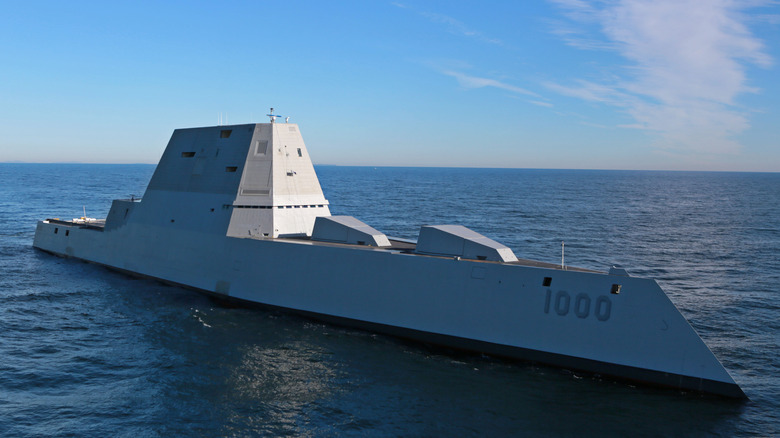
Unfortunately, the technological advancements of the Navy's sci-fi stealth ship came at a price. Over its 11-year development, costs skyrocketed to$23 billion. To put such astronomical numbers in perspective, the US Navy's new nuclear supercarrier, the Gerald R. Ford-class, costs $13 billion. Ammunition alone proved a financial disaster for the Zumwalt, as each round cost over $800,000, forcing a purchase cut from 20,000 to 2,400 units.
Further complicating things, the Zumwalt's expensive stealth advancements were ill-suited for the Navy's planned near-shore use, where crowded waterways and clear sightlines nullify much of its anti-radar capability. Between rising costs and competing design priorities, Naval planners largely viewed the Zumwalt-class destroyers as an expensive ship without a mission. Since canceling its ammunition order, however, the Navy has begun to reorient the Zumwalt away from close shore combat and towards clandestine operations and long range missile strikes.
This repurposing began in August 2023, when the DDG-1000 underwent a 3-year modernization effort. Part of which involved replacing the Advanced Gun Systems with a state-of-the-art Conventional Prompt Strike (CPS) weapons system that carries Common Hypersonic Glide Bodies capable of worldwide range at speeds up to Mach 5. Through these efforts, the Navy hopes that the CPS system will shift the Zumwalt-class destroyer into a key cog of its global force-projection efforts, particularly in the Pacific theatre.