

Blue Origin Is Coming For SpaceX With Over 5,000 Satellites Launching Sooner Than You'd Think
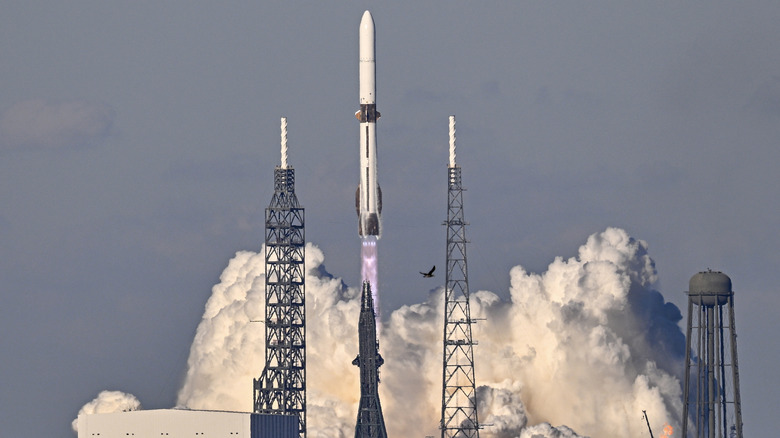
Blue Origin, the Space exploration company owned by Amazon titan Jeff Bezos,announced its latest plans to launch its new satellite communications network. Dubbed TeraWave, the constellation of 5,408 low and medium Earth orbit satellites will reportedly offer an internet network superior to its competitors, namely Elon Musk's SpaceX, delivering speeds as high as 6 terabits per second and enabling Blue Origin's global customers to process larger datasets.
Scheduled to begin deployment at the end of 2027, the constellation's lofty goals will heavily depend on the continued development of its New Glenn rocket. Completing its second mission in November 2025, when it sent two NASA Escape and Plasma Acceleration and Dynamics Explorers (EscaPADE) spacecraft towards Mars, Blue Origin is the second company in history to launch and land a reusable orbital rocket booster. This milestone was a key accomplishment for orchestrating the scale of launches needed for the company's TeraWave satellite constellation.
The January 21, 2026, announcement is a major step for the Bezos-owned company, which is caught in a budding space race that has seen billionaires, nation states, and startups speeding to populate the next frontier with infrastructure projects ranging from lunar nuclear reactors to solar-powered orbital AI data centers. Bezos is heavily invested in this race, touting Blue Origin as his "most important work" in an op-ed with Fast Company, reportedly investing at least $10 billion in the company since 2000. In addition to Blue Origin, the billionaire is involved in Amazon's satellite division Leo, formerly Project Kuiper, which looks to rapidly scale its own constellation of 180 internet-providing satellites to roughly 3,200. Despite these grandiose plans, however, the collective achievements of Bezos' space efforts pale in comparison to those of its chief rival, SpaceX, prompting a key question: Can TeraWave close the gap?
TeraWave at a glance
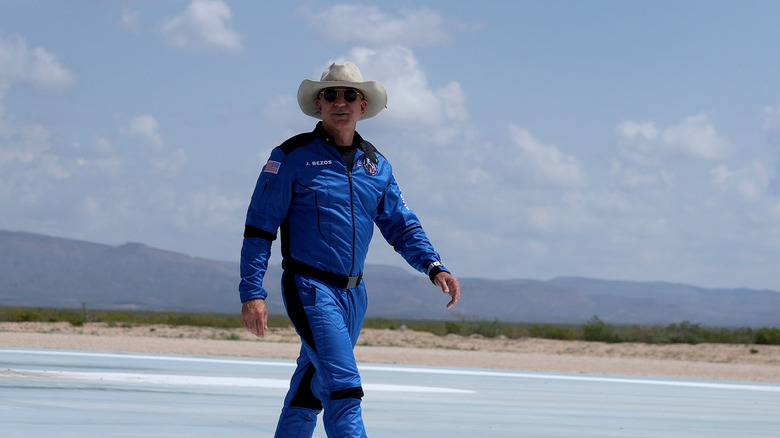
According to Blue Origin, TeraWave will deploy a "multi-orbit design" using both medium Earth orbit (MEO) and low Earth orbit (LEO) satellites to deliver high-speed connections "in remote, rural, and suburban areas where diverse fiber paths are costly, technically infeasible, or slow to deploy." It will do so through two types of connectivity, launching 5,280 LEO satellites capable of speeds up to 144 gbps and 128 MEO satellites that deliver 6 tbps through optical lasers that beam data to users. While TeraWave satellites will begin deployment in the last quarter of 2027, a timeline for its completion has not been announced at time of writing.
To put TeraWave into perspective, Starlink's optical laser system currently reaches 200 gbps and only shares data between constellation satellites. Musk proclaimed on X that SpaceX's "space to ground laser links will exceed" Blue Origin's 6 tbps speeds. However, SpaceX has yet to outline when it will reach such metrics. Starlink's website lists its next generation of satellites, slated to launch later this year, as providing "over a terabit per second of downlink capacity" and "over 200 gbps of uplink capacity."
While TeraWave's metrics are impressive, 6 terabytes is overkill for personal consumption. As such, Blue Origin's constellation will reportedly market itself to a more select userbase than SpaceX's 6 million customers, aiming for approximately 100,000 enterprise, government, and data center clients. Meanwhile, Amazon's Leo project, which began deploying its constellation last year, will pursue a strategy more similar to Starlink, courting individual consumers as well as enterprise and governmental ones. Although there is some overlap, these divergent client strategies could reduce conflict between Bezos' space ventures. Critically, Amazon lacks its own launch capabilities, and relies on providers like SpaceX and Blue Origin to launch Leo's constellation, further differentiating Bezos' two projects.
An escalating space race
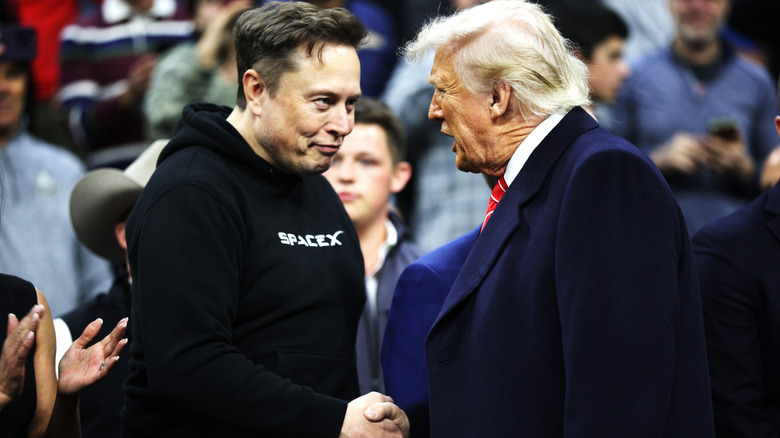
Thus far, Elon Musk has garnered a substantial lead over Jeff Bezos in the billionaire space race. With 10,000+ satellites, $8 billion of profit in 2025 (via Reuters), and over $24 billion in U.S. government funding over time, SpaceX is well ahead of its competitors. SpaceX achieved its first vertical landing of an orbital rocket in 2015, roughly a decade earlier than Blue Origin's New Glenn rocket and underscoring the differing development strategies of the two billionaires' space projects. Musk's move-fast-and-break-things mentality has led to both rapid development and fiery mishaps.
Whether TeraWave can turn this tide will somewhat depend on the respective growth of technological trends like large-scale data processing solutions for a growing AI sector. Both Bezos and Musk have touted low earth orbit as the next frontier for growing infrastructural and energy demands, including space-bound data centers, likely serviced by their respective internet services. This competition extends to NASA's lunar push, in which SpaceX's Starship and Blue Origin's Mark 2 are slated to service the Artemis program's third and fifth missions.
Of course, the two companies aren't alone at the forefront of the budding space race. New Zealand startup Rocket Lab, for instance, is also developing its own reusable rocket. China recently applied to the U.N.'s space spectrum regulator, the International Telecommunications Union, to field constellations totaling up to 200,000 satellites as several of the country's state-owned firms approach rocket reusability in pursuit of Beijing's orbital ambitions. Member states of the European Space Agency, meanwhile, have committed $5.1 billion to similar space transportation projects (via ESA). The EU is also seeking to establish its own communications constellation, dubbed IRIS, while German military leaders have floated plans to build its own sovereign constellation. Japan has also made notable progress towards pursuing reusable launch capabilities.