

NASA's EMIT Sensor Does A Lot More Than Just Map Minerals

When NASA installed a unique imaging sensor on the outside of the International Space Station, the original intent was to help map the composition of minerals on the Earth's surface. Far from the only useful equipment NASA currently has in orbit, the sensor (called EMIT) allows scientists to identify, track, and quantify various properties in the planet's dusty regions. The acronym stands for Earth Surface Mineral Dust Source Investigation, and the imaging spectrometer is engineered to measure light in both visible and infrared wavelengths. It can identify minerals and other particles based on how they reflect and absorb light back on the surface, and NASA has already used it to produce global maps of surface minerals hiding in desert regions. Notably, the EMIT team studied how 10 key minerals influence our climate by cooling or warming the atmosphere.
Because of how the technology works, NASA can do a whole lot more than review and map minerals. By honing in on unique spectra of light — the specific ranges of wavelengths — NASA used EMIT to identify a huge sewage spill exiting the Tijuana River into the Pacific Ocean. The sensor registered a dip in reflected light as it was unable to pass through the wastewater plume, essentially acting as a location marker. This highlights how EMIT may be able to help crews on Earth identify and track pollution and other parameters more effectively. The visual overview provided a better map of the spreading plume and can be used to locate accessible sampling sites for lab tests. The EMIT team also used it to detect plastic pollution, showing it has practical uses outside of its intended mission — maybe for some we don't even know about yet.
Why is EMIT's detection of plastic pollution important?
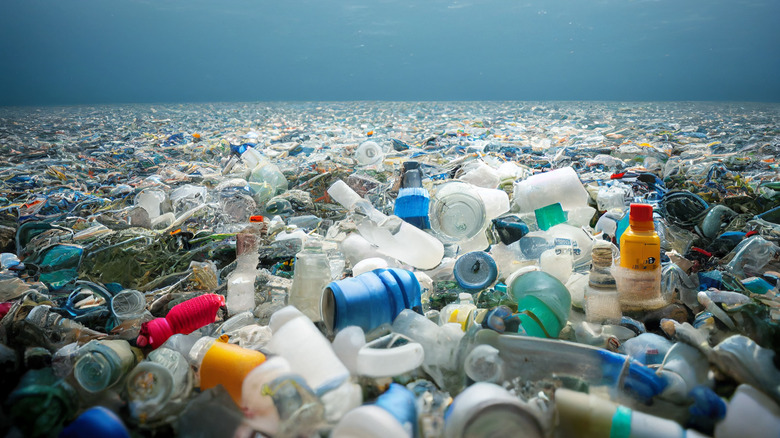
Like the wastewater plume, the important bit is not necessarily about the discovery of the plastic as much as it is about the implications of EMIT's capabilities. Before looking for specific items or materials, scientists need to know how they react to light so they can identify them with the spectrometer. Not everything reacts the same way, and, more importantly, seawater absorbs infrared light, so it can mask items in it or underneath the surface.
For the wastewater, the team honed in on a unique spectrum in the 620-nanometer range. But plastic waste, or waste in general, is composed of hundreds, potentially thousands, of different items, objects, and debris made of not just plastic but also metal, fabric, and other materials. As each type of debris has a unique marker, you can't merely focus on a single wavelength.
However, a NASA intern named Ashley Ohall compiled a library of nearly 25,000 molecular "fingerprints" that can be used to identify all manner of garbage, such as rope, tires, bubble wrap, bottle caps, and more. The hope is that Ohall's litter library gives scientists a reference point to better spot ocean debris and plastic pollution hanging out in and contaminating our planet's most valuable resource. Once located, the team can study how large waste deposits move with ocean currents and where they go — they can travel thousands of miles from their source. Moreover, if something like this can be achieved with EMIT, knowing about the wastewater plume and how it tracks methane and carbon dioxide leaks, the broader question is what else can it see that we have yet to discover? NASA should probably get something else like EMIT into space before it deorbits the ISS in 2030.