

This Was Stephen Hawking's Darkest Warning For Humanity
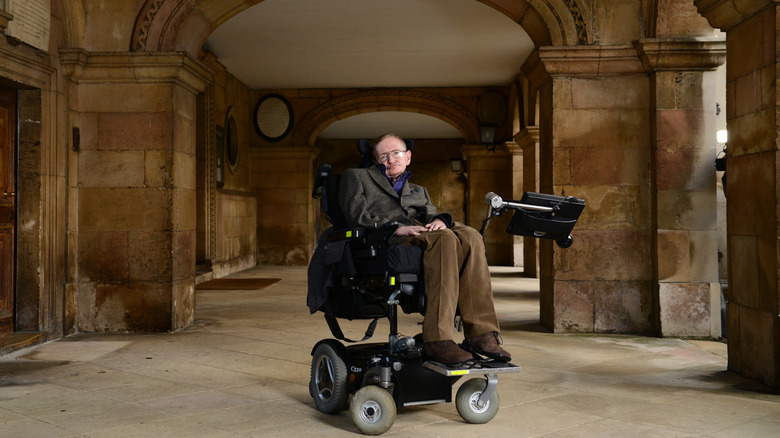
Lauded astrophysicist Stephen Hawking was outspoken about the existential threats facing humanity. Known for his work on the mysteries of general relatively and black holes, Hawking used his platform as the world's most famous scientist to deliver several harsh warnings regarding man's uncertain future, ranging from global warming to devastating nuclear disasters. Many of these pitfalls derived from the unabating press of technological advancement, and Hawking warned listeners about the dangers of AI's march towards singularity.
Hawking's most dire warning came during a 2016 speech at Oxford University, in which he claimed, "Although the chance of a disaster to planet Earth in a given year may be quite low, it adds up over time, and becomes a near certainty in the next 1,000 or 10,000 years" (via The Christian Science Monitor). The proximity of this prediction, abstract in comparison to our own lives but firmly within the scope of human history, is daunting. Hawking, for his part, coupled the prediction with a potential saving grace, postulating that, "By that time we should have spread out into space, and to other stars, so a disaster on Earth would not mean the end of the human race."
In many ways, the doomsday prediction, and the solution paired with it, are indicative of the somewhat perverse rhetoric powering much of the current space race. Billionaires like Elon Musk and Jeff Bezos have parroted similar sentiments, both in the certainty of Earth's demise and the interplanetary travel as the necessary prescription. Of course, such predictions take the inevitability of said disasters for granted, potentially pushing potential world-saving solutions to the side in favor of an all-but-inevitable contingency plan. As such, it may prove that man's search for a technological solution spells the end before it has finished writing its next chapter. So, is Hawking right?
The doomsday clock is ticking
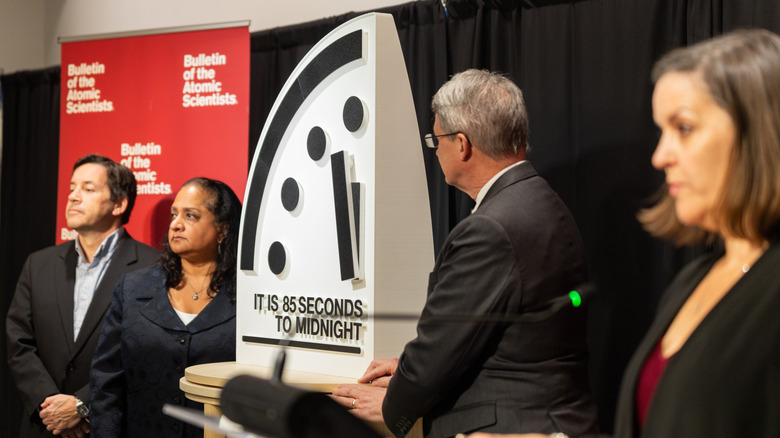
Unfortunately, the scientist's proclamation might have actually been too farsighted. In January 2026, the Bulletin of the Atomic Scientists' Doomsday Clock, a tool started by Albert Einstein, J. Robert Oppenheimer, and other nuclear scientists to convey man's proximity to self-wrought annihilation, or "midnight," released its most dire proclamation in its 79-year history when its Science and Security Board set the clock to "85 seconds to midnight." By comparison, the Bulletin's most optimistic prediction followed the USSR and U.S.'s 1991 START anti-proliferation treaty, pushing the clock's hands back to 17 minutes.
During his lifetime, Stephen Hawking was vocal about many of the concerns that promoted The Bulletin's 2026 pronouncement. Climate disaster, for example, was considered an existential threat by the scientist, who said in a 2016 interview with BBC that climate change was approaching a "tipping point" which "could push the Earth over the brink" of collapse (via BBC). Currently, climate scientists have pinpointed a rise in global temperatures of 1.5 degrees Celsius above pre-industrial levels as this ill-fated, no-way-back barometer. According the EU's Copernicus Climate Change Service, temperatures had risen by 1.41 degrees Celsius in December 2025, and are set to break the 1.5 mark in March 2029.
Of course, a major driver of the world's environmental crisis is the unrestrained rise of resource-needy artificial intelligence programs. Hawking, however, forewarned a different AI-induced threat, fearing singularity, or when AI would advance beyond human control. The Bulletin, for its part, adds AI-enabled warfare, particularly biological weapons, as a potential threat. Along the same lines, both have warned against the dangers of nuclear proliferation. In 2017, for instance, Hawking argued in an interview with The Times that humanity needed to quell the "inherited instinct" of aggression before it could "destroy us all by nuclear or biological war."
Is space the solution?
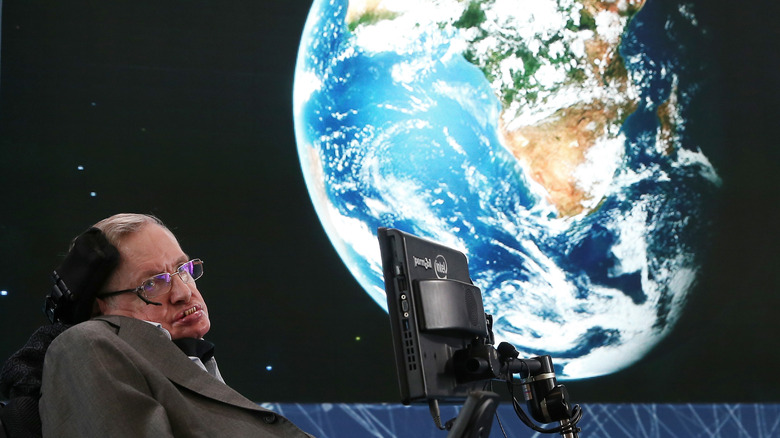
Central to both doomsday proclamations are complex economic, environmental, and security challenges that require international cooperation to address them. Unfortunately, The Bulletin's 2026 report is pessimistic about this possibility, stating that mounting nationalism, waning international cooperation, and a growing "winner-takes-all great power competition" have elevated the "risks of nuclear war, climate change, the misuse of biotechnology, the potential threat of artificial intelligence, and other apocalyptic dangers."
Nowhere is this more obvious than in Hawking's proscribed apocalypse-solution, space. As the NASA plans to deorbit the International Space Station, Washington, Beijing, Moscow, and the world's largest corporations are escalating their race to capture space-bound resources. For example, lunar infrastructure, ranging from nuclear powerplants to research hubs and mining facilities, has garnered widespread attention. Global space programs are also looking to populate Earth's orbit with satellite constellations, data centers, and missile networks. Many of these projects, like the Trump administration's Golden Dome, have exacerbated mounting proliferation concerns as the world's major nuclear treaties near their expiration. Then there's AI; America is making plans to respond to China pulling ahead in the AI race, leading to a mass consolidation of financial, environmental, and technological resources that is more likely to exacerbate these issues than solve them.
As the world actualizes many of Hawking's concerns, attention needs to move towards addressing these issues directly. While daunting, climate change and nuclear proliferation are solvable conundrums with actionable solutions more readily attainable and equitable than mass space colonization. Furthermore, it's no guarantee that relocating space will address the underlying threats prompting mass migration in the first place. All told, fending off Hawking's predictions will require the immediate adoption of extensive, cooperative solutions currently lacking on the international stage. Hawking, for his part, was ultimately optimistic, telling The Times, "I think the human race will rise to meet these challenges." Let's hope he is right.