

3 Nobel Prize Winners Invented A New Material That Could Change Everything
When you hear the term "invent," your mind probably jumps to a new device or an upgrade to an existing one — kind of like the stuff you see at the Consumer Electronics Show. However, every now and then someone invents a new and somewhat novel material that will be used in future devices. Or perhaps we should say three people? Enter the metal–organic framework (MOF).
In 1989, Richard Robson invented the first MOF material, and this work was later refined by Susumu Kitagawa and Omar Yaghi. MOFs, as outlined in the January 2012 edition of Chemical Reviews, are ultra-porous crystalline materials. Up to 90% of a sample of an MOF is "free volume," or the amount of material that doesn't contain any molecules of said material. To put that in perspective, one gram of an MOF has the equivalent surface area of a football field.
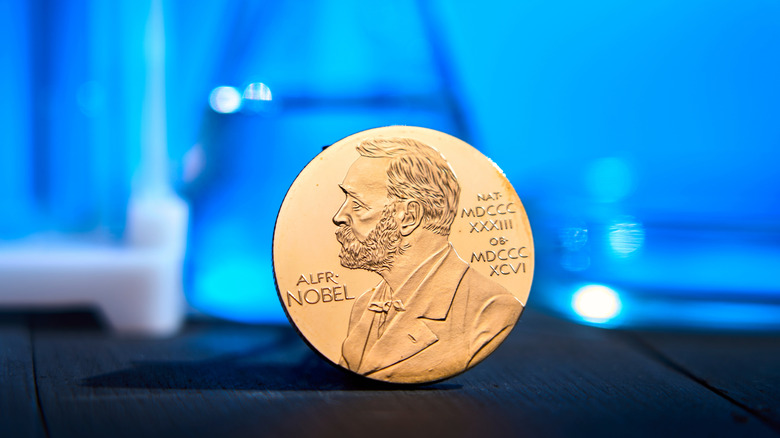
While the material was invented several decades ago, the Royal Swedish Academy of Sciences (which awards Nobel Prizes for chemistry) only recently decided that the creation of MOFs was worthy of a prize. On October 8, 2025, the Nobel Foundation announced it would award Kitagawa, Robinson, and Yaghi the Nobel Prize in Chemistry "for the development of metal-organic frameworks."
Why MOFs are worthy of a Nobel Prize

Anyone who knows anything about the Nobel Foundation knows that it doesn't hand out Nobel Prizes like they're t-shirts at a sports game. Recipients need to do something groundbreaking to earn a Nobel Prize, which is the only way to describe MOFs. According Mircea Dincӑ, a Professor of Chemistry at Princeton University, the ability to create bonds that can support a material with so much empty space is a feat worthy of praise in and of itself. However, that isn't the only reason Kitagawa, Robson, and Yaghi received a Nobel Prize.
An MOF's main selling point is its sheer customizability and the potential applications it encourages. The publication in Chemical Reviews states the material can yank carbon dioxide out of coal-fired power plant emissions, which could help make the energy source cleaner – not even nuclear power is 100% clean when you take into account the fissionable material waste. However, that is only one use. The Royal Swedish Academy of Sciences claims that chemists can alter an MOF's composite makeup to draw water out of the air, encourage specific chemical reactions, and store potentially dangerous gases. According to Dincӑ, the metal and organic components that make up MOFs have "millions of possible combinations," which can have results that are impossible in other mediums. In fact, Dincӑ's own lab pioneered an MOF that can conduct electricity, and normally electrical currents abhor empty space.
Multiple scientists have been working on MOFs to make them out of an ever-expanding list of metals, many of which produce new uses for the spongy material. And if an AI can produce a nanolattice that's stronger than steel but lighter than foam, imagine what it can do for the field of MOF development.