

5 Laptops More Powerful Than The 2026 MacBook Pro

It's no secret that Apple has set the standard for efficiency, battery life, and thermal management in a compact form factor with the MacBook Pro M5. While the latest M5 base chip has the same 10 core and thread count as the base M4, Apple has boosted the memory bandwidth to 153 GB/s from M4's 120 GB/s. This 30% boost results in consistent and predictable results for many macOS-optimized workflows.
But overall power doesn't come down to a single component, and with Windows holding a 32.52% market share between January 2025 and January 2026, many will find better performance and the applications they need outside of the Apple ecosystem, especially considering the MacBook Pro M5 has a design flaw.
With rising component costs, users are also looking down the road at the right to repair. Serviceability on a MacBook Pro 14 M5, for example, only allows users to replace the battery, which is terrible for maintenance down the line on a big investment. Meanwhile, Windows laptop equivalents sporting discrete GPUs, desktop-class CPUs, and replaceable RAM are more accessible than Apple's. In this context, it doesn't matter how powerful something is if it can't be fixed.
ThinkPad P16 Gen 2: For Engineering, 3D design, and massive projects
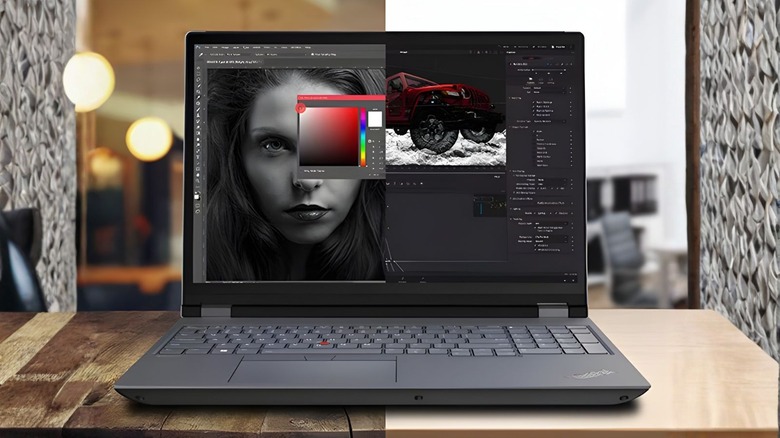
Lenovo's ThinkPad P116 Gen 2 is a laptop users can depend on like a desktop, and it makes ground meat of CAD work, 3D modeling, simulation, and anything else that chews CPU cores, GPU cores, and RAM. Lenovo's own specs state support for up to an NVIDIA RTX 5000 Ada generation laptop GPU and up to a ridiculous 192 GB of DDR5 non-ECC memory or 128 GB of ECC memory.
Its headroom matters when it comes to managing big assemblies, huge scenes, and large datasets, making sure there's enough memory to process without slowing projects down. The NVIDIA RTX 5000 Ada option is a different class of graphics than what Apple offers in its MacBook Pro. This special "Ray Tracing Texel Extreme", or RTX, GPU has 16 GB of GDDR6 ECC VRAM, which, in English, translates to more room for complex 3D assets and more stability for professional workloads, more so for programs that are tuned for Nvidia's ecosystem.
The M5 MacBook Pro can be great for creative work, but for workflows that need workstation graphics or big projects, the ThinkPad P16 Gen 2 is just built differently, prioritizing heavy lifting and specialty specs over aesthetics and efficiency, starting with a $4,449 price point that reflects just that.
Legion 9i Gen 10: High-end gaming and real-time 3D work
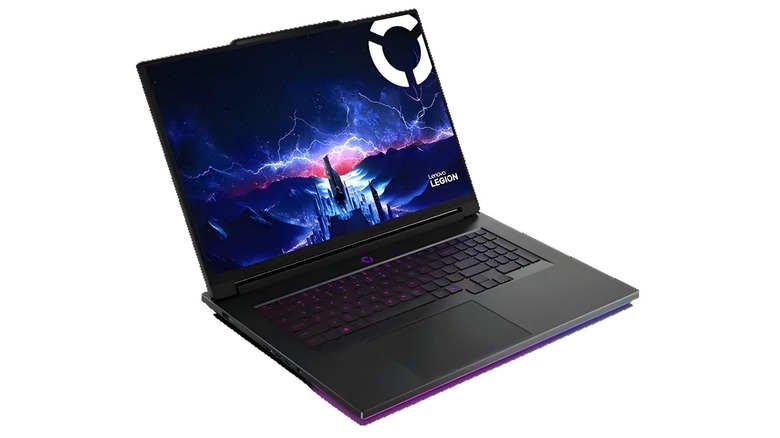
The Legion 9i Gen 10 by Lenovo packs a punch for anyone looking for desktop-level gaming and real-time 3D performance in a form factor that can move between rooms, studios, or events. Lenovo has put an 18-inch 4K display with a 240 Hz refresh rate in it with an integrated "naked eye" 3D screen on certain configurations. It's a switchable 2D/3D display that uses eye tracking and a lenticular lens for glasses-free 3D.
Epic gaming aside, it beats the M5 MacBook Pro practically by running GPU-heavy applications and tasks like effects, 3D work, and AI features, with a dedicated discrete Nvidia RTX 5080 graphics card. That means higher frame rates and resolution in demanding games, faster previews in game engines, and better performance in 3D-heavy 3D applications.
However, it does fall short of the MacBook Pro in terms of battery life and portability, but if someone is sinking $4,829.99 or more on this beast, it isn't for integrated graphics and efficient power management. If the workload is graphics-heavy, this is the caliber of laptop that professionals and gamers are looking for.
Asus ProArt P16: For GPU-based video and creative apps
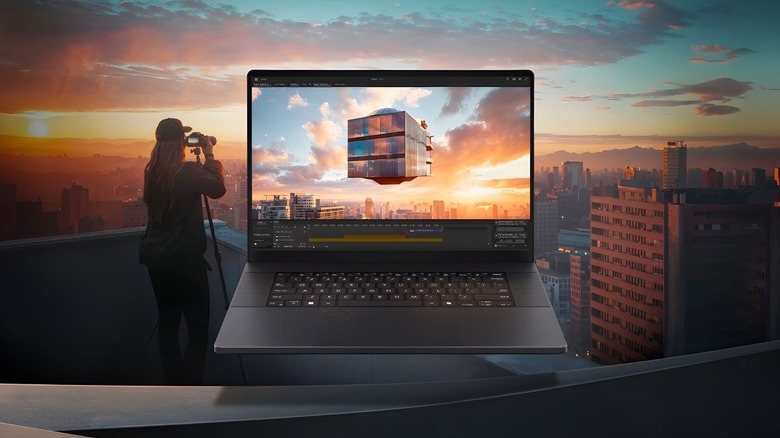
For users looking for a Windows-powered laptop that has a dedicated GPU for running creative tools faster than the onboard graphics of a MacBook, there's the Asus ProArt P16. Starting at $2,999.99 with an AMD Ryzen AI 9 HX 370 CPU and NVIDIA's GeForce RTX 5070 GPU, it also has its dedicated AI processing chip (known as a Neural Processing Unit) in the AMD XDNA NPU that can process 50 TOPS. This stands for "Trillion Operations Per Second", which, in this case, would be 50 trillion operations per second.
The base model features a 16:10 60 Hz 16-inch 4K OLED touchscreen, but the $4,499.99 model bumps the refresh rate up to 120 Hz and gets you an RTX 5090 GPU, which frankly isn't needed for much outside of gaming. Creative apps, such as video and photo editing suites, run better with a dedicated graphics card, specifically for 3D work, special effects, and general AI features.
The discrete laptop GPU in the Asus ProArt P16 is the difference between a laptop that simply runs fine and one that is fast and stays fast under intense creative workloads. The MacBook Pro M5 is great in Mac-Optimized workflows, including multiple layers, effects, color work, and exports, but having an RTX 5070 GPU on a larger 16-inch OLED screen is no competition for most.
Razer Blade 14: Clean design and big specs
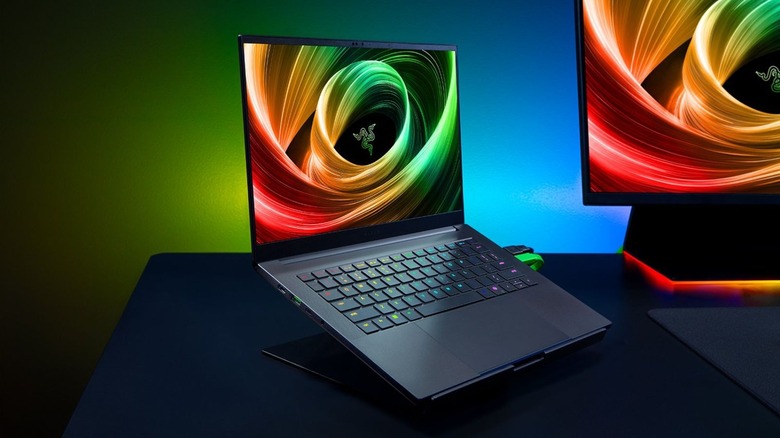
The Razer Blade 14 is the cleanest example of a Windows laptop that's more powerful than a MacBook M5, specifically in graphical performance. For $2,699.99, users get an Nvidia RTX 5070 8 GB along with 32 GB of DDR5 RAM, backed up by AMD's Ryzen AI 9 365 CPU and a stunning 14-inch 3K 120 Hz OLED display. An extra $800 can be saved by going for the less powerful RTX 5060 8 GB GPU and downgrading to 16 GB of DDR5 RAM instead.
This is first and foremost a gaming laptop and is marketed as such, which instantly beats the MacBook Pro M5 on sheer compatibility with games. The Razer Blade 14 is also a creative workflow beast by taking advantage of NVIDIA's CUDA and Tensor cores to streamline 3D rendering, video rendering, post-processing, and general image work.
The M5 MacBook Pro is a beast, as well, with arguably one of the best SoC (System on a Chip) setups on the market, but it leaves little room for more horsepower for these kinds of workflows where dedicated VRAM and GPUs are a must. For a 14-inch laptop that's also a graphical powerhouse while going head-to-head with Apple's slimline style, this is the laptop every day of the week.
ASUS ROG Strix SCAR 16: In a league of its own
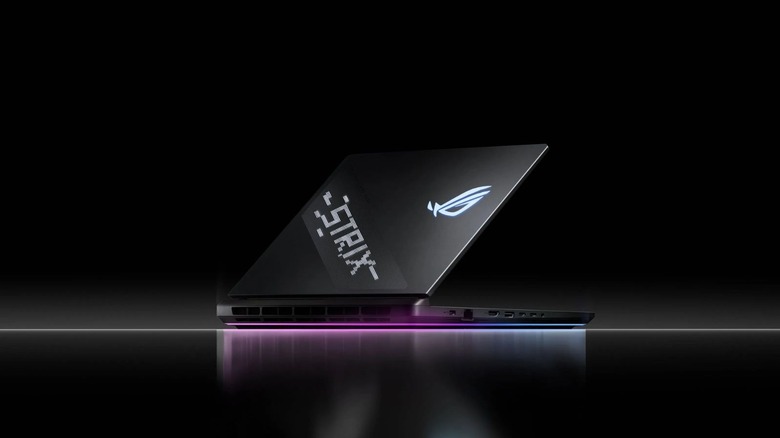
The ASUS ROG Strix SCAR 16 is the MacBook M5 alternative that is quite literally the best in every use case. Yes, it's more expensive at $3,299.99, but that gets users an Intel Core Ultra 9 275HX CPU, an NVIDIA RTX 5080 (Boosted) sporting 16 GB of GDDR7 VRAM, 16 GB DDR5 RAM, and a 16-inch 3 ms response time 2.5K (2560 x 1600) 16:10 anti-glare display. That's a lot packed into a sleek-looking laptop with RGB lighting built in. For those who want to push their dedicated GPU to the limit, there's also a boosted RTX 5090 upgrade with a massive 24 GB of GDDR7 VRAM for $4,499.99.
Both of these GPUs have a power draw of 175W, which is the exact opposite of Apple's efficient and compact one-fan solution to the MacBook Pro M5. Some will see the SCAR 16 as overkill and completely unnecessary, which is true when considering everyday tasks, light video, and photo editing. But for high-refresh rate gaming that's packed with vast 3D scenes with ray-tracing sprinkled on top, it's a playground.
The same goes for anyone who doesn't want their workload bottlenecked by an integrated graphics card or SoC like Apple's M5 chip. These laptops will handle anything from video rendering to complex problem solving with ample GDDR7 in the dedicated GPU, a top-tier CPU, and a dedicated NPU with highs of 13 TOPS.