

Airplanes Still Use Floppy Disks For Their Software - Here's Why

The floppy disk: An archaic software storage medium that you might associate with playing "Oregon Trail" in the 80s, doing schoolwork in a 90s computer lab, and, as it turns out, even some of today's most prominent airplanes. The iconic Boeing 747, still takes to the skies as America's "Doomsday" plane, and for commercial flights in Germany, China, and Russia with software loaded by floppy disks. The 747 also saw continued commercial use in the United States until Delta Airlines finally retired the craft in 2017.
Floppy disks stand as a solution that simply works. Until very recently, wireless data loading was impractical due to the likelihood of failure and the possibility of packet loss during transmission. It used to be that the slightest interference could cause catastrophic problems if planes relied on wireless communication, including something as innocuous as a passenger choosing not to use a phone's airplane mode. However, modern advancements in airborne data-loading systems are rendering floppy disks and other physical data loaders increasingly obsolete.
The Federal Aviation Administration (FAA) explains that it can be cost prohibitive to retrofit older models with modern solutions when the floppy remains a reliable medium that excels at limiting exposure to outside security risks. In an official Advisory Circular document published by the FAA, further evidence is provided explaining why U.S. aircraft used floppy disks for so long. The FAA follows a strict "Legacy System Software Process Flow Chart." Part of this process entails conducting an exhaustive "software change impact analysis" if modifications are required.
Will airplanes ever stop using floppy disks?
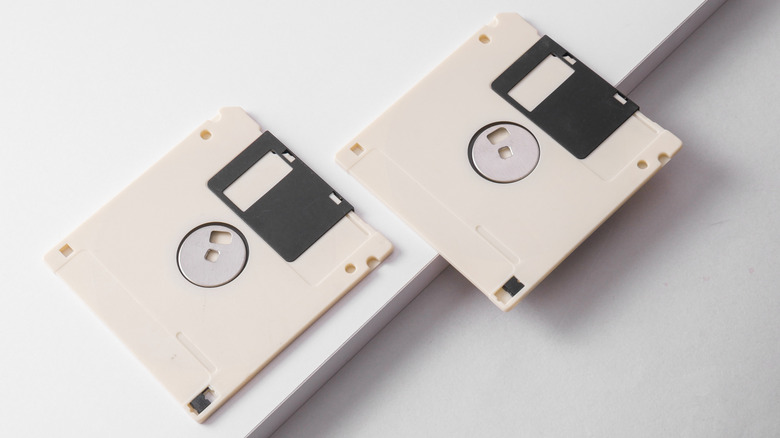
The fact that some airplanes continue to rely on floppy disks is a prime example of the "if it ain't broke, don't fix it" philosophy. However, signs continue to indicate that the global aviation industry could benefit from being more proactive about modernization. As a recent example, chaos broke out at Newark Liberty International Airport in May 2025 when outdated technology was cited as the reason behind more than 2,800 flight delays and cancellations.
An assessment conducted by the U.S. Government Accountability Office (GAO) found that 51 out of the FAA's 138 information systems were unsustainable due to outdated functionality and a lack of spare parts, among other reasons. The GAO made several recommendations on how the FAA should address the problem, including expediting air traffic control modernization.
With any luck, the latest risk assessments will lead to a global phasing out of floppy disks once and for all. It's bittersweet to think about those nostalgic floppies disappearing forever, but it is certainly amusing to think that the noise of loading a floppy disk is one of those forgotten tech sounds that has become lost to everyone — except for air traffic control operators.