

Japan's New Anti-Ship Missile Can Barrel-Roll In Mid-Air
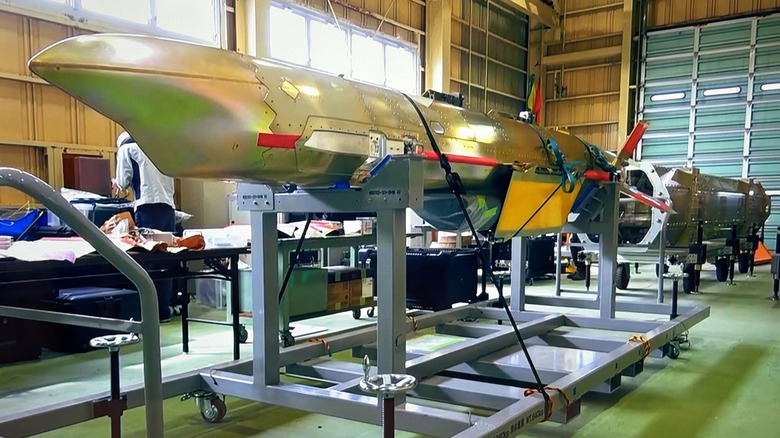
The conventional barrel roll is an aerial maneuver where the pilot shifts the airplane into a complete rotation, wing over wing, while completing both a loop and a roll at the same time. It was a defensive maneuver that could force attackers to fly out in front, called overshooting. Today, it's more of a stylistic maneuver used during air shows and the like. But a new long-range, anti-ship cruise missile from Japan has been seen executing the maneuver on video, essentially making it more difficult to intercept.
The missile, known as the "New SSM" or Surface-to-Ship Missile, is meant specifically for "island defense" and will help protect the country's southern islands from naval attacks. Japanese authorities have not specified an effective range for the missile, but say it will out-travel the common Type 12 anti-ship cruise missile. That has a maximum range of about 124 miles or 200 kilometers. The barrel roll maneuver, when used, should help the New SSM max out that range without being intercepted by air defenses along the way.
That's significant as the New SSM is intended to mainly be fired from ground-based launchers, whether on traditional land or by ship. Longer ranges will offer better firing positions. The U.S. Navy-commissioned Zumwalt-class destroyer DDG-1000 fires long-range intercontinental missiles, for example. Although Japan's New SSM can also be launched from the air by select jets like the F-2 and larger varieties.
How would a barrel roll help the New SSM evade defenses?
Ultimately, supersonic cruise missiles fly at low altitudes to avoid radar and other sensor systems. Nuclear-powered missiles or warheads work in the same way, flying at lower altitudes on a pre-programmed flight pattern. Some cruise missiles will do the opposite and fly at high altitudes, diving when close to the intended target. At high altitudes, they're more susceptible to missile defense as they cannot avoid tracking systems as effectively. Striking a balance between those ranges is beneficial, but again, it may open up the missiles to tracking and, by proxy, interception.
Ballistic missile defense systems work by tracking incoming objects and "intercepting" before they can reach their target, either by colliding with them and destroying them directly or by using blast fragmentation within proximity to detonate the payload in the missile early.
The New SSM would theoretically be able to avoid both of those scenarios, direct collision and blast fragmentation, through its barrel roll maneuvers. The loop and roll movement is helical while still keeping it on its current trajectory. Imagine the SSM flying up and over while it's also rotating on its axis like a corkscrew. That would certainly make for a smaller target and make it more challenging for a ballistic missile and/or blast fragmentation to strike the armament.
This highlights a big reason why military missile tests are run frequently: To ensure that the defense systems work, but also to better understand how they might be intercepted and how to avoid such a thing. It appears that Japan's new and agile SSM missile may be the result of similar research.