

Drone Swarms Are Becoming The New Big Threat To Aircraft Carriers
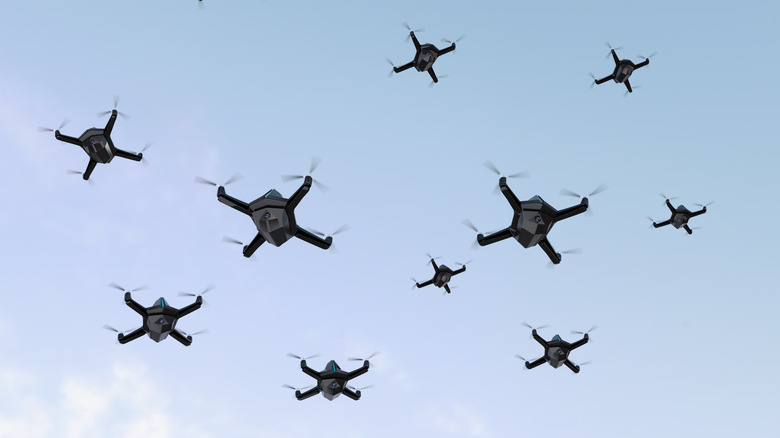
Largely considered the paragon of power projection overseas since the U.S. began deploying nuclear-powered carriers in in the '60s, aircraft carriers have stood as a measuring stick for military strength. For decades, the world's militaries have sought to neutralize the advantages of carriers on the battlefield, particularly given the overwhelming advantage of the U.S.' eleven carriers. China, which added its most advanced carrier yet in 2025, is looking to aggressively expand its fleet, hoping to build six carriers over the next decade, potentially including a nuclear-powered vessel. However, military planners are beginning to worry that aircraft carriers are facing a very different threat, one that comes in a small, extremely cheap package: drones.
In many ways, drones encapsulate the broad shifts enveloping modern battlefields, where booms in artificial intelligence and robotics have begun to revolutionize everything from the geographic scope of battlefields to reconnaissance and logistics operations. They've also democratized warfare, enabling terrorist groups, drug traffickers, paramilitary organizations, and smaller militaries to overcome traditional financial constraints and deploy high-level military operations. Exemplified by conflicts in Ukraine and the Middle East, drones have become an increasingly effective means of neutralizing arsenal and troop advantages of larger powers.
At the center of this change is the potential for swarm attacks, in which adversaries launch masses of drones to overwhelm an opponent's defenses. More than a matter of scale, drone swarm attacks use AI technologies to launch autonomous, coordinated hordes capable of reacting to targets in real time, posing several challenges for traditional defense systems. While experts largely debate whether true swarm capabilities are within reach, militaries continue to seek means of combating drone swarms. As these technologies develop, aircraft carriers will need to adjust their defense strategies to mitigate the potential threat.
Why are drone swarms so effective?
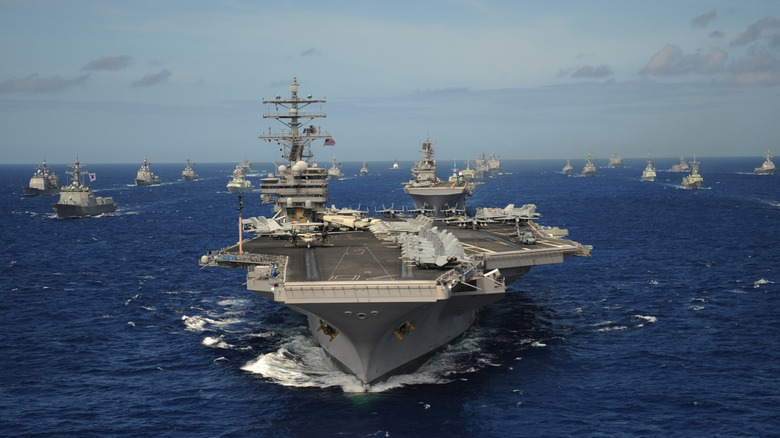
There are several reasons why carriers are relatively susceptible to drone attacks. For one, their size, otherwise an advantage when used as a display of force, make aircraft carriers incredibly easy to identify, track and, ultimately, attack. It also makes it difficult to conduct evasive actions, particularly within narrow, contested waterways like the Taiwan Straight. Their comparative lack of speed exacerbates these issues, meaning that carriers likely have to rely on various defense systems to ward off missile strikes and swarms of unmanned aerial and underwater vehicles. As such, multilayered attacks involving swarms of drones and long-range missiles can inflict major damage upon both a carrier and its collection of aircraft.
Although aerial, surface, and underwater drones have proven formidable against large ships, particularly in the Black Sea, the greatest threat may arrive at the bank rather than the battlefield. That's because traditional defense systems are extremely costly when compared to the drones they'd be tasked with destroying.
For instance, Russia's Iranian-manufactured Shaheed attack drones cost approximately $35,000 per unit. This is little compared to the interceptor missiles traditionally deployed by U.S. carriers, which typically range from $1.5 million to $4.3 million each. Such disparities are only likely to increase, as nations seek novel means of manufacturing and deploying cheap drones at scale. The U.S. Marines, for instance, claim to have developed a 3D-printed attack drone costing as low as $700. As these technologies develop, fending off hundreds, if not thousands, of drones through traditional kinetic defense systems becomes an increasingly dire economic model.
Defending against the swarm
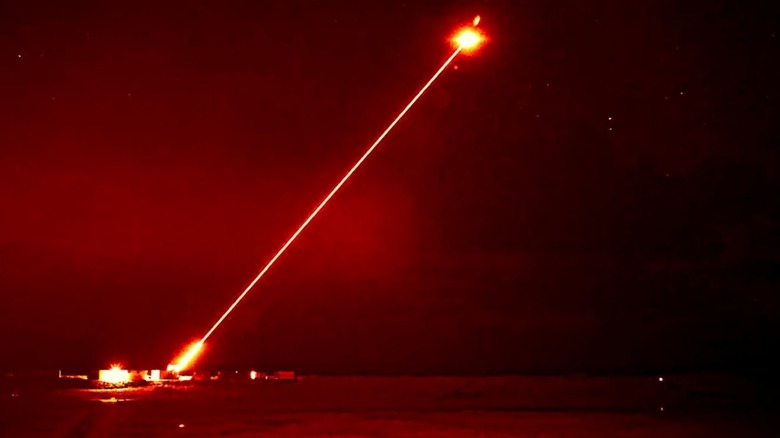
To combat this rising threat, nations are increasingly investing in anti-drone defenses that eschew traditional kinetic systems. One example is the rise of laser weapons systems, which present several advantages for navies looking to combat drone attacks. By eliminating costly munitions, lasers are a cost-effective means of downing drones. For instance, the DragonFire laser system recently added to the U.K.'s Type 45 Destroyers cost only £10 per shot. Furthermore, laser systems like the DragonFire depend on a ship's power, meaning their ammunition is essentially unlimited, giving them another major advantage over other close-range weapons systems during extended combat scenarios. The U.S. Navy recently announced that it used Lockheed Martin's 60-kilowatt HELIOS laser on the USS Preble to down UAVs during a testing sequence last year. To date, France, Germany, South Korea, Russia, and China are among a host of countries that have looked to add laser defense systems to their naval arsenals.
Countries are also seeking to develop systems to disrupt drones' electronic systems. China, for instance, has made headlines with its Hurricane 3000 high-power microwave system, which uses directed microwave beams to disrupt the electronics of drones up to almost two miles away. Jammers, cyber takeover, GPS spoofing, and electromagnetic pulses are other effective means of disrupting a drone's electronic systems to ward off incursions, although each comes with its own drawbacks. Militaries are even looking to develop their own swarms of defense drones to combat attacks.
Ultimately, aircraft carriers will likely need to deploy a multilayered approach to address the budding threat. Whether militaries can develop these defenses as quickly as their adversaries can build drones at scale, remains an essential question, particularly as swarm technologies continue to develop.