

China's Drone Fleet Does A Lot More Than Just Deliver Lunch
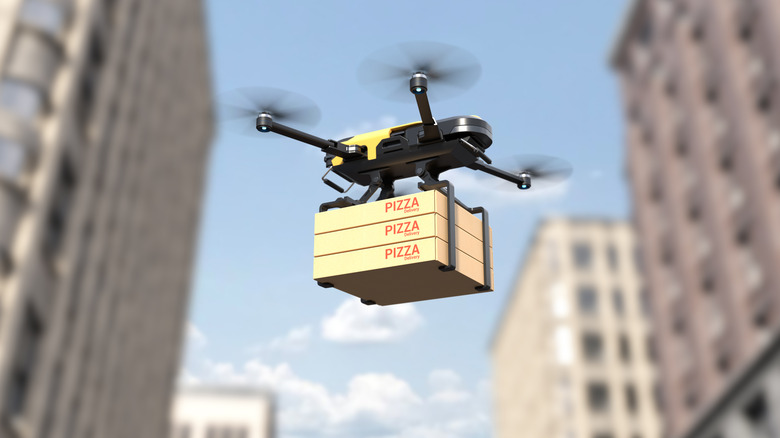
While there might not be flying cars just yet, there are plenty of flying drones. Many are commercially available — so long as you promise not to fly them near stadiums or airports — and some countries and corporations are investing heavily to create autonomous delivery fleets. Case in point: China.
Hefei, China, might as well be the drone capital of the world, at least going by a report by The New York Times. According to the article, Hefei, "a city the size of Chicago," relies heavily on drones for deliveries. Granted, this isn't a new concept, as Amazon is testing the waters of a drone-powered delivery system, even though its drones can't stop figuratively and literally running into problems.
However, Hefei's drones can ship just about anything. Food is one such option; patrons can order their meals at a park, and a flying drone will drop it off (you can see a similar delivery drone in action on the Dancing Bacons YouTube channel). However, similar drones in Hefei can also transport more crucial supplies, such as blood destined for hospitals.
Chinese drones can charge your cars and also be your cars
As electric cars are very popular in China, charging stations have popped up like weeds, and while Hefei has plenty of them (and big ones, too), the city also sports an even more novel charging method: automated battery-swapping stations. Instead of plugging a charging cable into a car, a robotic drone can pop out a car battery like a pair of AA batteries and insert a new one. Plus, the process takes about as long as filling up a gas-powered car with fuel.
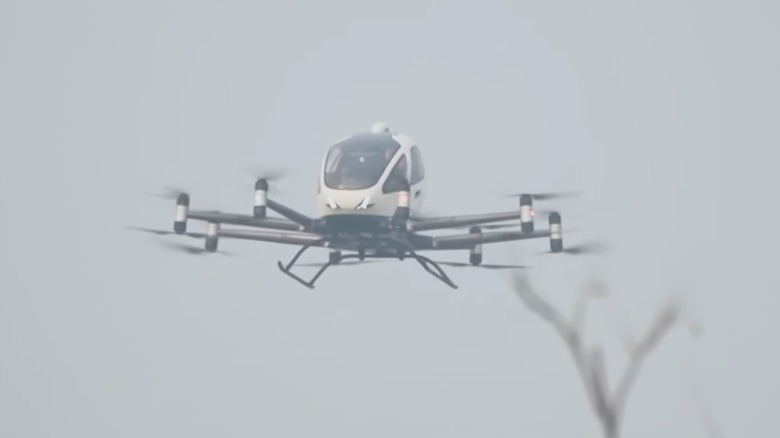
Hefei's drones don't just stop at delivering goods and helping people get where they need to go; the city also has drones that transport people. And no, that is not a strange way of saying Hefei has self-driving cars and trains — which it does. The pièce de résistance of the city is its flying taxis. Sort of. According to The New York Times, these multi-rotor copters can whisk away up to two passengers at 80 mph.
However, they aren't perfect. These taxis can only fly for 25 minutes and can't generate enough lift to carry the average U.S. citizen. And unlike the aforementioned drones, these are piloted remotely. These taxis aren't technically the world's first flying cars, but they're faster and currently available. Meanwhile, you can only pre-order the Jetson One (the world's first flying car) and hope it ships by 2028.
Why China is investing heavily in drones
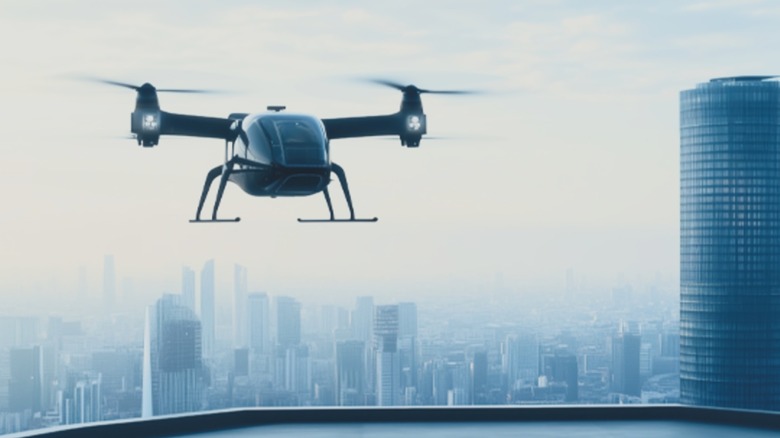
China's interest in drones is inexorably tied to a growing sector known as the "low-altitude economy," which emphasizes the use of electric vertical take-off and landing (eVTOL) vehicles. The Bank of America links the rise of the low-altitude economy to an increasing interest in electric vehicles, but eVTOLs are more than just gas-free helicopters. Bank of America likens eVTOLs to a cross between helicopters and drones and claims that they are safer, more environmentally friendly, and less noisy than helicopters.
Plus, according to Bank of America, eVTOLs are less expensive, which is always a boon for a growing economic sector. According to the New York Times article, a major driving force behind China's interest in the low-altitude economy is the "e" in "eVTOLs." China is dumping huge sums of money into the research and development of clean sources of electricity, due in no small part to the costs of importing fossil fuels.
The more the country can rely on green electricity, the more it can use electric vehicles like eVTOLs to transport everything from passengers to burgers. And the more China can rely on these technologies, the more it can manufacture them and sell them to other countries, which in turn could encourage them to adopt clean sources of electricity — perhaps sources that China pioneered? Food for thought.