

What Computers Does NASA Use?
NASA has been practically synonymous with advanced computing for nearly 70 years. To this day, the National Aeronautics and Space Administration continues to accomplish the impossible with computers. For example, NASA's EMIT sensor detected ocean trash from space and studied how some minerals affect Earth's climate. So, what kind of computers does NASA use to accomplish these amazing feats? How advanced is their tech compared to the best computers you can buy today? To the surprise of absolutely no one, the power of NASA's supercomputers is a world apart from even the most expensive consumer-grade systems on the market.
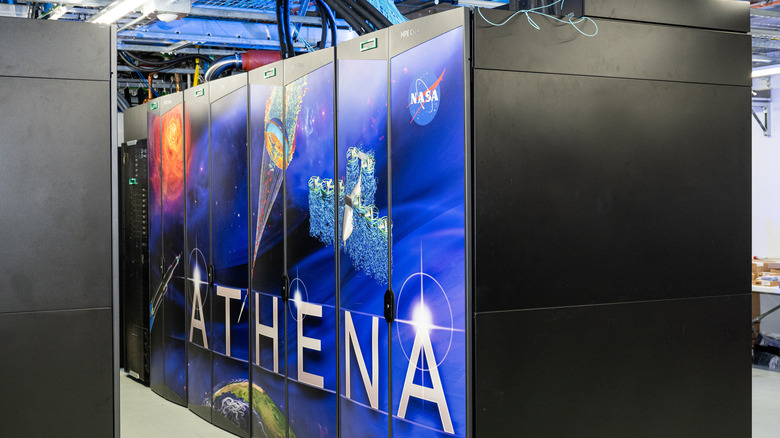
NASA transparently discloses the tech used in their high-end computing program through a publicly accessible computing systems overview document. Their most powerful supercomputer system is Athena, which entered service in January 2026. Athena is capable of over 20 petaflops of peak performance, making it roughly 190 times faster than the NVIDIA GeForce RTX 5090 graphics card that cutting-edge gaming PCs are using today. NASA's deployment of supercomputers at the Advanced Supercomputing Facility in Moffett Field, CA is supported by an archival storage capacity of 1,400 petabytes.
It's not all about supercomputers, though. NASA's regular offices adhere to the government-wide strategic solutions minimum specifications for workstations, which entail using standard business-class desktops and laptops. This means that NASA officials spend much of their day working in Windows 11 using PCs equipped with original equipment manufacturer (OEM) components, just like a typical office worker.
NASA is not a modern forerunner of computing

Despite NASA's jaw-dropping tech deployment, their computers are actually not the most advanced on the planet. That distinction goes to the organizations conducting newer types of research. The U.S. National Labs, China's National Supercomputer Center, EuroHPC, and tech giants like Google and NVIDIA all have one thing in common: developing high-performance computing (HPC) for AI research. These labs have achieved computing at the exaflop level, making their tech at least 50 times faster than NASA's Athena.
NASA also plans to use Athena to "train large-scale artificial intelligence foundation models capable of analyzing massive datasets to uncover new scientific insights." However, NASA places just as much importance on simulating rocket launches and designing next-generation aircraft. Keep in mind that NASA also has a proclivity to rely on older, more proven tech and to push those trusty systems to their limits.
To put it another way, NASA is a leader in applied HPC, rather than an experimenter in untested computing. Safety, precision, and long-term stability need to be NASA's priorities, especially when the Artemis missions plan on sending astronauts back to the moon. Mission control cannot allow anything to go wrong, which is why NASA continues to use computers that push the limits without sacrificing reliability.