

Ukraine Is Testing A Laser To Shoot Down Enemy Aircraft, And It Could Change Everything
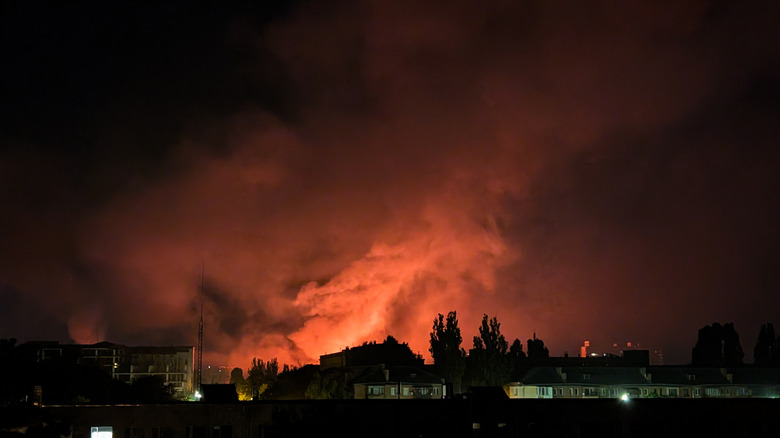
Four years into Russia's invasion, and Ukraine stands at the forefront of a changing aerial defense landscape. The conflict's increasing reliance on drones has given militaries around the world an inside look at the evolving nature of aerial combat and its effect on asymmetric warfare. Drones have been the predominant means of attack for both sides of the war, causing roughly 70% of casualties, and are expanding the geographic scope, logistics, and targets of modern warfare, necessitating defense strategies to fend off mass sorties of the cheap, deadly aircraft.
Ukraine, for its part, has been at the cutting edge of this effort. One recently tested weapon designed to combat drones is straight out of a science fiction movie, capable of incinerating aircraft out of the sky. The new high-energy beam weapon is aptly dubbed Sunray. First reported by The Atlantic's Simon Shuster in early February 2026, it is indicative of a new wave of anti-drone technologies sweeping through global military forces.
Global naval forces, for instance, have deployed high-powered laser beams on warships like the U.K.'s Type 45 destroyer. Unmanned aerial, surface, and subsurface drones are a growing threat to aircraft carriers, battleships, and merchant vessels, and have begun to even the playing field for military naval powers. The Russo-Ukrainian conflict, in particular, has been instructive in shaping these innovations as the two nations incorporate and counteract the unmanned weapons systems revolutionizing land, air, and sea drones.
The Sunray
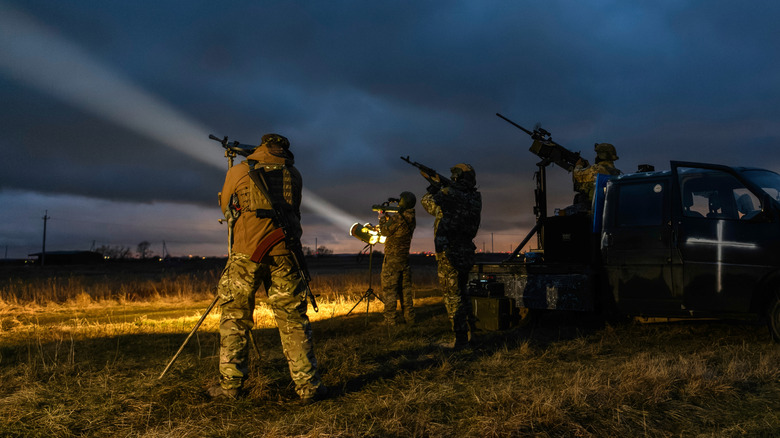
The Sunray resembles a retail-sized telescope with cameras strapped to either side to identify and track targets. Small enough to fit in the trunk of a car, Ukrainian soldiers downed a drone flying "a few hundred yards away" from the hood of a pickup truck. Its diminutive size will be a key advantage for the Ukrainian military in desperate need of portable air defenses capable of protecting frontline cities, military installations, and critical infrastructure. For Shuster, the weapon doesn't resemble lasers from movie lore, emitting neither a sound nor a flashing beam of red light.
Instead, the drone simply "began to burn as if struck by invisible lightning, then fell to the ground in a fiery arc." According to Shuster, the high-energy beam gun took roughly two years and a couple million dollars to develop and is expected to retail for "a few hundred thousand dollars." These costs are in sharp contrast to typical Western weapons programs. The U.K, for instance, paid £316 million to develop the aforementioned DragonFire laser program in November 2025, while the U.S.'s Helios laser gun resulted from a $150 million contract with Lockheed Martin.
Pavlo Yelizarov, head commander of Ukraine's air defense forces, told Shuster that the price differential was a necessity of the war, requiring Ukrainian firms develop weapons faster, cheaper, and with considerably less resources than their Western counterparts. "Many American companies are driven by money," Yelizarov pointed out. "We have another component at play: the need to survive."
Building the anti-drone dome
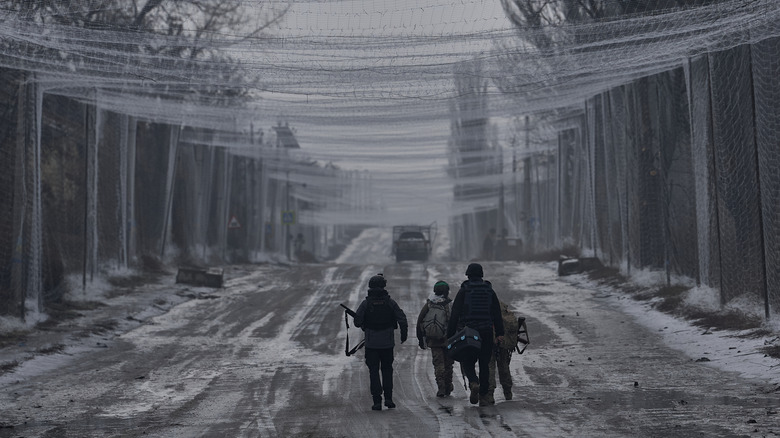
The Sunray — and even the Apollo laser capable of taking down 200 drones — is indicative of a war that has upended modern battlefields. Defending against Russia's drone swarms is a massive undertaking, as thousands of explosive-laden quadcopters bombard towns like Kherson and Nikopol every week, killing at least 2,514 civilians in 2025 alone. Low manufacturing costs make Russia's mass-produced Shahed drones, a First Person View UAV originally from Iran that costs roughly $35,000, a financial quagmire for Ukrainian defense forces. Previously reliant on costly U.S.-made Patriot missiles to ward off Russian attacks, each downed quadcopter amounted to a financial loss in the millions, rendering traditional air defenses unsustainable. High-energy beams like the Sunray, which lack costly ammunition, could flip the script.
The Sunray is just one of the many technologies likely to play a role in Ukraine's iteration of Israel's Iron Dome aerial defense network. In addition to its latest laser gun, the country has developed short-range rockets and 3D-printed interceptor drones to bolster its UAV defenses. This unconventional approach is exemplified by the man executing it, whose origin story more resembles that of a startup or rock band. A career TV producer, Pavlo Yelizarov founded Ukraine's most infamous drone attack unit, the Lasar Group, in his garage.
Only time will tell what role the Sunray system plays in Ukraine's aerial defenses. Likely part of a multipronged approach, Ukraine's air defenses will likely prioritize troop deployments, critical wartime infrastructure, and battlefront cities. But whatever the battleplan, Ukrainian officials are looking for immediate results. In the words of Ukraine's defense minister, Mykhailo Fedorov, "The anti-drone dome is not about the future. It's about survival today" (Via Ukrinform).