

In-Store TV Demos Are Actually Misleading - Here's Why

When you're thinking about buying a brand-new TV, research can only inform your potential purchase so much. Once you've zeroed in on one or two models, you're probably going to want to see the TVs in action. Fortunately, stores like Best Buy, Walmart, and Target have numerous TVs on display, from entry-level sets to premium and flagship screens. But beware: for the images presented inside a brick-and-mortar outlet may actually be a clever deception.
Common TV-buying mistakes – like investing in a screen that's too large, or settling for an entry-level set when you have the funds for something nicer — are easier to make than you may think. Another of these pitfalls is assuming that in-store TV demos are reflective of the type of picture the TV will produce in a home setting. Unfortunately, that's almost never the case, especially when you're looking at top-shelf QLED and OLED models. Manufacturers like Samsung and LG want their leading TVs looking as bright and colorful as possible, which often means one or two things:
For starters, there's a good chance these top-rung TVs (and many other sets on display) are set to store or demo mode. This often maxes out the TV's brightness and color saturation, so the picture you're looking at still appears vivid and punchy in a brightly-lit store. There's also specialized content to consider, as we're willing to bet that Samsung's best QD-OLED is running either a built-in demo loop or has an external source connected that's feeding the screen an uncompressed 4K or 8K signal.
Be wary of demo modes and picture-perfect content
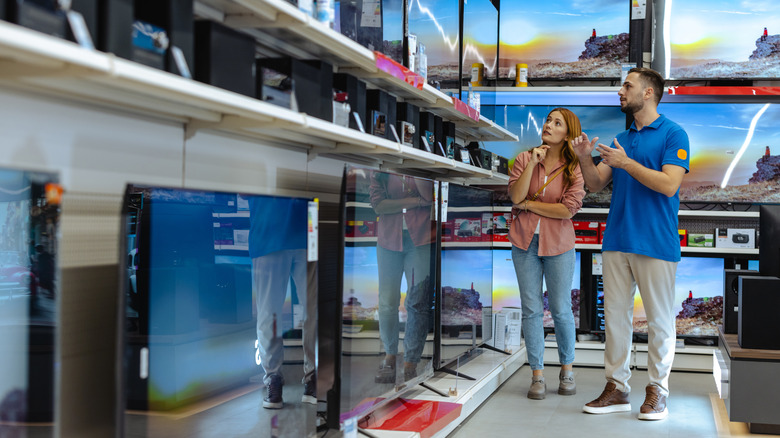
Here's some inside baseball: I once worked for a major TV retailer, and can offer first-hand confirmation that even entry-level sets are often hooked up to specialized content hubs. Mind you, it may only be a coaxial feed that can't push more than 1080p HD, but uncompressed HD on a TV set to store mode can look fantastic. And now that you've peered behind the curtain, I wouldn't blame you if you felt like you couldn't see past the smoke and mirrors. But you quite literally can.
Whether you're looking at one of the best cheap TV brands or an industry-lauded LG OLED, you can always ask a salesperson to switch the TV out of demo mode. Home mode should give you a more realistic idea of how the TV will look in a traditional viewing space (e.g., living room, bedroom, home office, etc.). If the TV is running an external loop, the salesperson may even be able to bypass the source to show you content that isn't tailor-made for wowing the masses.
Your best-case scenario is the salesperson goes above and beyond, and offers to show you an over-the-air broadcast. Sometimes, those coaxial feeds we mentioned will pick up local stations, so you'll be able to see what a near-imperfect HD source looks like (we say near-perfect because the coaxial may be connected to an amplified cable splitter).