

This US Navy Base Shot Down An Unauthorized Drone, But It Was Flown By One Of Their Own
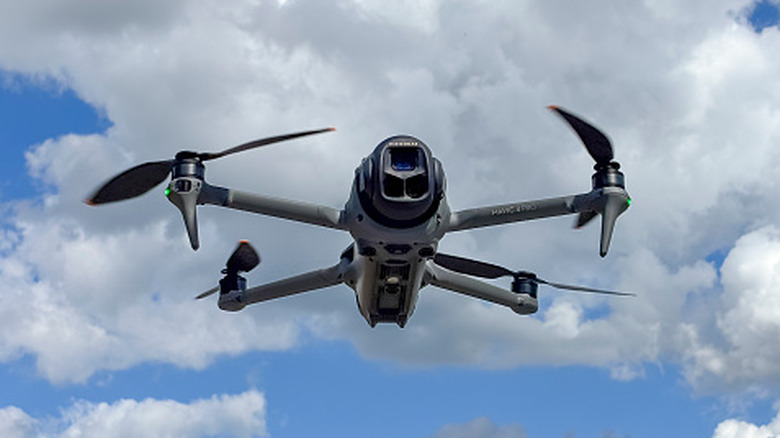
It's no secret that military bases are heavily secured and fortified areas, and that has only become even more true with the rise of drones. Soldiers must stay vigilant for any unmanned vehicles and take them down on sight. That's exactly what happened earlier this month at a naval base near Seattle, Washington. The good news is that the drone wasn't being piloted by a malicious actor trying to gather intel or blow up the base; the strange news is that it belonged to someone on the base.
The Navy reported that on February 3, an unnamed reservist (a member of the reserve forces who trains annually but is otherwise a civilian) at Naval Air Station (NAS) Whidbey Island decided to fly a personal quadcopter-style drone during his break. He didn't tell anyone beforehand. According to the base's spokesperson, Michael Welding, the device was promptly disabled as soon as it was spotted. Soldiers on the scene quickly determined that the drone didn't contain any explosives or anything else that posed a physical threat and quickly traced it back to the aforementioned reservist. As the use of personal drones is "in violation of base regulations," the reservist was later held for questioning.
Why a drone outside of NAS Whidbey Island was treated with hostility
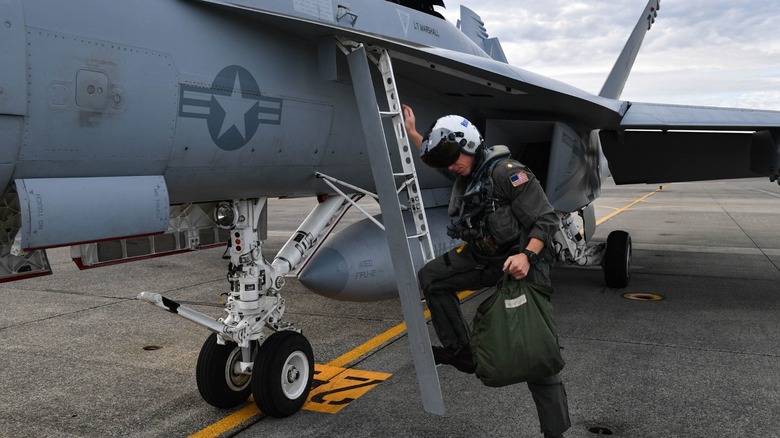
Even if you never heard of NAS Whidbey Island, you are probably aware of the EA-18G Growler. The majority of these airborne electronic attack vehicles are stationed at NAS Whidbey Island and make up the 390th Electronic Combat Squadron. Growlers can launch from aircraft carriers and jam radars, leaving enemies blind to air-based attacks. While the EA-18G doesn't have the firepower of an F-35 Lightning II fighter jet, it still plays an important role on the modern battlefield. Had a drone from a malicious party successfully gotten away with critical intel on NAS Whidbey Island — or worse, blown the base up — the U.S. military's combat capabilities would have been hamstrung until they could procure more Growlers.
To be fair, every branch of the U.S. military treats drones with hostility as a general rule. According to Pentagon guidelines, if a soldier spots an unauthorized drone approaching their location, they have to regard the drone as a security threat and take it down immediately. It doesn't matter if a swarm of weaponized drones attacks an aircraft carrier en masse or if a soldier spots a lone quadcopter buzzing around a base's fence; personnel have to shoot first, ask questions later (or never). Then again, it's also illegal to fly drones near airports and other restricted areas, so if a drone approaches a naval base, it kind of makes sense for personnel to assume the worst and jump into action.