

A New Investigation Revealed Nevada's EV Charging Stations Might Be In Trouble
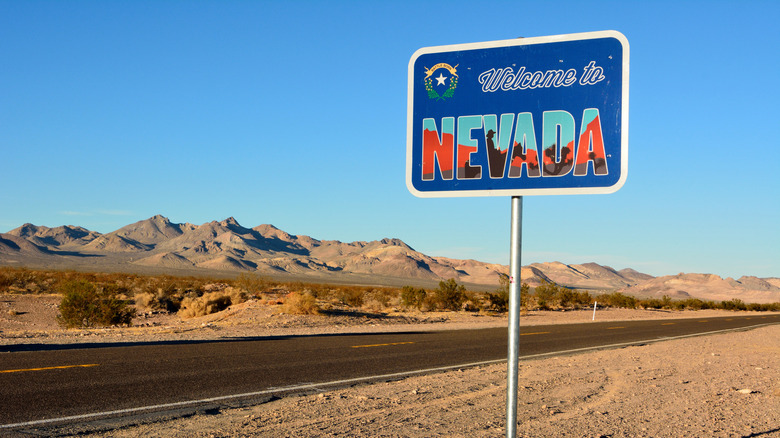
You can't drive a standard car without gas, and you can't drive an electric vehicle without a charged battery. It's kind of obvious when you think about it, but while gas stations are established landmarks the world over, EV charging stations are somewhat rare in certain parts of the United States. And in states such as Nevada, they're getting even rarer.
In mid-January, Scott Allison, the owner of the site Scott Explains, published a personal study he carried out on the electric charging stations throughout Nevada. For those who live outside the state, in 2015, the Nevada government started what it called the Nevada Electric Highway project. The goal was to set up an infrastructure to support EV charging stations on various interstate highways, starting with US-95. The project expanded to US-93, US-50, I-15, and I-80. However, according to Allison, of the state's original 29 fast-charge EV stations, only seven remain operational, leaving gigantic service gaps that can stretch for up to 232 miles. Unless you own an electric SUV with one of the longest battery ranges on the market, you are not making that trip without a lengthy pitstop to charge up at a slower EV station. And no, extending the car's range by using eco mode and relying on regenerative braking won't help.
Once the money dried up, so did the stations
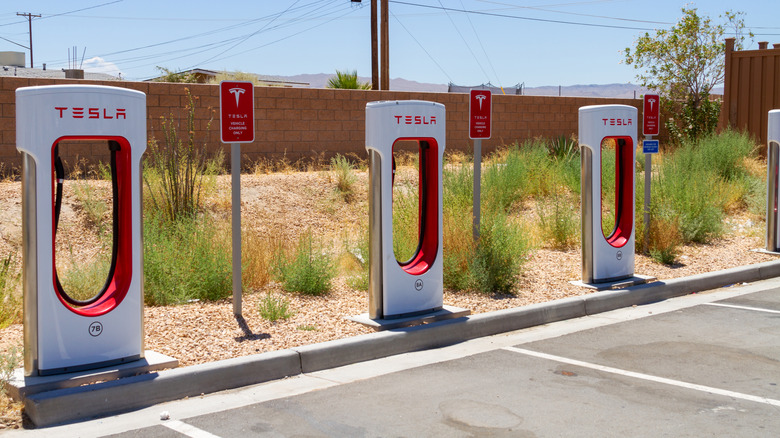
According to Scott Allison's findings, the people who ran the EV stations relied on grant money to "purchase and install" the necessary equipment. Given the vast swaths of land with little to no population (approximately 90% of the Nevadan landscape by his calculations), these subsidies were downright essential for setting up these charging locations. While one EV station became defunct in 2021, the majority went belly up between March 2023 and October 2025 — a relatively short amount of time. And since Allison published his findings in January 2026 and only has data on when a charger was "last online" up to December 2025, it's possible his information is already out of date. This is partially because the information EV drivers use to locate nearby chargers is also out of date.
While Allison collected data for his blog post, he came across a "very nice site" in Alamo, Nevada (not to be confused with Alamo, Texas). The site looked well-maintained and inviting, except for one problem: The chargers didn't work and haven't been plugged in since March 2025. According to some comments left by other EV owners, this particular location was listed as "available" despite being cut off from the grid. The entire northern half and most of the eastern portion of Nevada are completely dry, leaving EV drivers without a reliable source of fast power.
Nevada's electric highway is getting a charge, but it might not be enough
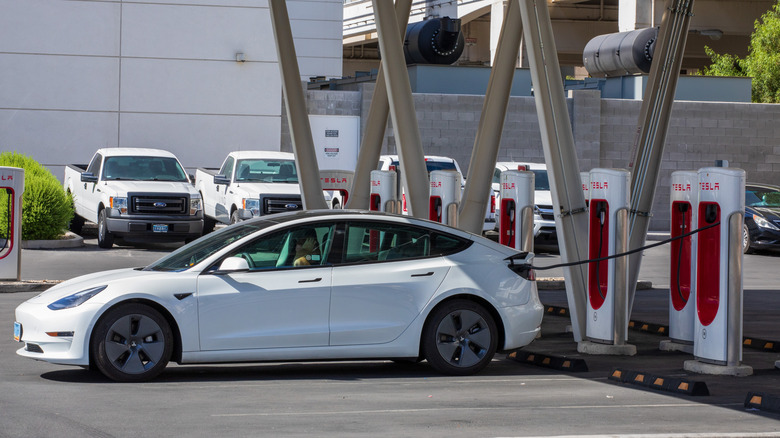
In the spirit of fairness, Scott Allison pointed out that there has been a major push to increase the number of charging stations throughout Nevada, but that's a double-edged sword. As he elaborates, efforts are mostly focused around Las Vegas and throughout I-15 and I-80. While he hopes that the National Electric Vehicle Infrastructure program might help turn things around and help the Nevada Department of Transportation create a "reliable charging network," he doesn't expect much progress until the end of 2026.
But, we hear you ask, what's to stop any new EV charging station owners from running out of money, resulting in even more abandoned locations? Allison was thinking the exact same thing. As previously stated, rural proprietors need government funds to stay up and running, and according to Allison, they need to reach an uptime of 97% (i.e., they are available and operational 354 days of the year). If they don't, then they aren't worth the government investment.
Ultimately, the future of Nevada's electric highway might hinge on the success of electric vehicles in the U.S. If manufacturers can sell EVs to plenty of Nevadans and/or tourists who will drive to Nevada (and if manufacturers can get a handle on the semiconductor shortage), then Nevada's roads might see enough traffic to justify maintaining existing fast EV charge stations, as well as building new ones.