

How Fast Can A Navy Supercarrier Travel To The Middle East From The US?
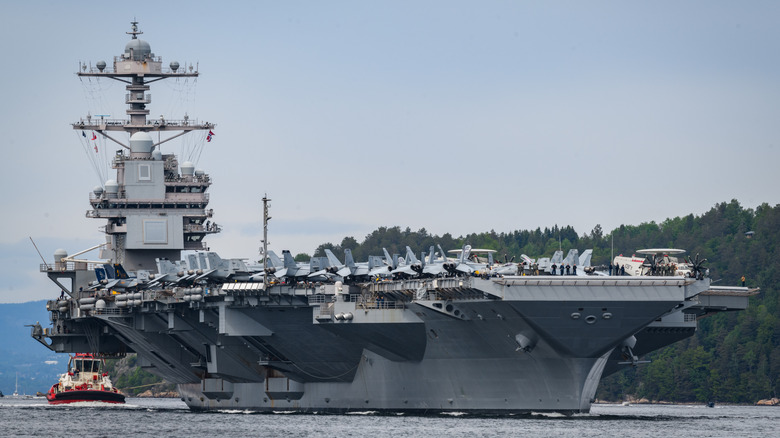
As of February 2026, the U.S. military is continuing efforts to build its presence in the Middle East by deploying naval warships to the region. This deployment comes in the wake of news that the U.S. Navy is working on a new supercarrier which will be added to the fleet in 2027. If the United States sends another Navy supercarrier to the Middle East, curiosity begs the question of how long it would take for it to travel there.
The modern supercarriers of the U.S. Navy are nuclear-powered titans that weigh up to 100,000 tons or more. The USS Gerald R. Ford is the world's largest warship and a key example of a supercarrier's capabilities. A Ford-class aircraft carrier can reach a max "flanking speed" of around 30 knots (approximately 35 miles per hour). Vessels departing from the Naval Station Norfolk in Virginia must travel over 5,900 miles to reach the Suez Canal. The canal itself is 120 miles long and ships would then have to cross the 1,200–mile Red Sea and the 920-mile Gulf of Aden to reach the Arabian Sea, where the U.S. military operates in the Middle East.
What this all means is that a Navy supercarrier travelling at 35 mph could get from the United States to the Middle East in less than 10 days unobstructed. A nuclear-powered supercarrier could make the 8,140-mile journey to the Arabian Sea without stopping or worrying about fuel. It can be decades before these carriers need to worry about refueling, even if it does take a long time to refuel a supercarrier when needed.
How can a Navy supercarrier travel to the Middle East so quickly?
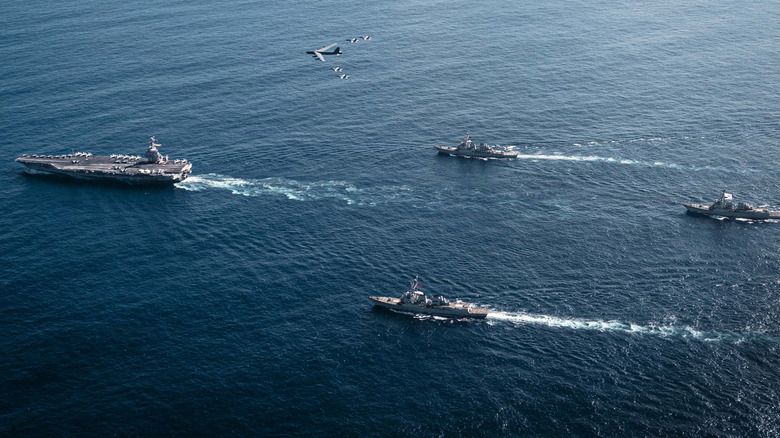
The term "supercarrier" isn't officially used by the military, but it colloquially refers to the largest aircraft carriers at any given time. The USS Gerald R. Ford is the quintessential supercarrier at 1,106 feet long and a waterline width of 134 feet. Considering its massive size, it's all the more surprising that this supercarrier would be capable of traveling over 8,000 miles in 10 days. The speed comes from high-performance turbines powered by steam generated from the onboard nuclear powerplant. Nuclear aircraft carriers are equipped with turbines that generate up to 280,000 shaft horsepower over four shafts. For comparison, the most powerful tugboats tend to max out at 22,000 horsepower.
The actual top speed of military vessels like the USS Gerald R. Ford is classified. Official sources explain that it can reach 30 knots, but it's reasonable to assume that it could go faster if necessary. Some commonly-believed myths state that supercarriers can reach 40 knots (46 mph), which would mean they could travel from the U.S. to the Middle East in just seven days.
The ability to travel across the world's waters at high speeds is incredibly important. However, the implementation of onboard nuclear power plants makes these ships cost-prohibitive to manufacture. The United States currently has 11 nuclear-powered aircraft carriers in active service, but the fact the U.S. Navy is using 3D-printed parts on aircraft carriers makes it possible that even more supercarriers will enter service in the coming years.