

Resupplying A Navy Aircraft Carrier At Sea Is Incredibly Dangerous - Here's Why
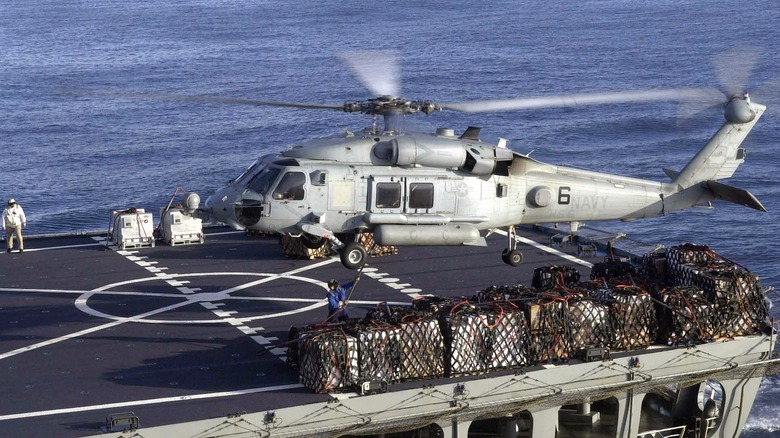
Aircraft carriers are some of the biggest seafaring vessels in the U.S. Navy's arsenal. They're so prodigiously huge — and require so much power — that refueling can take years in drydock. However, on the flipside, carriers can stay at sea for years on end, but still require supplies such as food, water, and ammunition to maintain their crews. And unlike delivering a pizza to a military base, resupplying aircraft carriers is a dangerous task that can threaten life and limb.
In order to transfer fresh batches of supplies and fuel, a supply ship and carrier must maintain a distance of up to 300 feet and secure a wire highline that can carry a fuel hose and cargo via the Standard Tensioned Replenishment Alongside Method (STREAM). Ram-tensioner devices automatically maintain constant tension, but the main problem comes down to physics. Both vessels weigh tens to hundreds of tons and must maintain the same speed and trajectory. Any ship moving within close proximity to another creates hydrodynamic interaction, which in this case produces a suction effect between the ships. If the helmspersons don't adjust accordingly, steering so much as one degree off perfect parallelity can cause the vessels to slam into one another.
While these vessels include an emergency breakaway system to avoid such scenarios, accidents can happen. While not an aircraft carrier, earlier this year, an Arleigh Burke-class destroyer, the USS Truxtun, collided with the USNS Supply (no, seriously, that's its name). Only two crewmembers were injured, but it was enough to get the Truxtun's captain, former Commander James Koffi, fired. As destroyers are 1/10th the size of carriers, imagine how much worse the damage could've been.
Ships still must resupply in bad weather and while under fire
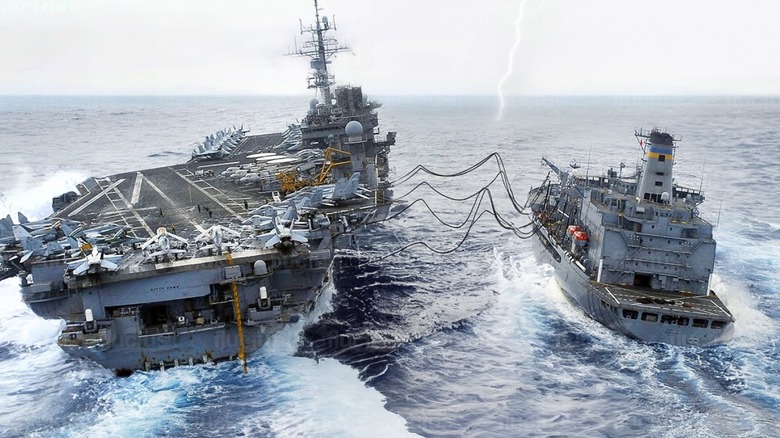
In an ideal situation, crewmembers should only fight against waves and underwater currents that threaten to throw the ships into each other, but oceans are rarely ideal. Bad weather can flare up and make dangerous refueling missions even more life-threatening — and climate changes are making these extreme weather patterns more frequent and dangerous.
Rain and fog reduce visibility, and high winds can snap the already taut cables, damaging nearby equipment and gravely injuring crewmembers. And then there are hurricanes. If either an aircraft carrier or supply ship encounters one, they postpone supply runs and relocate to safer waters to try again. Given the threat hurricanes pose, one might assume Navy ships would also call off resupply missions during dangerous scenarios such as when they're under attack. Not so.
From September 2024 to May 2025, the USS Harry S. Truman was stationed in the Red Sea. During that time, the ship was resupplied by the USNS Arctic, all while the resupply vessel was allegedly "under fire from Houthi missiles and one-way attack drones." The crewmembers unloaded everything from missiles to ice cream onto the aircraft carrier. While the USS Harry S. Truman got most of the glory, the USNS Arctic was the mission's unsung hero.
Advanced technology is making resupply runs (mostly) safer
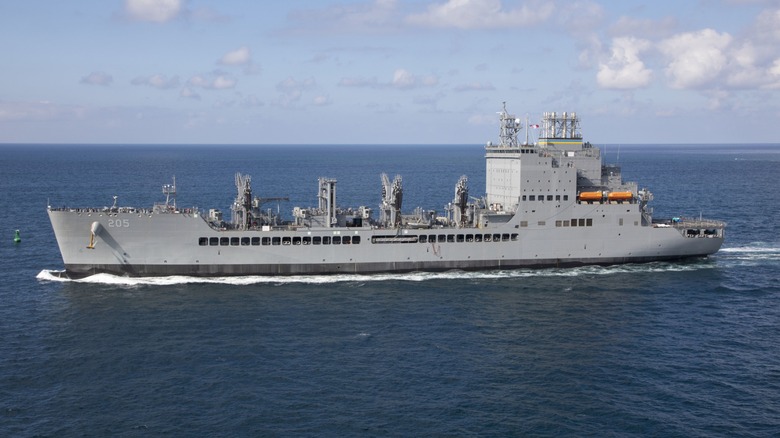
While the STREAM maneuver is the de-facto way to resupply aircraft carriers and other vessels, it isn't the only method. Helicopters such as MH-60S Seahawks (not to be confused with SeaHawk drones that can scan for water pollution) can help supplement supply runs by carrying several thousand pounds worth of cargo and dropping them directly onto carrier flight decks. Plus, the Navy is investing in unmanned logistics drones to help with resupply missions. However, both air-based methods come with unique limitations, as high winds and low-visibility scenarios can prove dangerous.
The Navy is also upgrading more traditional resupply and refuelling methods. For instance, the T-AO is a new class of fleet resupply vessel poised to replace the current line of fleet oilers, but more importantly, the U.S. Navy is looking into autonomous refueling systems, albeit currently for unmanned vehicles.
In 2025, the U.S. Navy contracted Louisville company Stratom to develop a refueling system that can refill Unmanned Surface Vehicles. While these ships are a far cry from aircraft carriers, this system could be the first step towards safer resupply methods for manned naval ships. But if so, that's a long time off.