

The Future Of Wi-Fi Is Here And It's Fixing 7's Biggest Problems

New consumer devices, like the Honor Magic V6 foldable phone and the Honor MagicPad 4 tablet, aren't the only new innovations announced at this year's Mobile World Congress (MWC 2026) event in Barcelona, Spain. Lenovo announced several new laptop and tablet models early on Monday, including a few exciting concept devices, like a foldable Legion handheld gaming console. Later, Qualcomm unveiled some of the next-generation chips that will power upcoming AI-ready wearables, 6G connectivity, and Wi-Fi 8 (802.11bn). The latter is especially interesting, as Qualcomm said its upcoming FastConnect 8800 chip will deliver the world's fastest Wi-Fi connection and the longest Wi-Fi range. That should be great news to anyone still having Wi-Fi issues with their devices, including products that support Wi-Fi 7 connectivity.
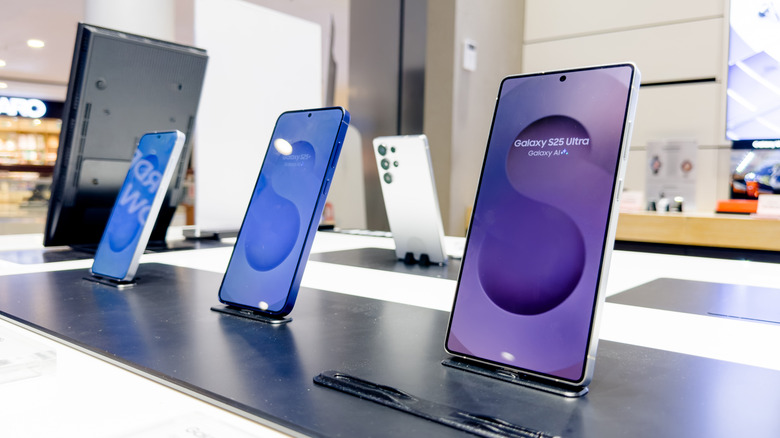
Wi-Fi 8 support in phones and other consumer products is just the first step. Routers that can support Wi-Fi 8 connectivity will be needed in homes, offices, and public spaces to offer the speed and range improvements Qualcomm mentioned. Qualcomm hasn't shared a precise roadmap for the FastConnect 8800 rollout, but the company said the FastConnect 8800 and other Wi-Fi 8 chips are being tested by customers, with commercial products expected in late 2026. The FastConnect 7800 chip, which supports Wi-Fi 7, Bluetooth 6, and UWB, is available in the Samsung Galaxy S25 Ultra flagship that Samsung released last year. A few days ago, Samsung launched the Galaxy S26 series. The Galaxy S26 Ultra runs on Qualcomm's Snapdragon 8 Elite Gen 5 processor, which is paired with the FastConnect 7900 chip, which also supports Wi-Fi 7 connectivity.
What Qualcomm's Wi-Fi 8 chip will offer
Qualcomm detailed the FastConnect 8800 chip in a briefing with reporters before MWC 2026 kicked off, explaining that the chip will integrate several wireless technologies in addition to Wi-Fi 8 connectivity. The chip will also support Bluetooth 7 (speeds up to 7.5 Mbps), and the latest versions of Ultra Wide Band 802.15.4ab (UWB) and Thread 1.5 wireless standards. In addition, the Wi-Fi chip will feature on-board AI support that may improve functionality and offer additional features. Qualcomm said the AI may be involved in determining proximity measurements for all the various built-in connectivity options to improve tracking. Finally, the FastConnect 8800 will be the first mobile chip to support 4x4 Wi-Fi architecture (compared to 2x2 for previous versions).
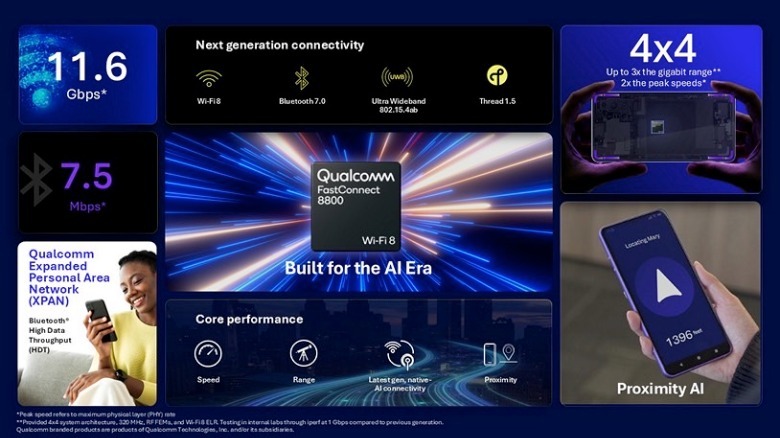
Speaking of speed, the FastConnect 8800 chip will support data speeds of up to 11.6 Gbit/s, which is about twice as fast as the previous FastConnect generation and twice as fast as competitors. The chip may be four times faster than the iPhone 17's Wi-Fi chip. When it comes to range, the Wi-Fi 8 chip should offer up three times longer range than the previous FastConnect chip. Also, Qualcomm said that the new chip will be able to sustain 1 Gbit/s speeds at a signal that's 20dB weaker than the previous generation, depending on the environment.
Wi-Fi issues will not go away immediately
In a blog post last July, Qualcomm explained that "Wi-Fi 8 marks a fundamental pivot — moving beyond peak speeds to prioritize reliable performance in challenging real-world conditions." The new standard should deliver "consistent, low-latency, and near-lossless connectivity even in highly congested, interference-prone, and mobile environments," Qualcomm added. However, the 802.11bn standard won't be finalized until 2028, according to the same blog post. Separately, TP-Link announced the first Wi-Fi 8 connection in October. "This technology is poised to deliver the ultra-reliable wireless performance that the industry will require as more devices and bandwidth-intensive applications come online," the company said at the time.
In other words, it may take time until we see the first consumer devices with FastConnect 8800 chips. It's unclear if the Wi-Fi 8 routers will be ready by then. Qualcomm's new chip should still work with the current Wi-Fi standards, including Wi-Fi 7 (and earlier), which means it will offer the same speeds, reliability, and potential issues as the current networks. Some Wi-Fi 7 users have encountered range and speed issues with their setups. Others explained that Wi-Fi 7 routers may suffer from firmware bugs that can impact performance. There's also the matter of 6 GHz support, a band some countries may not support. It's a band you need for Multi-Link Operation (MLO), the ability to connect to multiple bands. MLO can also fail in some devices.