

China Mobile Showed Off A Robot-Only Restaurant At MWC 2026 - Here's What Happened
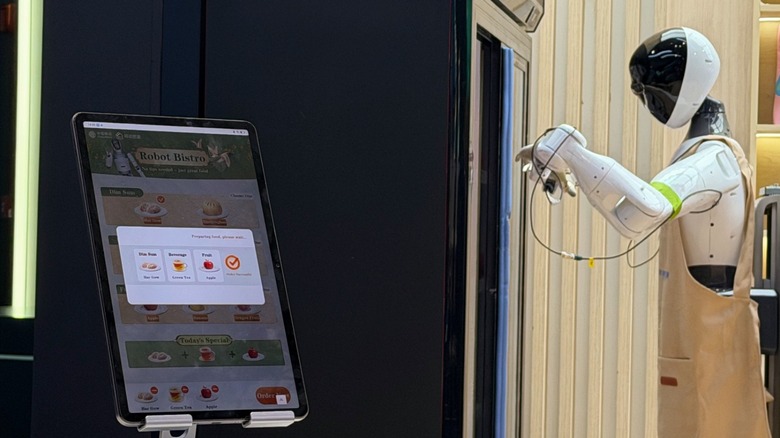
What's a big tech trade show without robots all over it? At Mobile World Congress 2026 (MWC), one of the highlights of the robot world comes from China Mobile. The company is showcasing several of its technologies at the event, as it combines its 5G network with cloud services, AI, and even a new generation of robots that is still not ready to launch to customers. To put all of that to test, the company made a robot-only restaurant where you can see what the future of fast food might look like.
In the demo, you can choose your order from a tablet, and after you place it, the restaurant staff, made up of four robots, starts to work. China Mobile tells BGR that there's a main Lingxi robot, which is the waiter, and the other robots will perform tasks depending on the main one's actions. In this case, the other robots were assigned to get dumplings ready, pour tea in a cup, and get an apple from a fridge. Each of these tasks are performed as the waiter robot approaches the others. In total, this operation should take two minutes and 24 seconds, but the demo felt a bit slower than that.
China Mobile's robots won't replace human work (for now)
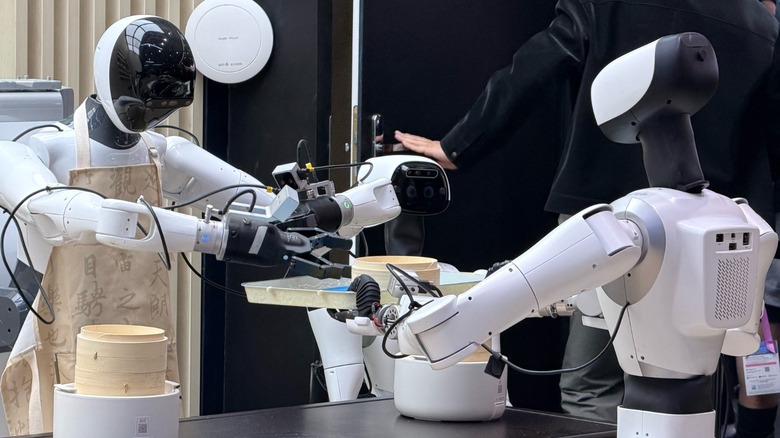
During the demo, everything worked as expected. The waiter robot slowly raised a tray for the first bot to place the dumpling plate. Then, it slowly rolled to the other humanoid robot in charge of pouring tea from a jar — no tea was spilled. After a few moments, the main robot met the final staff member that got an apple from a fridge. With all the orders ready, the waiter robot brought it to the cashier.
China Mobile says the accuracy of this process is 92%, which means that every 10 orders, nine will go according to the plan. While there are many goals with this test, such as improving the speed and making the robots more efficient, the company explains to BGR that a big step has been how stable the new generation of Lingxi robots are. The previous models, for example, would likely spill the tea (and not in a good way), and this new generation is able to confidently pour drinks and even carry them around on a tray.
While the company might eventually take inspiration from Elon Musk's Tesla Diner in Los Angeles for a future initiative, it doesn't seem like robots are anywhere near to replace human jobs — at least not in the foreseeable future.
What China Mobile wanted to achieve with a robot restaurant
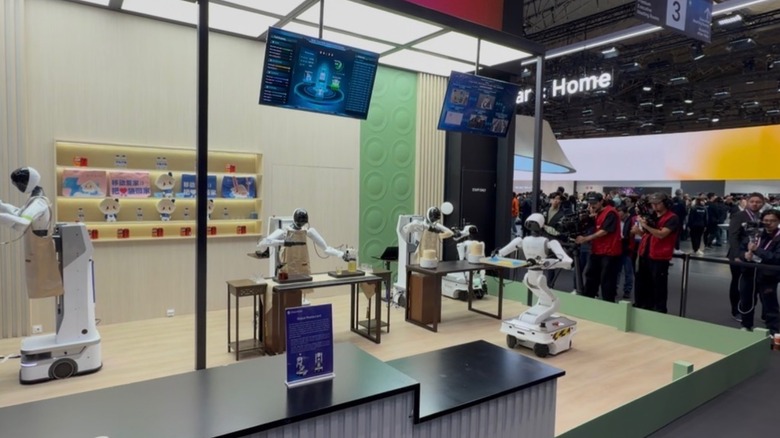
The robot restaurant at MWC 2026 was made to highlight the Vision-Language-Action large model used by China Mobile, as it's used for a real-time scheduling system where multiple robots can perform several tasks. While all robots are connected to the same network and rely on a main bot to perform their activities, the company successfully displayed a conflict-free operation, which I must say, was a lot quieter than any of "The Bear" episodes I watched.
The company also put into test its VLA-Real-Time Asynchronous Inference System (VLA-RAI), which should improve motion smoothness on robots and make the operation become 1.3 to 1.5 times faster than human teleoperation. According to China Mobile, the goal is to make this hypothetical fast food chain operate without anyone. At least in the test, it showed this is possible.
While humans would have performed all the tasks shown a lot faster than the robots, it's part of this new humanoid-robot push that not only China is having, but also the U.S. and Europe. Still, the other regions don't seem to be as avid to show what their robots are capable of doing as Chinese companies. And they're getting pretty good at all-things robots.