

The USS Abraham Lincoln Aircraft Carrier Can Navigate Without GPS Or Radar - Here's How
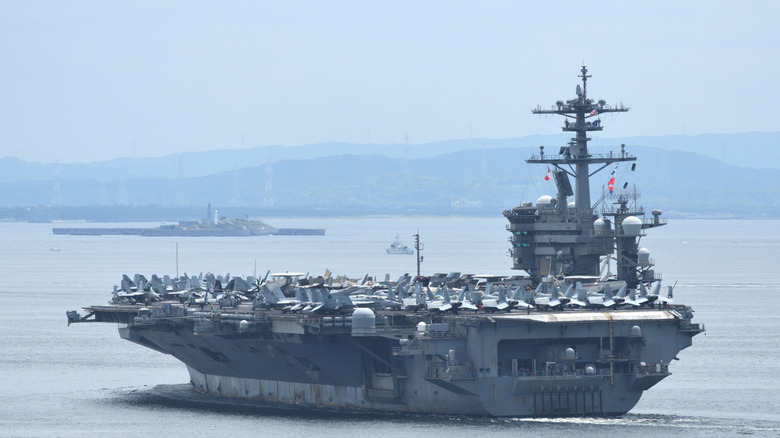
If you live in a big city or just travel a lot, then chances are you've gotten pretty used to how handy apps like Google Maps and Apple Maps can be. Not only is it easy to plug in where you want to go, but these apps will even provide you with multiple different paths you can take to reach your destination, as well as give you turn-by-turn directions and information on the speed limits, street names, and more. Out on the high seas, though, things are a bit more hectic.
Sure, there are instruments designed to help naval ships navigate the open seas, but what happens when massive ships like the USS Abraham Lincoln find themselves in potentially hostile waters where communication and electronic instruments might be blocked? Well, the ship's navigators can turn to the stars, of course. Despite the major advances seen in technology, sailors aboard ships like the USS Abraham Lincoln continue to rely on an archaic navigation process that many might expect to have died out ages ago.
While it isn't an actual requirement, the U.S. Naval Institute has argued that every ship should be able to navigate using only celestial navigation techniques. That's because if an emergency were to ever come up and the electronic systems were unusable, the navigators aboard these ships would need to be able to navigate home safely, and using celestial navigation would allow them to do that. All they'd need is the sun, moon, or stars, the horizon, navigational instruments like a sextant, and nautical charts.
How sailors use celestial navigation to get around
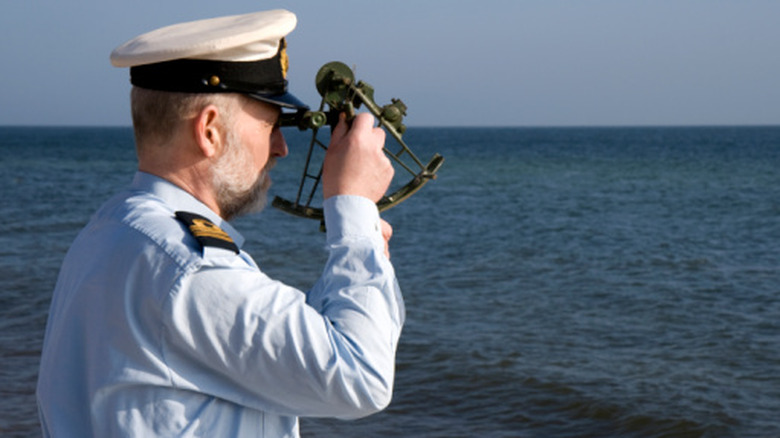
The entire point behind celestial navigation is to use observations of the heavens and specialized instruments like a sextant to compare the current position of the sun, stars, etc, in relation to Earth with the stars, sun, and position of other heavenly bodies with known celestial charts. These elements are pretty much unhackable, making them ideal, especially for large nuclear supercarriers like the USS Abraham Lincoln.
To take advantage of celestial navigation, sailors need to measure the angles between different heavenly bodies, such as the moon, sun, the horizon, and the stars. They call these measurements "sights." Once taken, the measurements are then used alongside tables and almanacs of celestial data that provide detailed information about the predicted angle of different heavenly bodies at different times. Then, the sailors compare these predictions to the actual measurements they took, allowing them to determine where the celestial object was at the time of the sighting.
Next, navigators take that data and use it to help plot something called lines of position. By observing the locations of several celestial objects, the navigator can determine where lines of position fall and then use those to determine where the lines intersect, to give them their approximate location. Next, they need to look at their previous position — called the dead reckoning — and then make adjustments based on updates over a period of time. This allows the navigator to see where the ship is moving and to more accurately determine if it is headed in the right direction.
Why celestial navigation remains a valuable skill

There are many reasons why sailors aboard ships like the USS Abraham might find themselves relying on celestial navigation. Whether it's electronic issues with the onboard GPS systems or just the fact that massive aircraft carriers like the Abraham Lincoln often find themselves in warzones, where using electronic and radio systems can be dangerous. By turning to the stars, these massive vessels can ensure they safely extract themselves from the risky situations they end up in, giving them a chance to resupply the ship in safer waters or even head to new destinations.
This is especially true in the case of ships like the USS Abraham Lincoln. These supercarriers remain some of the most important in America's military fleets. They're designed to run for decades at a time and even take years to refuel thanks to their complex nuclear design. However, when out on the open waters of the world, ensuring these ships have everything they need to safely get around, no matter what situations they find themselves in, is extremely important.