

USB-C Solved The Biggest Problems The Creator Had With USB Connectors
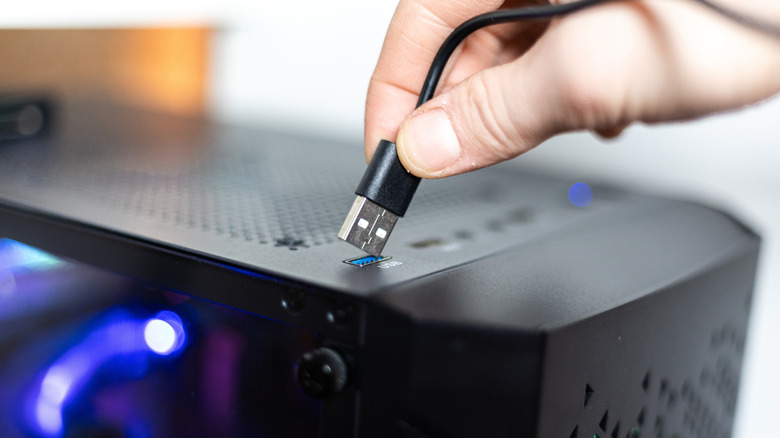
If you've ever tried to plug a standard USB cord or connector in while not looking, fumbling around with the connection altogether, you know it can sometimes be difficult to plug in. That's because USB Type-A only has one way to connect. The simplest way to check if you have the right orientation is to try to plug in the connector and, if it doesn't fit, flip it around. Guessing the wrong orientation is a minor annoyance, but it happens. It turns out, there's a very specific reason why the original USB port was designed this way.
Ajay Bhatt, the team leader at Intel and credited creator of USB, says that it's because making a reversible system would have required twice as many wires and circuits, thereby increasing the cost of development and production. At the time, the team chose to keep the standard accessible, namely so they could get everyone on board, and by "everyone", that means all the major computing and technology companies. For the port and connector to truly be universal — USB actually means Universal Serial Bus – getting as many companies as possible to adopt the standard was critical.
Introduced in 1996, USB has been around for quite some time and has gone through many iterations since then. That's why there are so many different types of USB ports, but the most recent is USB-C or USB Type-C, which introduces a reversible design. It addresses what Bhatt says is "the biggest annoyance" about the original USB format.
How are USB-C cables and ports reversible?
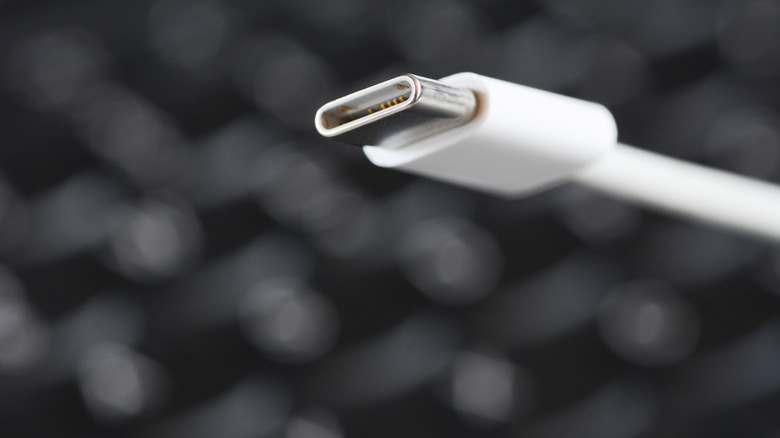
USB-C was created from the start to be reversible and slimmer, unlike the original USB design. It features a symmetrical 24-pin layout, split into 12 pins on either side of the connector. Because these pins are identical on both sides, when you plug in devices, it doesn't matter whether you have the connector facing a certain way. It's a fairly simple setup. But how does the cable or system know which pins to use? Something called the Configuration Channel, special pins, helps the system detect which way the cable is oriented, diverting data or energy signals to the right pins.
While more complex than standard USB, this design still manages to be accessible and inexpensive, give or take certain features. Some low-cost Type-C systems drop support for certain advanced features, like only offering USB 2.0 or limiting power delivery. That said, the design does lend some credence to Bhatt's commentary on a reversible connector that would require double the wires, double the complexity and increased costs.
The new standard was developed by the USB Implementers Forum (USB-IF), which is a conglomerate of hundreds of major electronics and tech companies, including Apple, Microsoft, Intel, Dell, HP, and more. USB-C is also multi-purpose, and can be used for a variety of applications besides power and data delivery, plus, it's smaller and more portable, and offers much faster transfer rates and higher power delivery. Pretty much all of modern devices use USB-C ports now, because of the standard's sheer versatility.