

Faster 3D Printing Could Be A Simple Pattern Away
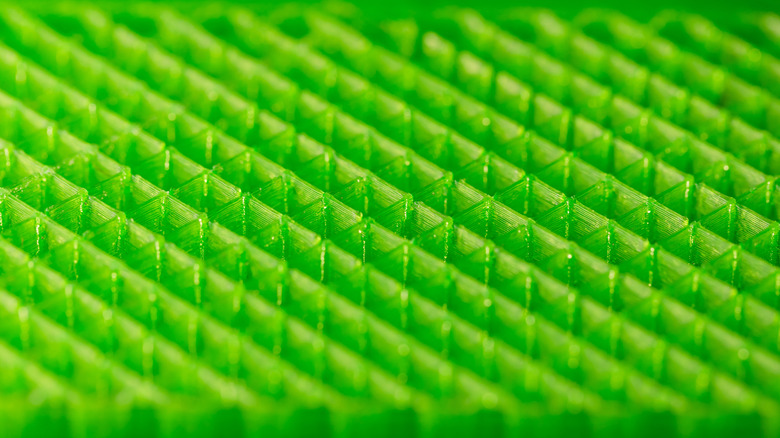
As impressive as the 3D printing process is, it can also be a bit time consuming. You are creating something out of nothing after all, and your printer needs to dispense and layer every square inch of the final piece. 3D printer pros agree on printing tricks like allowing the system to run at a slower pace to reduce headaches. That said, there are methods you can employ to speed things up without sacrificing quality — chief among them being a simpler infill pattern.
Alongside the basic contours of a project, your 3D printer dispenses filament to fill out the internal structure of flat surfaces. As with the main objects that make up the final piece, the printer manually draws out those patterns, and depending on complexity, you could be waiting all day just to finish one side of a cube. Opting for simpler infill patterns that focus on straight, even lines allows your printer to move in quick, sweeping motions, saving you both time and filament on the overall print.
Infill patterns add strength and stability to 3D printed projects
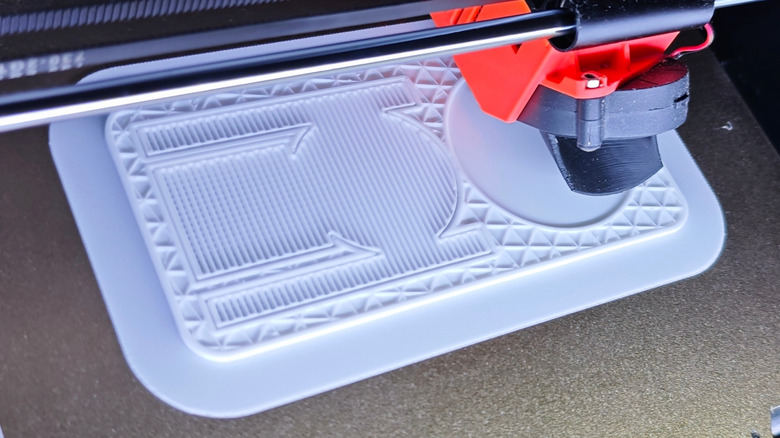
Let's go over a brief explanation on what an infill pattern does for your 3D printing project. You might assume that if complex patterns are slowing down your printing process, the optimal move would be to do away with them entirely. However, infill patterns form the structural support for your prints. If you printed a flat object with no infill pattern, it would have very low rigidity, which is not ideal for anything that's supposed to stand on its own.
If you were 3D printing a gadget to use every day, there's a good chance it wouldn't hold up very long without this internal structure. Creating surfaces with an infill pattern helps to shore it up against physical force. A flat, featureless sheet bends easily, but a textured sheet is stronger and harder to bend beyond its intended shape. Using an infill pattern is also a faster and more efficient process than making solid, heavy blocks of material as it provides the same level of structural integrity without burning as much filament.
Simpler infill patterns require less 3D printing time
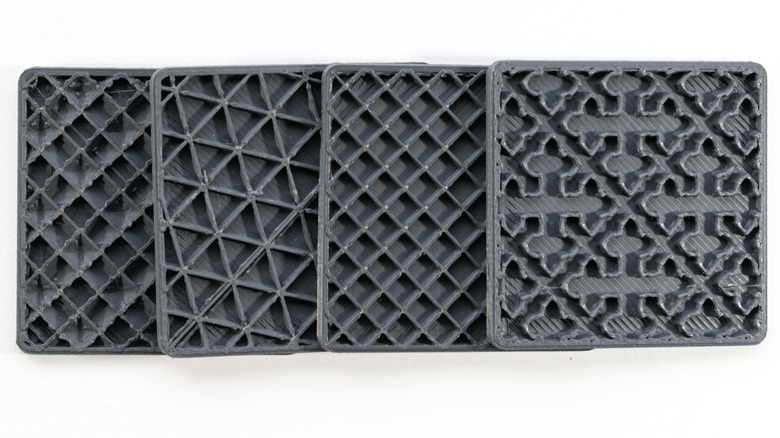
Considering that the infill pattern makes up the structure of a 3D print, it stands to reason that a more complex pattern would offer more support. This is technically true, but it comes with an asterisk: More intricate patterns make your prints sturdier, but they also require more material to create, not to mention longer processing times.
If you're irritated with how long prints are taking, an ideal solution is to use a simpler pattern. Essentially, any infill pattern that doesn't require your 3D printer nozzle to zig-zag or perform complex motions will cut down print time substantially. If you're performing a quick, simple 3D print, an infill pattern consisting of single-direction straight lines allows your printer to create the piece with a few fast swipes.
The problem with this pattern is that it only provides stability along a single axis. For something with a little more muscle, try a lightning pattern that uses a tree branch-like structure to provide more strength where it's needed, while shoring up thinner, weaker sections of the print. Remember, you can also fine-tune the density of the infill pattern if you don't want to use as much filament, though this will decrease overall integrity. Also note that no matter how robust your infill patterns are, there are still some objects that should never be 3D printed.