

Are Wired Accessories Actually More Reliable Than Wireless?

There's an age-old notion that wired accessories are more reliable, more accurate, or better-performing than their wireless counterparts. It's a rule of thumb that's stood the test of time because, once upon a time, it was a definitive fact. In 2003, hardware reviewers were commenting on wireless computer mice and their effort to chase the polling rate limits of wired USB connections. There were constant concerns about signal stability, and there was a real risk that the wireless connection would cut out when it mattered most.
It's also considered common knowledge that wired headphones deliver superior audio quality and that wired video game controllers guarantee less input delay. Really, though, how noticeable is the difference in the realm of modern tech? Can it truly be said that wireless accessories are still less reliable?
Nowadays, there's an increasingly thin line between many types of wired and wireless accessories. It's a difference that matters to high-end professionals who need every advantage possible. The convenience factor of being cord-free is often more than enough to give wireless utility the edge. For the vast majority of people, wireless accessories are perfectly reliable.
How wireless accessories became more reliable

The evolution of wireless technology is particularly apparent in the realm of video games. Wired game controllers exhibit an input delay between one and three milliseconds. Wireless controllers using a 2.4 GHz USB connection may have a six-millisecond delay, but sometimes as low as one millisecond under ideal conditions. Considering that humans perceive a 100ms input as instantaneous, the difference between wired accessories and wireless ones is practically nonexistent today.
Wireless accessories were able to reach this point thanks to advancements in USB technology. Manufacturers typically develop their own proprietary radio frequency protocols to stream data over wireless USB connections. The Xbox Wireless protocol, for example, is designed to optimize the connection of wireless accessories in the Microsoft ecosystem. The Xbox Wireless Adapter is a USB dongle that can facilitate a strong connection when the less reliable Bluetooth technology isn't an option. Interestingly, many wireless accessories still use the USB 2.0 standard; your game controller is probably plugged into the wrong port if you're using the blue USB 3.0 slot.
Why some wireless accessories are still less reliable than wired
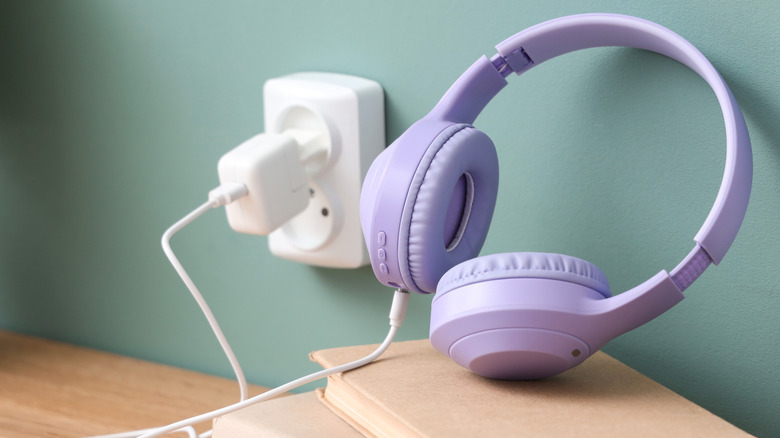
The biggest elephant in the room is battery life. It feels like certain "wireless" peripherals need to be constantly plugged in to keep their batteries alive, and some wireless headphones completely lose their ability to hold a charge after just three years. Battery-powered mice can last for months of continuous use, but you will have to bust open a pack of AAs at some point. Modern technology lets you enjoy the benefits of wireless charging, though nothing beats the reliability of a wired accessory that never stops working.
Audiophiles and professional sound designers still swear by their wired headphones, too. Even the best wireless headphones still have to rely on Bluetooth codecs that subtly affect the purity of the source audio. Wireless headphones can also experience as much as 40 milliseconds of delay, which can be the difference between victory and defeat for competitive gamers relying on audio cues.
Internet devices are the peripherals that display the biggest disparity between wireless and wired. Wireless routers often deliver a fraction of their promised speed because the average home contains so many other devices and obstacles that interfere with Wi-Fi signals. It's easy to believe that no one uses wired internet anymore, but content creators and hardcore gamers still use Ethernet cables to guarantee maximum speeds and minimal dropouts.