

NASA Has Bad News About What Could Happen To Humans Born In Space
It's a long-held dream in science-fiction that one day, humanity will migrate to the stars, living their lives aboard space stations in microgravity. It's a romantic notion that humans can be born and live their entire lives in space, and it's one we have entirely too little data to pursue in reality at this point, especially considering the many health problems that can already plague fully-grown astronauts. To remedy this, NASA scientists conducted an experiment to see how a creature born in microgravity would acclimate upon return to Earth, and the results show that the being in question may not be able to discern up from down — literally.
Back in 1991, NASA was interested in determining how a human born in the microgravity of space, comparable to the modern-day ISS, would fare upon return to the home planet. Rather than risk a human life, the researchers sent an unexpected kind of critter instead: jellyfish. Compared to something like a chimpanzee, a jellyfish doesn't have much in the way of physical similarities to humans, but they do have one crucial factor: they can discern direction with assistance from gravity. Upon their return to Earth, the jellyfish used in the experiment were physically fine, but extremely disoriented, which may bode poorly for any space-born humans in the future.
Space-born jellyfish can't tell up from down
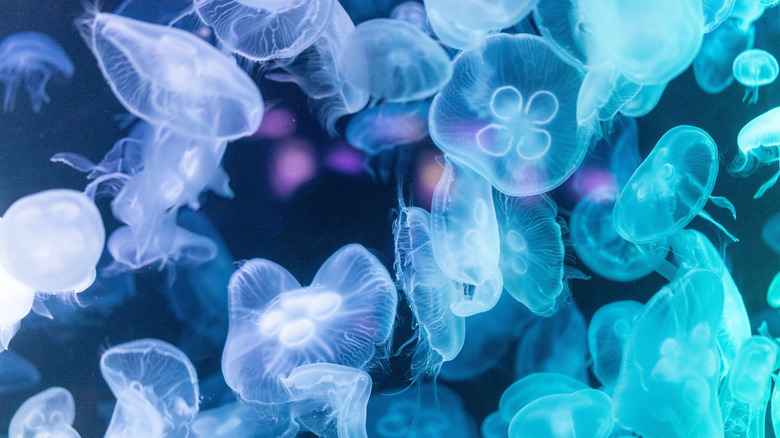
For the experiment, NASA scientists sent approximately 2,500 Aurelia Ephyra jellyfish polyps into space aboard a shuttle. These fledgling jellyfish were given everything they needed to survive and thrive in an accelerated setting, including plenty of saltwater and a crew of scientists to monitor them. The experiment lasted a little over a week. When the shuttle returned to Earth, those 2,500 polyps had multiplied into an impressive 60,000 fully-grown jellyfish. At a glance, all of the space-born jellyfish seemed perfectly normal. However, once they entered the grip of Earth's gravity, the researchers noticed a vital change: a large portion of the jellyfish experienced severe directional control issues, unable to swim properly or orient themselves. In short, the jellyfish were exhibiting all of the telltale signs of intense vertigo, unable to discern if they were moving up or down.
Much like humans, jellyfish have a physical characteristic that allows them to orient themselves while in traditional gravity. During their growth, jellyfish develop calcium sulfate crystals along the surface of their bodies. These crystals are very similar to the calcium carbonate in the human inner ear. Both structures can sense changes in gravity and send signals to fine hairs, allowing jellyfish and humans to properly orient themselves. The space-born jellyfish did still develop their crystals, but since they weren't born in actual gravity, their bodies couldn't parse that information properly, leading to persistent disorientation.
While only a portion of the jellyfish developed this affliction — around 18% — it's a worrying result, implying that a comparable portion of humans born in space and used to living with no gravity could see similar problems if they ever came home.