

Are Smart Plugs Better Than Outlet Timers?
We may receive a commission on purchases made from links.
Our homes are gradually getting smarter in both the micro and macro senses, with all kinds of gadgets giving us a greater degree of control over what turns on, when, and how. Even if you have an appliance with no inherent smart features, a smart plug could still allow you to remotely power it on or off, not to mention set activation and deactivation timers. Smart plugs are a great way to cheaply turn your house into a smart home.
Technically speaking, automating on and off times isn't exclusive to smart plugs. Outlet timers can do it as well — they just do it without all the additional smart features that may make the difference.
Both outlet timers and smart plugs can serve the same general purpose, keeping a particular appliance or installation in your home on a consistent activation timer. But that's about the only purpose that an outlet timer can serve, whereas a smart plug can also be used for remote activation or syncing with other smart appliances and systems. A smart plug is, for all intents and purposes, a direct upgrade over an outlet timer, with the only real reason you'd want to use the latter being that you can't or don't want to use a smartphone or smart home framework to set it up.
Smart plugs have the same features as outlet timers, plus more
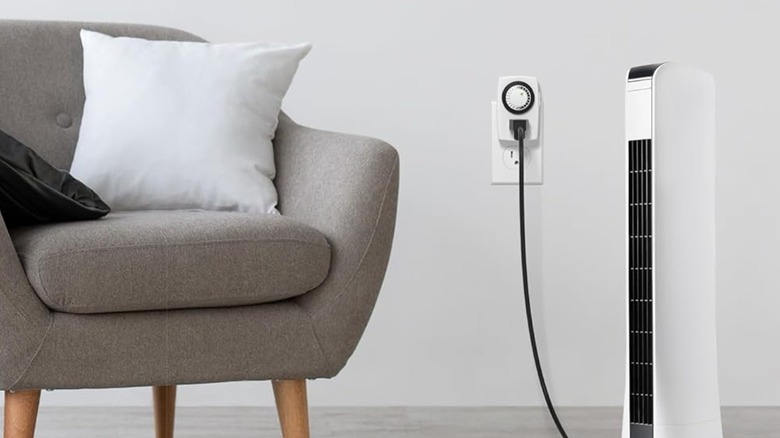
The singular function of an outlet timer is to be plugged into an outlet, have a device or appliance plugged into it, and regulate the flow of power based on a timer. Older or simpler outlet timers have mechanical timers that are set with a physical dial like an egg timer, while newer ones have programmable digital timers. When the timer goes off, the device either cuts or activates power to the plugged-in appliance.
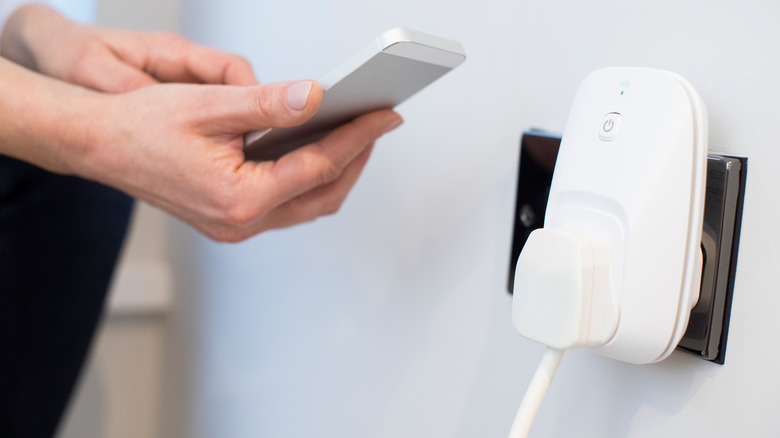
A smart plug can serve this exact same purpose, receiving a plug in its outlet and activating and deactivating it at scheduled intervals. The chief difference here is one of functional breadth, as there are all kinds of ways you can use smart plugs in your home. You can program activation and deactivation times on a smart plug using your smartphone, but you can also remotely activate the outlet with your phone if you don't want to wait for the timer, monitor the state of the electricity flowing through the connected outlet, and create automations where you synchronize its functions with other gadgets in your smart home collection.
The only weakness of a smart plug versus an outlet timer is that you generally need to set up and manage a smart plug with your smartphone. If you don't have a smartphone or just don't feel like going through the setup process, an outlet timer would make for a sufficient analog replacement, not to mention a potentially cheaper one.