

How Much Gold Is Actually In Your Old Laptop?
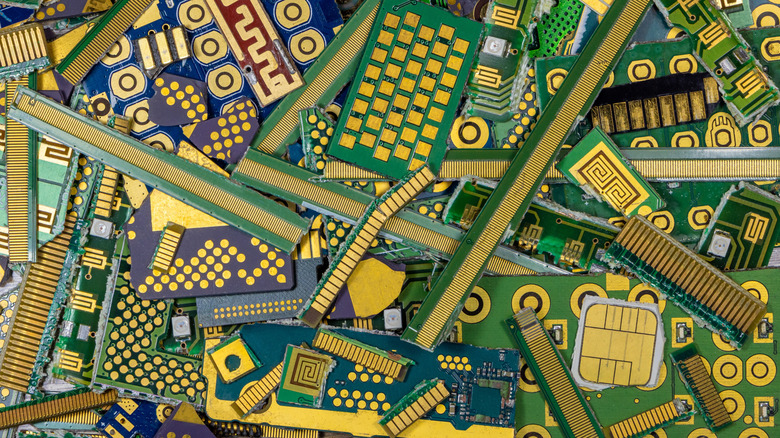
Inside your devices are rare earth metals like neodymium and europium, as well as precious metals like gold and silver. While that might give you an impulse to start cracking cases to find out how much gold is actually in your smartphone, it probably wouldn't be a very lucrative endeavor. For example, gold experts say it would take dozens of phones just to mine one gram of gold.
That does bring up a related question, though: How much gold is actually in your old laptop? Since laptops are generally much bigger than smartphones and include more components, you might expect there to be a little more gold inside. And, in fact, gold is used quite a bit inside a computer, mainly for circuit boards, connectors, and other contacts. But, while gold does show up in several places, the overall quantity in a laptop is still pretty small and wouldn't amount to much if collected and melted down.
SD Bullion estimates that about one-fifth of a gram of gold is used inside the average computer, maybe a little more. Laptops generally fall toward the smaller end of computers, and SD Bullion estimates each one contains about a 10th of a gram of gold. Like phones, that's not much, but could be valuable at scale ... if you were willing to tear down hundreds of devices to make it profitable. Imagine the amount of labor needed to collect the devices and break them down, then separate and melt the materials!
Why is gold used inside a desktop or laptop?
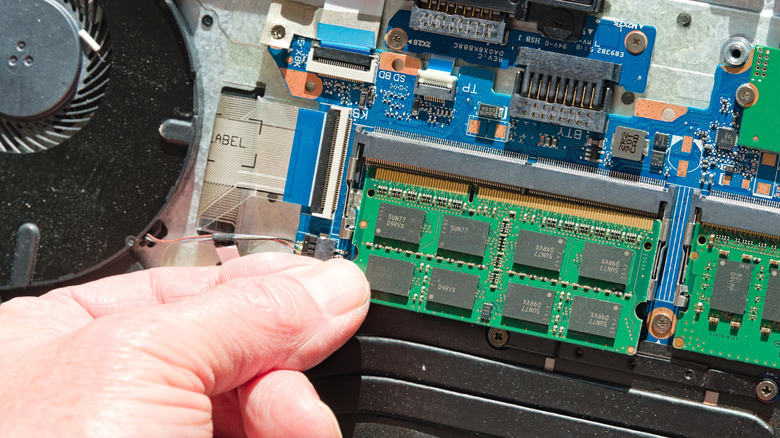
The general properties of gold are what make it such a great material for use in electronics, specifically printed circuit boards and other primary components, like CPUs or RAM. For starters, gold is highly conductive, which is critical for modern electronics. But pure gold also doesn't break down or tarnish over time like metals prone to rust do. Inside electronics, that means the material won't lose its efficiency over time in a measurable way. That's why gold is used for plating connectors, switches, delicate bonding wires, circuits, and more — places where electricity would be channeled, passed, or generated. In addition, gold plating is used to increase corrosion resistance for various components, PCBs included, to stop long-term wear.
Pretty much all modern electronics include gold in small increments, not just computers or smartphones. Appliances like refrigerators, washing and drying machines, vacuums, TVs, and even your car all have printed circuit boards inside and smaller components that employ gold. That's one big reason why it's best to recycle your old electronics rather than throwing them out completely and letting them end up in a landfill. Those rare materials can be recovered and reused in many cases, but recycling also prevents them from entering the soil or contaminating the local environment.
Recovering gold from old electronics is sort of like what happens to your old batteries when you recycle them. The materials can be broken down, safely disposed of, or repurposed as necessary instead of just becoming hazardous waste if disposed of normally. If you have old electronics lying around, Costco will even trade you for them. It's certainly a lot easier than trying to collect and break down all the gold parts.