

A '90s Sci-Fi War Movie That Began A Franchise Started As A Box-Office Bomb
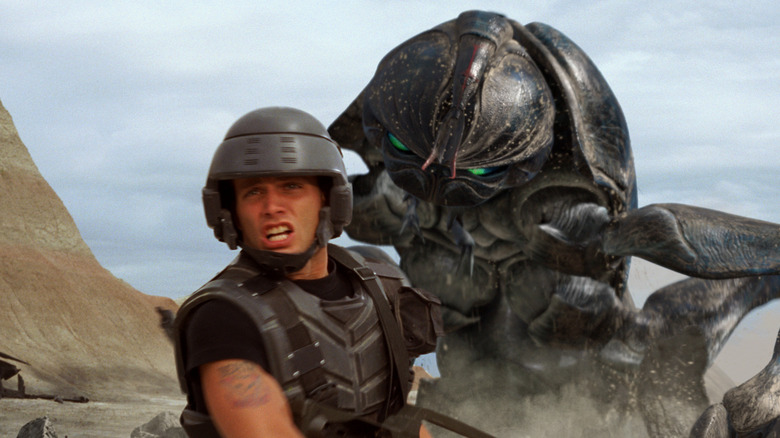
Paul Verhoeven's 1997 action sci-fi movie "Starship Troopers" — which the worst "Planet of the Apes" movie stole tech from — is the epitome of how a cult classic is born. Upon its release, Verhoeven's film was completely misinterpreted by audiences, who simply weren't ready for an unapologetically campy, scathingly sharp, and uncompromisingly violent satire that used a war between giant alien bugs and humans to deliver a fresh and innovative take on full-blown fascism.
Based on Robert A. Heinlein's 1959 novel, Verhoeven's epic follows Johnny Rico (Casper Van Dien), a young man enlisting in the Mobile Infantry instead of going to college, three of his close friends, and the unit of his fellow comrades under a stratocratic regime in the future of the 23rd century. It's a basic premise that somehow misled 1997 audiences into believing they were getting a classic space opera instead of the excessive, over-the-top, and outwardly dumb gorefest that "Starship Troopers" delivered with zealous flair.
There's a reason many millennials growing up in the '90s fell in love with this R-rated masterwork, even if they didn't necessarily understand its greater ambitions as a full-on farce. It was pretty much a dream come true as far as bloody combat and aliens go, with an underlying message. Yet its bare and raw appeal wasn't a big enough draw at the time, and the movie ended up failing commercially, making $121 million worldwide at the box office against an estimated $105-110 million budget. It took years until it gained much-deserved re-evaluation, becoming a lauded cult classic championed by both critics and viewers. That led to the movie spawning a long-running franchise (although without Verhoeven's capable hands) of many sequels, which ironically turned into the kind of B-movie trash that the original so skillfully avoided becoming.
Starship Troopers knew exactly what it was doing, but the sequels failed to recapture its magic
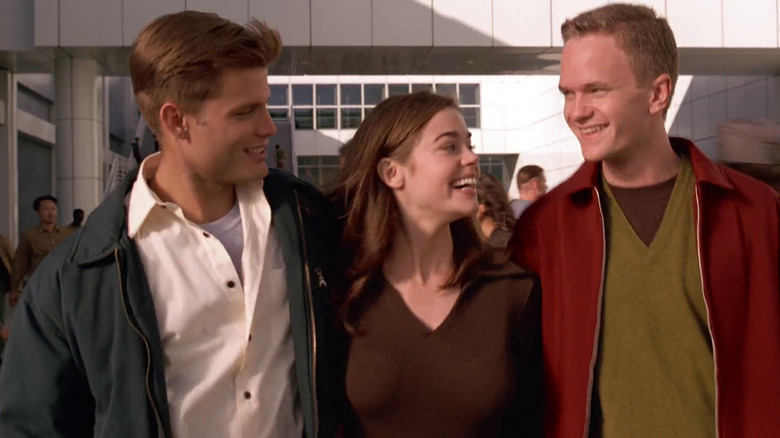
After the success of "RoboCop" (which was almost ruined by Oreo Cookies) and "Total Recall," Paul Verhoeven was brimming with confidence when it came to sci-fi, perfectly understanding the assignment of how to execute Ed Neumeier's script for maximum effect. He leaned into the story's high-school mechanics — since we essentially follow four friends as they graduate and then enlist in the military, receiving different training and various positions — and infused them with over-the-top patriotism and deliberate melodrama. Using blatant humor, explicit violence, and mawkish romantic beats, it's always evident that Verhoeven didn't take those narrative elements seriously other than employing them to deliver a harsh yet accurate critique of the military and American society at large.
The two direct-to-video sequels (still penned by Neumeier), operating with a small portion of the original's budget, were lackluster (visually and otherwise) continuations that completely missed the point of why the original hit so hard. Both "Starship Troopers 2: Hero of the Federation" and "Starship Troopers 3: Marauder" were almost universally panned, rather understandably.
The Japanese adult animation sequels in 2012 and 2017, continuing the plotline of the previous live-action movies, didn't fare much better either. Ultimately, "Starship Troopers" was a singular achievement thanks to Verhoeven's brilliance and uncanny (if unsubtle) vision as a director making all the difference. It wasn't a coincidence that Hollywood studios didn't want to roll the dice on investing heavily in a big-budget sequel (especially without Verhoeven) when the first film didn't perform well and was only redeemed much later after its release. In retrospect, the existence of "Starship Troopers" — an openly audacious and courageous effort of filmmaking — is something of a miracle.