

Why Some Hard Drives Have Breather Holes (And What Happens If You Cover Them)
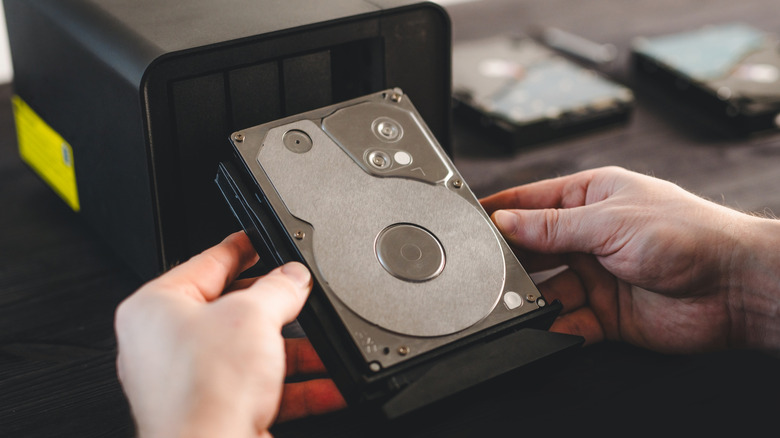
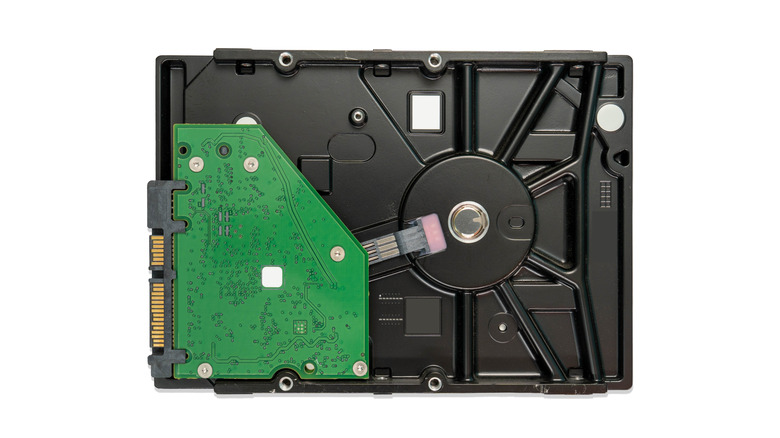
There's a common myth about hard disk drives (HDDs) that they're vacuum-sealed in order to protect the magnetic disk from outside contaminants. While protecting the disk is important, only certain kinds of HDDs are fully sealed, while others are dotted with distinct breather holes. Though these holes may seem simple, they're one of the most vital components of an HDD, ensuring consistent stability and performance — and if they were covered up, the device could end up completely destroying itself.
Breather holes that dot the surface of an HDD are what allow the insides of the device to maintain an ideal, equal air pressure. This, in turn, ensures that all of the internal components of the HDD are functioning in harmony, from the magnetic disk to the read/write head that saves and overwrites data on its surface. If you're ever assembling your own PC and using an HDD, you must make absolutely certain the breather holes are uncovered, or else that HDD won't be doing much in the way of data storage at all, and you'll struggle to find any uses for the hard drive other than storage.
Breather holes create precise air pressure within the drive
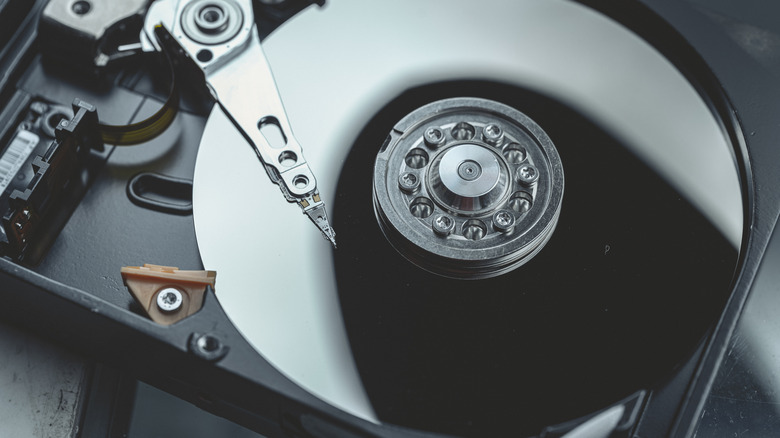
The two most important components of an HDD are the magnetic disk, also known as the platter, and the read/write head above it. When you save data on an HDD, the read/write head generates a small magnetic field and moves radially along the disk's surface, altering its magnetic orientation and allowing it to store binary data. The head can then scan the surface in order to read the data. This delicate magnetic procedure is also why being exposed to powerful magnets can damage an HDD. Here's the important part, though: The read/write head doesn't actually touch the disk's surface when doing its job. Rather, it floats ever-so-slightly above the disk's surface with the help of an air bearing.
An air bearing is a little cushion of air situated between the read/write head and the disk, holding the head just close enough that its magnetic field can alter the disk without making physical contact. The air bearing is incredibly small, mere nanometers across, but it's maintained by a carefully balanced air pressure inside and outside of the device. This is the purpose of the breather holes; it's those holes that allow the HDD to maintain a perfect pressure equilibrium internally and externally, which in turn preserves the air bearing and allows the read/write head to do its job.
Covering the holes can cause errors and damage
Because the air bearing between the read/write head and the disk is so tiny, it needs that extremely precise pressure equilibrium in order to maintain it. If the pressure skews internally or externally, even a little, the entire process could be thrown out of whack. That is exactly what will end up happening if you cover up your HDD's breather holes.
The precise results of covering up your HDD's breather holes will depend on whether the pressure inside the device increases or drops, but it's bad news either way. If the pressure inside the HDD increases, the air bearing will become denser, which can prop the read/write head higher up from the disk. If the read/write head is too high, its magnetic field won't be able to reach the disk, which can lead to read/write errors.
Inversely, if the pressure inside the HDD drops, the air bearing could lose its integrity or disappear entirely, dropping the read/write head right onto the disk. The disk is an extremely delicate piece of equipment, and any direct contact could permanently scratch or scuff it. If the disk is scratched, any data stored on the scratched segment is lost forever, which means the entire HDD is effectively worthless. HDDs are extremely delicate in this regard, though on the bright side, it's not hard to dispose of old hard drives.