

The Surprising Way LED Lights Can Interfere With Your Garage Door Opener
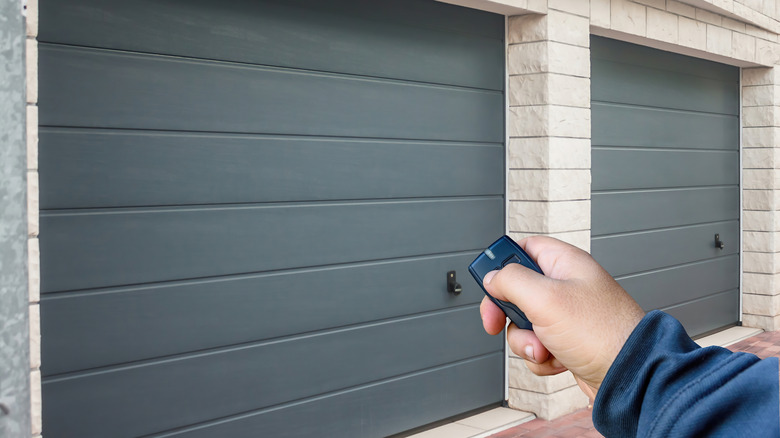
Here's a scenario you may be familiar with: You're pulling up to your garage in your car, and you click the button on your garage door remote. Annoyingly, the door doesn't open, forcing you to get out of your car and keep pressing the button until it does. While the obvious assumption here is that there's something wrong with your garage door opener or the remote, there may be a different, unexpected culprit: the LED lights installed above the door, interfering with the remote's signal.
Due to a particular quirk in how some LED lights operate, they can emit a small degree of electromagnetic radiation, which can scramble the radio frequency sent from your garage door remote to the motor. While this won't endanger your garage door's overall functionality, it can be very annoying, especially if you're trying to pull your vehicle in while it's raining or snowing. If you're experiencing this problem consistently, you may be able to remedy it by moving or replacing any nearby LED lights or upgrading your garage door equipment.
How do LED lights cause electromagnetic interference?
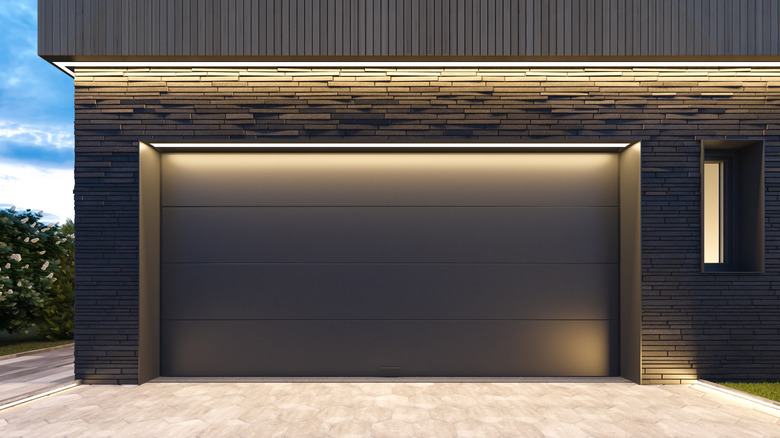
All home electronics generate their own electromagnetic radiation, and LED lights are no exception. To clarify, though, electromagnetic interference is not generated by the actual lighting surfaces of an LED. Rather, the source of the static is the LED driver, a small device located in the center of an LED light. The driver is a vital component that transforms incoming voltage into electrical current to power the lights. It maintains lighting levels through rapid switching to dim and brighten the lights as needed. As a byproduct of this process, the drivers can emit electromagnetic noise, or static. If you have an LED light on, over, or near your garage, and it's emitting static on the same frequency as your garage door remote, the remote's signal can become garbled, preventing it from reaching the door opener's motor.
There are a few ways you can tackle this problem, depending on where your lights are located, their build quality, and whether or not you're willing to replace them. The simplest approach would be to remove and relocate any LED lights situated right next to your garage so their static can't catch your remote's signal. If that's not an option, you may need to replace them instead. LED lights emitting electromagnetic interference are generally of a slightly lower quality, with poor shielding that doesn't properly contain or redirect any noise produced. Using properly shielded LEDs, as well as those that don't emit noise in the same frequency range as your garage remote (usually between 300 and 400 MHz), should solve the problem. Alternatively, you could also visit a retailer like Costco for smart garage solutions that don't use radio signals, or use smart lights that can be remotely turned off.