

What Happened To Zenith TVs? Why The American Brand Disappeared
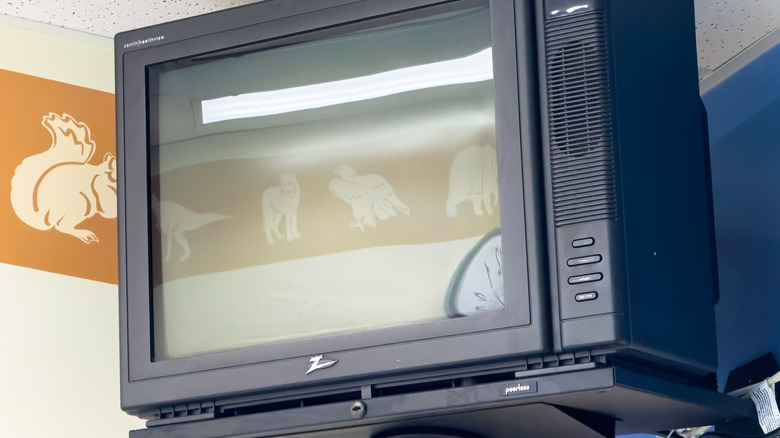
At the height of its better days, Zenith was a premier American TV manufacturer well known for top-of-the-line sets. Those looking to build a home movie theater with a high-fidelity TV would generally migrate towards Zenith as the centerpiece. The company's slogan was even "The quality goes in before the name goes on." But in 1999, Zenith filed Chapter 11 bankruptcy, and eventually GoldStar, which would become LG, bought the remaining shares, after having already owned a controlling stake. Unfortunately, that's when Zenith became a subsidiary and shifted focus away from TVs entirely.
Zenith was actually one of the first companies to produce the HDTV — high definition TV sets. Those became incredibly popular around 1998, shortly before the company went under. So, what exactly happened, and why did Zenith disappear? At the time, there were quite a few things happening that led to Zenith's downfall. Competition was rising steadily, and many comparable manufacturers were already established in the market or on their way. Brands like Sony, Panasonic, RCA, Magnavox, and Sharp were also creating desirable products. But many of those manufacturers had already shifted operations to countries or regions where production was cheaper. When Zenith eventually did, it saved money at the expense of quality, and the brand began losing reputation. Finally, Zenith was a relatively small company compared to its rivals and the rest of the electronics industry, which had grown on a global scale.
All of these things meant Zenith simply could not compete in regard to marketing, innovation, or, in many ways, financially, and the TVs disappeared from store shelves. Still, if you come across a Zenith or quality CRT TV, experts say you should always buy it at thrift stores. They're phenomenal for retro gaming and watching old VHS tapes.
Zenith couldn't keep up with the competition and innovation
While there are a lot of cool things you can do if you decide to repurpose your old TVs, there's no denying the fact that they are clearly retro — especially old Zenith TVs — when compared to today's ultra-thin, ultra-high fidelity sets. Those old CRT TVs or cathode-ray tube TVs were incredibly heavy, bulky, and most could not be mounted to walls or placed on thin, floating furniture like sleek entertainment stands. They required sturdy furniture like a desk, a full-size dresser, or an all-wood entertainment center. When Zenith went under in 1999, that was before flat-panel TVs and more modern technologies became common and popular. But the TVs at the time were still being compacted in size and deployed in new, interesting ways.
The brand disappeared when it was acquired by LG, primarily because it could not keep up with the fast-moving competition and innovation in the industry. It had been known to stick to tried-and-true technologies to uphold its reputation for quality, and that conservative approach opened up the opportunity for it to fall behind in many ways. Zenith had undergone a brand shift in 1997, spurred by GoldStar, but it wasn't enough, and that's evident by where the company ended up.