

The Next Evolution Of Hard Drives Could Be Even More Sci-Fi Than We Thought
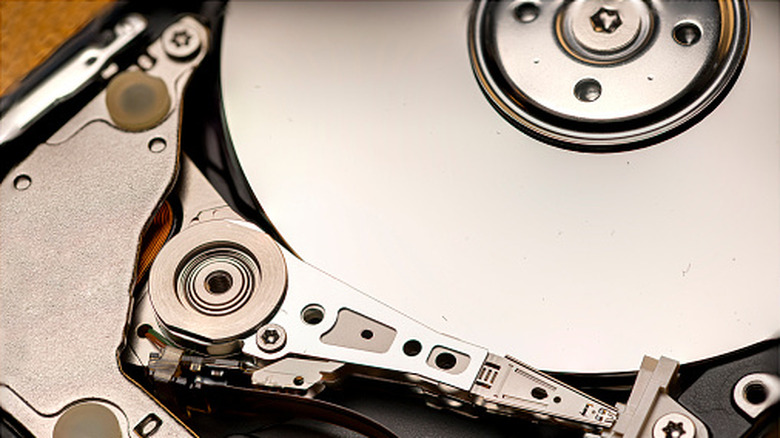
Is civilization reaching the limit of traditional hard drive size and speed? The biggest HDDs on the market exceed 30TB, and some drives use helium to increase efficiency and fit more platters into their cases. And while SSDs are popular, especially among the gaming crowd, the next big step in hard drive technology is ... DNA? As in the helical molecule that acts as the blueprint of all life? Well, sort of.
In September of 2025, a team of researchers at the University of Missouri announced their latest progress on what is best described as a "DNA hard drive." Their research, published on PNAS Nexus, outlines the idea to transcribe data onto a "universal DNA template" (likely artificial DNA) via heated microstaples of different lengths. Think of it like turning DNA molecules into punch cards via branding. The team ran into numerous roadblocks along the way, including the high cost of transcribing data and an inability to rewrite information after it was transferred.
However, the most recent breakthrough uses a mechanism akin to how viruses infect cell DNA (a process called "viral ribosomal frameshifting") to write data onto the universal DNA template without the need for synthesis or enzymatic processing. In other words, the researchers have made the process "rapid" and "cost-effective," which potentially opens the gates for widespread future use. Assuming you don't mind future computers acting like the Animus from "Assassin's Creed," that is.
DNA drives have several advantages
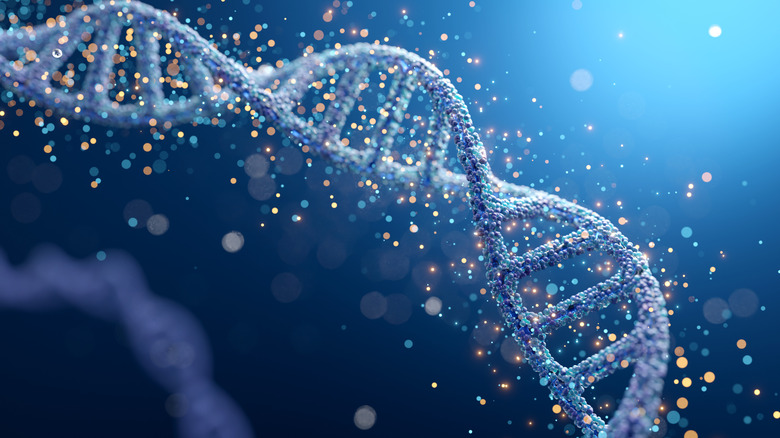
You're probably wondering what DNA can do that a spinning magnetic platter can't. For starters, DNA can hold a veritable fortress of data – 215 million gigabytes per gram. The researchers at the University of Missouri have achieved a data density of around 25 bases per bit (a base is a "G," "A," "T," and "C" nucleotide that forms pairs), and at three billion base pairs in a complete human genome, that amounts to about 240 million bits, or 30MB. That doesn't sound like much until you consider that all that data is packed into each cell in every body. Suddenly, DNA drives sound extremely cost-effective in terms of the amount of space they require.
DNA drives aren't just densely packed with data. The University of Missouri researchers also claim that a DNA drive can achieve parallel data writing and rewriting, which would speed up processes running off the technology even faster. Furthermore, DNA drives could be used to implement fuzzy logic circuits where truths aren't absolutes (1s and 0s in standard Boolean computing) but different shades. This technology could make computers more flexible.
Of course, DNA drives aren't without flaws. Computing systems have to decode and unzip the data engraved on the molecules. The researchers believe a "novel nanopore unzipping marker" can aid in the process and increase accuracy, but microstaples that function as data markers still must be identified in sequence. Moreover, the most recent tests place the system's reading rate at 10 bits per second, whereas the slowest HDDs and SSDs can reach speeds of 80 MB/s and 550 MB/s, respectively. Still, as testing continues, unzipping speeds will only improve, so one day DNA drives might be ready for the mass market.