

New Process Shortens Nuclear Waste Timeline From 100,000 Years To Only Hundreds
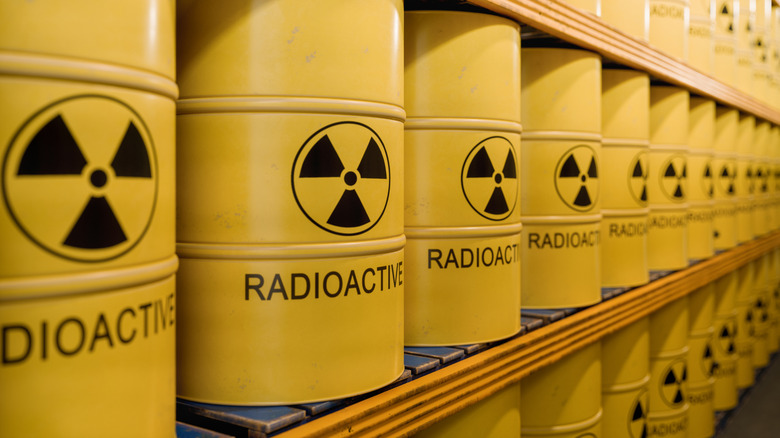
Nuclear energy isn't as clean as we like to believe. The associated power plants produce small amounts of nuclear waste that require proper disposal. The main enemy here is time. All radioactive materials eventually lose their radioactivity, but the process can take hundreds of thousands of years. However, a team of researchers has figured out a way to shave millennia off the wait.
Recently, the U.S. Department of Energy announced that the Thomas Jefferson National Accelerator Facility, or Jefferson Lab for short, would lead a program to improve the management of nuclear power plant waste. The project revolves around using particle accelerators to cut the radioactive decay of unprocessed expended nuclear fuel rods down from 100,000 years to approximately 300 years.
If the project, dubbed the Nuclear Energy Waste Transmutation Optimized Now (NEWTON) program, is successful, engineers can use it to detoxify nuclear waste starting in 30 years. And that's just using the technology we currently have available. Depending on how quickly the associated tech evolves, we might one day have particle accelerators that can reduce the radioactive life of spent nuclear rods to mere decades.
How particle accelerators speed up the radioactive decay
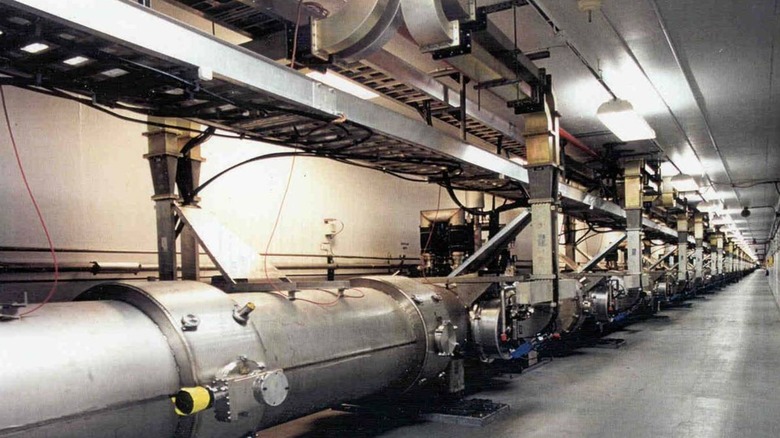
Despite what video games like "Fallout" might claim, you can't just suck the radiation out of something and have it dissipate harmlessly into the aether. The NEWTON project achieves its purpose by converting dangerously radioactive isotopes into slightly less radioactive isotopes. They're still dangerous (all radioactive nuclear waste comes with some inherent danger), just more manageably so. Quite frankly, it's the closest anyone has ever come to real-life alchemy, so the "transmutation" part of the name is pretty apt.
The Jefferson Lab's particle accelerator functions by shooting beams of high-energy protons into materials such as liquid mercury. As the accelerator does this, the material releases neutrons into containers of nuclear waste secured within the device through a process known as "spalling." The neutrons bond with the spent nuclear fuel, essentially diluting the material, reducing its radioactive life. Oh, and the reaction also generates electricity, which is always a positive.
So what happens after the NEWTON accelerator is finished converting the radioactive waste? Either the transmuted matter is buried (safely, mind you — nuclear waste doesn't exactly just go away) for 300 years, or it is recycled and put to "beneficial use."
Double the projects, double the chance for success
When the U.S. Department of Energy gave Jefferson Lab $8.17 million in grant money for the NEWTON program, the government was technically funding two different projects. These grants won't go towards building the particle accelerator but making it more efficient.
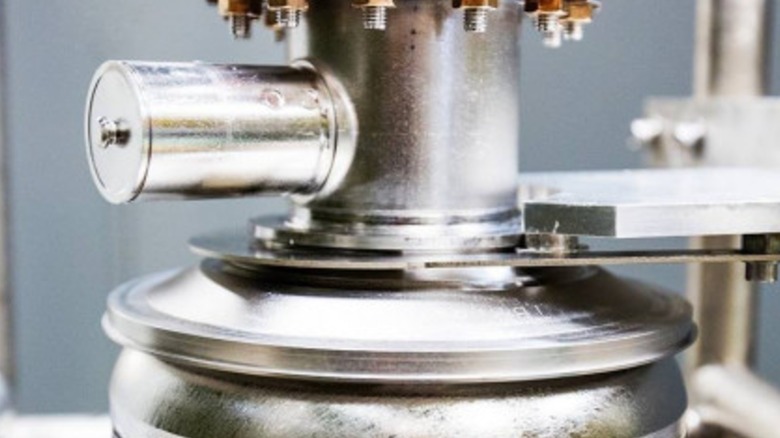
The first project in the NEWTON program is designed to "amp up the SRF particle accelerator components." According to Jefferson Lab, modern accelerators are coated in a special material called niobium, which becomes superconductive at low temperatures. The coating is efficient but requires expensive cryogenic equipment. Half of the grant money will go towards testing whether adding a layer of tin on the inside of the niobium surface will make it even more efficient. In theory, the combination of materials will also allow the accelerator to operate at higher temperatures, thus precluding the need for costly refrigeration. The other half of the grant money will go towards "powering up" the SRF accelerator cavities with a magnetron. Researchers believe a magnetron could fuel the particle beams, but they need to test how much energy is required and how to make it match the frequency of the particle accelerator cavity. Efficiency will be key.
If Jefferson Lab is successful, the foundation might have found a way to make nuclear energy even cleaner.