

Charging Your Tesla With Solar Panels Requires You To Do A Few Things First
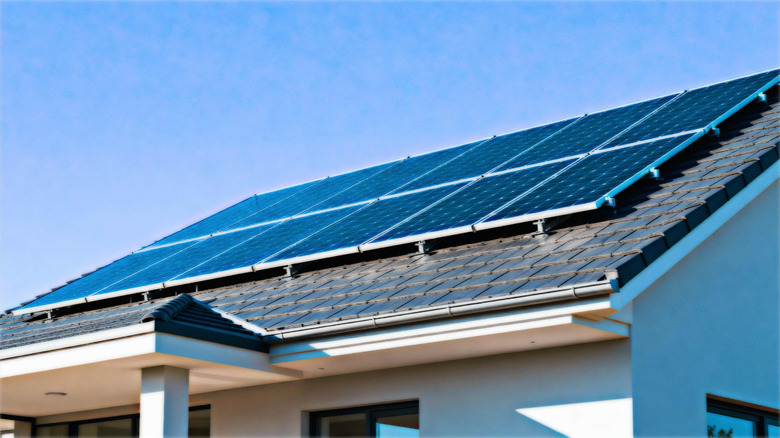
You can charge pretty much anything with a solar panel, given the right setup and enough time. For example, certain smaller panels have USB ports incorporated so you can plug your mobile devices right in, like you would a conventional power adapter. Many smart home gadgets you might have around your outdoor areas use solar to charge, like speakers, cameras, lights, and beyond. But does that also mean you can charge more substantial devices like, say, a Tesla or another electric vehicle? You absolutely can, but it's not a plug-and-play solution. You may need to do a few things first.
For instance, you cannot simply run cables straight from solar panels to your EV battery or its charging system. Not to mention, solar energy levels fluctuate based on a number of factors, and you'll need a consistent energy source to charge your Tesla's battery. The correct way to do it is to use a battery backup solution, which the panels would charge first, and then you plug that into your EV. Tesla's Powerwall is an excellent example. The Powerwall includes lithium-ion battery packs, where the energy is stored, as well as a built-in inverter, so if you opt to make your own system, you'd need a similar installation. An inverter converts the direct current (DC) electricity produced by solar panels into alternating current (AC) so it's usable by an EV. It's definitely possible to create your own solar backup system, but you'd need several components, including a charge controller, a suitable battery, an inverter, and, of course, solar panels. Ultimately, though, it is possible to charge your Tesla or EV with solar, even though it's not as straightforward as it might have seemed at first.
How many solar panels do you need to charge an EV?
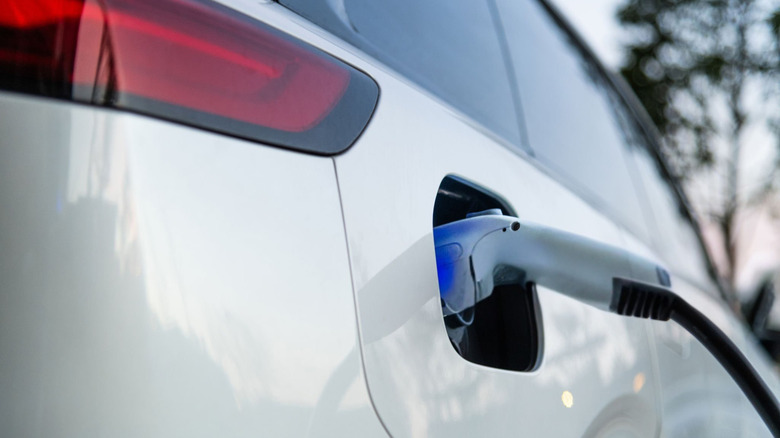
Every EV has different energy requirements. It depends on how far and how often you drive, which affects how often you're recharging your vehicle's batteries. Moreover, electric vehicles have battery capacities of varying sizes, some bigger than others. The larger the battery, the more power they hold, and the more energy needed to recharge it.
Edmunds estimates the average electric vehicle consumes 394 kilowatt-hours (kWh) per month. Annually, that's more than 4,700 kilowatt-hours. You can find the number of panels needed to charge an EV by dividing that total by a local production ratio (a measure of how efficiently a system converts DC to AC power), then dividing again by the wattage of panels you're considering. If your production ratio is 1.5 and you're considering 350-watt panels, that works out to about nine panels to charge an EV reliably, but that's not entirely accurate. Sure, some of the best solar panels you can buy are rated for 400 watts or above, but panels hardly ever deliver at their full capacity on a consistent basis. All of which means that you'll probably need more than nine panels to charge an EV on the regular.
That doesn't include additional panels you'd be using to power your home's energy needs, either. The typical home requires between 16 and 23 panels to offset utility bills with solar. Taking more than half of those away to charge your EV isn't ideal. It might be better to use net metering to sell excess renewable energy back to the grid for credits, and instead charge your EV the traditional route while using the credits to lower your utility bill. Net metering is something you should consider before installing solar panels on your home, anyway.