

Ukraine's Military Is Testing Exoskeletons That Look Like They Came From Edge Of Tomorrow
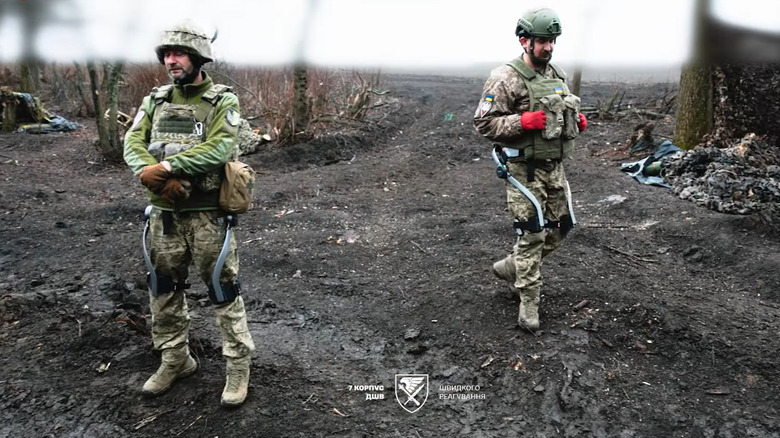
Due to its confluence with a worldwide explosion in artificial intelligence and robotics technologies, the war in Ukraine has become a testing ground for emergent military technologies. In many cases, the weapons systems emerging from the conflict increasingly resemble the tall tales of sci-fi, as swarms of aerial drones, unmanned search and rescue ground robots, and truck-mounted high energy laser guns continue to transform the shape and scope of modern conflicts. One recent innovation may be the first step in converting foot soldiers into the semi-bionic warriors made popular in futuristic films like the Tom-Cruise-Emily-Blunt-led "Edge of Tomorrow."
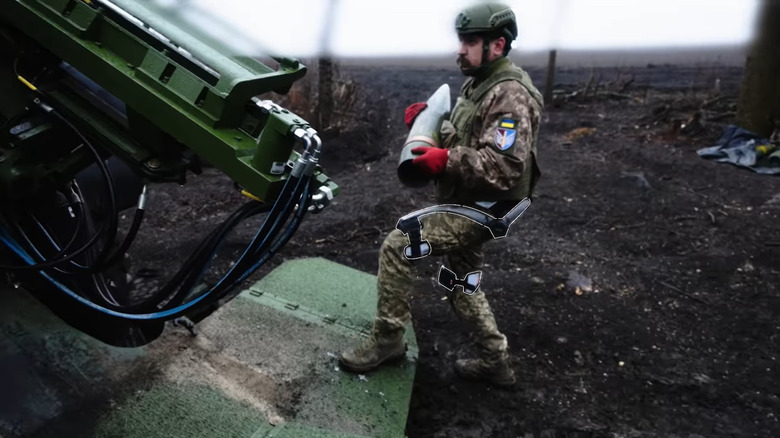
In a social media video released by Ukrainian forces, soldiers are seen wearing AI-enabled exoskeletons in a combat situation. Reportedly, the futuristic equipment is intended to reduce the physical load placed upon soldiers while enhancing both their speed and stamina on the battlefield. Shared in a Facebook video by Ukraine's 7th Air Assault Corps, troops are shown putting on what appear to be mechanical waist and leg braces before executing several tasks, such as carrying and loading artillery shells. The unit states that the technology is being tested in both logistical and combat operations in the Pokrovsk region, where Ukrainian media has declared that the 7th Air Assault Corps is repelling a major offensive.
This isn't the first time militaries have pursued exoskeletal. The U.S., China, and Russia have all pursued the technology. Lockheed Martin, meanwhile, secured a development agreement for its ONYX exoskeleton nearly a decade ago. However, Ukraine's new toy may be one of the only military-deployed exoskeletons consumers can buy a version of on Amazon, underscoring how the rapidity of technological innovation, when held within a globalized economy, increasingly blurs the lines between consumers and the battlefield.
Stronger, faster, longer: The age of exoskeleton soldiers
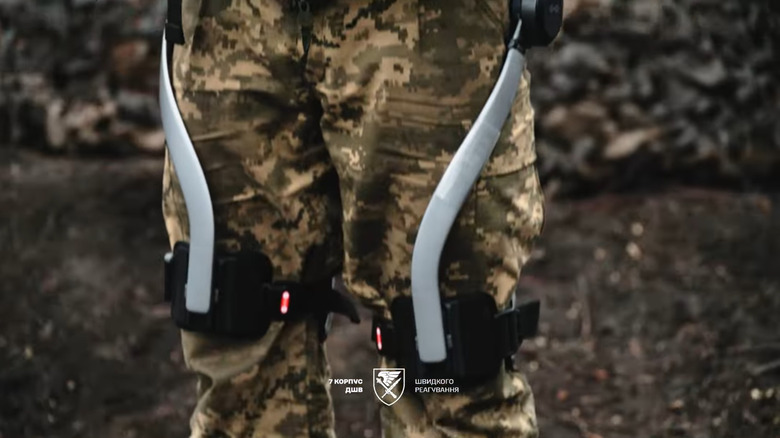
At first glance, Ukraine's new exoskeleton immediately conjures images of Tom Cruise's most underrated action film, "Edge of Tomorrow." And for what it's worth, Ukraine's military propaganda machine isn't shy about its futuristic technology, as the video posted by Ukraine's 7th Air Assault Corps plays more like the highlights of a high school football team than a military trial. Dubstep music overlays shots of soldiers strapping the exoskeletons around their waists and legs before rushing to load a CAESAR self-propelled Howitzer. According to its caption, the high-tech braces reduce a soldier's carrying load by 30%. It also can increase foot speed, reportedly helping soldiers reach 12 mph. According to the corps, the exoskeleton's range extends for up to 10 miles on a single charge. In a quote posted with the video, Colonel Vitaliy Serdyuk, the head of the 7th Corps' Missile Forces and Artillery Department, praises the exoskeletons for increasing soldier stamina, speed, and performance. Fashioned of carbon fiber, aluminum alloy, and stainless steel, the exoskeleton weighs just 4.4 pounds and is capable of functioning in extreme temperatures.
More interestingly, it deploys artificial intelligence to adjust weight distribution to a user's movements in real time, allowing soldiers to cycle through ten operating modes, which the video demonstrates via a soldier adjusting a thigh-high circular panel. Incredibly, it even comes with a mobile app. In an interview with Ukrainian newspaper Ukrainska Pravda, Serhii Lefter, a press officer for the 7th Rapid Response Corps, stated that the "app allows for custom settings" such as "enabling AI mode or adjusting power." However, Lefter stressed that the futuristic bionic leg braces could be used without the application.
Consumer good or military asset?
A military official told Ukrainska Pravda that the exoskeleton is part of the corps' "techno-air assault" capabilities. The unit has developed a reputation for its creative approaches to combat, garnering headlines for training soldiers in anti-drone defenses with VR headsets (via Ukrainska Pravda). Such an out-of-the-box approach has become the norm for a Ukrainian military needing to overcome a significant technological gap.
As indicated by military personnel speaking in the video, the exoskeletons appear to be a product marketed to outdoor enthusiasts by Chinese manufacturer Hypershell. A comparison of the video footage, military press releases, and Hypershell's website suggest it is likely the Hypershell X Pro, which shares the same performance metrics as those advertised by the Ukrainian military. In a statement given to Popular Science, a Hypershell spokesperson did not refute that the company's products were those pictured, instead stating that its exoskeletons are "designed for civilian use," adding "we do not support or condone any military application of our technology." To date, it's uncertain how Ukraine's military obtained the exoskeleton. As it stands, the Shanghai-based company has launched several pilot programs in Ukraine over the past two months, including those with drone conglomerate DroneUA and wholesaler METRO.
Ukraine's exoskeleton exemplifies its approach to asymmetric warfare, as its military often deploys consumer products to streamline an otherwise expensive, time-consuming procurement process. In 2022, for instance, the U.S. military spent $1.2 million developing the prototype for its SABER exoskeleton program. By contrast, Hypershell's X Pro retails for just under $1,000. This approach has helped close the technological gap with Russia, most notably kickstarting its now-world-leading drone program. As such, the takeaway from Ukraine's venture into sci-fi exoskeletons may not be the technology itself but its source, reflecting an ever-collapsing separation between military and consumer spheres.