

Don't Buy Antimicrobial Phone Cases - Do This Instead
We use smartphones at all times of day, no matter whether we're at work or home. We reach for the device every time we need to search the web for something or when a notification comes in. We don't necessarily wash our hands every time we use the phone, so it's reasonable to expect microorganisms to move between the hand and the handset. With that in mind, some cell phone users may be tempted to buy antimicrobial cases and screen protectors to reduce the risk of contaminating the devices with bacteria and viruses they may pick up during the day. In turn, the cleaner the device, the lower the chance of microorganisms transferring to clean hands. However, studies have shown that antimicrobial accessories aren't effective at significantly reducing the spread of microorganisms. Instead of buying antimicrobial cases and screen protectors, you might be better off cleaning your handset frequently using alcohol wipes.
A study from 2019 published in Infection Control & Hospital Epidemiology analyzed the effectiveness of silver-coated antimicrobial screen protectors in a setting where microbial load should be higher than in other places: the hospital. Duke University researchers recruited 26 doctors to determine whether the antimicrobial screen covers would prevent the contamination of handsets and reduce the recontamination of hands. The experiment showed that the silver-laden screen protector had some effect in reducing bacterial load by day seven, compared to the first day, but that effect disappeared by day 30. The microbiome found on the display after 30 days was similar to the start of the experiment, showing that antimicrobial display covers likely aren't a solution for reducing the spread of pathogens.
How to clean smartphones with alcohol wipes
The Duke researchers advised medical professionals to continue using proper hand hygiene, urging them to consider phones to be contaminated even if they have antimicrobial screen covers. The study also acknowledged that more testing is required to determine why the antimicrobial barriers tend to lose their effectiveness over such a short time. The research analyzed only the effects of antimicrobial screen protectors, but it stands to reason that similar conclusions can be drawn for antimicrobial phone cases that would be exposed to similar contaminants. Importantly, the researchers sterilized the phones in the experiments with 70% ethanol before applying the antimicrobial screen cover.
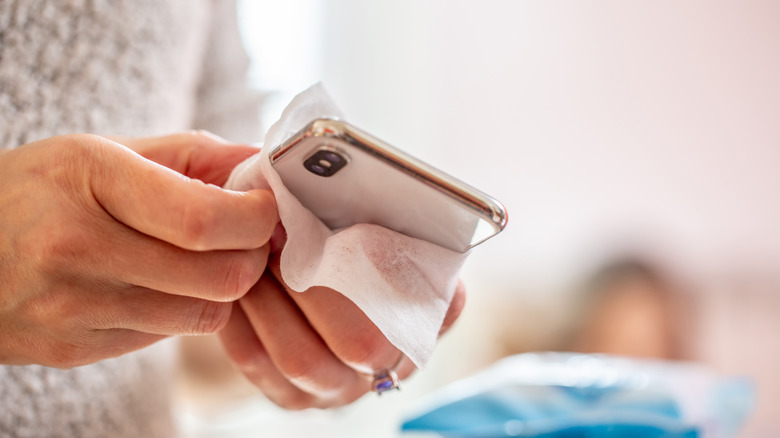
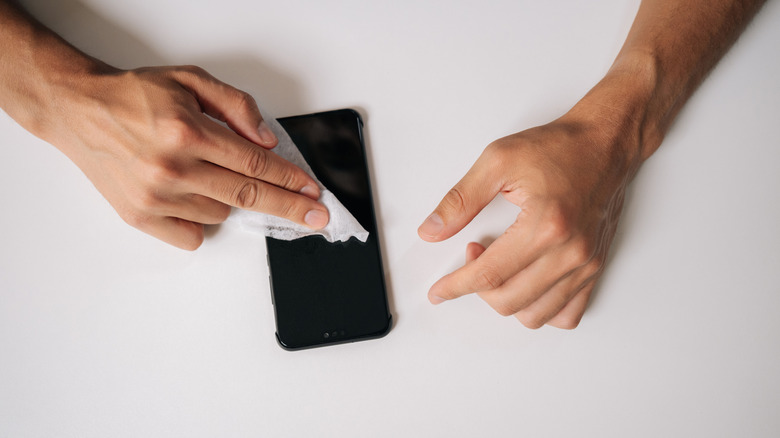
In our guides on how to deep clean iPhones and Android smartphones, we explained that smartphone vendors offer cleaning instructions that advise handset owners to use similar alcohol solutions for disinfecting the handset. Apple lists wipes containing 70% isopropyl or 75% ethyl alcohol, and Clorox Disinfecting Wipes on its support page for cleaning iPhone models. The iPhone maker advises owners to wipe the exterior surfaces of the handset gently when employing these disinfectants. This indicates that alcohol-based solutions are suitable for directly cleaning the front and back of the phone, but also protective accessories, like a screen protector or a case.
Similarly, Google recommends 70% isopropyl alcohol-based wipes or household disinfecting wipes for disinfecting Pixel devices. Samsung mentions hypochlorous acid-based solutions or alcohol-based solutions, like 70% ethanol or isopropyl alcohol, for disinfecting Galaxy phones and other devices. All three vendors warn against using bleach on mobile phones. Also, any alcohol-based solution should be applied via a wipe or a microfiber cloth, not poured directly on the handset. The same guidance can be used for cleaning regular phone cases you might be using with your iPhone or Android device.
How long does the antimicrobial protection last?
The Duke University researchers listed several types of bacteria found on the front and back of handsets, which included Staphylococcus, Streptococcus, and other types of bacteria that can live on human skin without necessarily causing illness. The experiment wasn't able to show whether the bacteria found on the phone surfaces were still capable of multiplying. While the study doesn't mention viruses, other similar studies have shown that viruses also inhabit the surfaces of phones. A 2023 review article in The Journal of Infection and Public Health analyzed existing literature on the presence of SARS-CoV-2, the virus responsible for the COVID-19 pandemic, on smartphones. The 15 studies explored in the review covered 511 mobile devices, of which 45% contained traces of the virus. The authors of the review suggested that healthcare workers should consider decontamination protocols for smartphones.
A 2026 study published in Antimicrobial Resistance & Infection Control showed that 70% isopropanol is "highly effective" in reducing contaminants on smartphone surfaces. Cleaning devices belonging to healthcare workers with the alcohol solution led to a fivefold decrease in bacterial load. A 2024 pilot study in The Journal of Hospital Infection compared the efficacy of 70% isopropyl alcohol wipes and ultraviolet light in disinfecting smartphones belonging to medical workers. Both methods worked well, reducing the bacteria on smartphone surfaces. However, the bacterial load increased within three hours for both cleaning methods, with the alcohol wipes having a slight advantage.
These separate studies indicate that smartphone users can benefit from using alcohol-based wipes to disinfect their devices, but they should consider cleaning surfaces frequently, especially if they use their devices in high-risk places, like hospitals and other areas where contaminants may abound. Routinely washing hands may also be advised in such circumstances.