

Why Your Car's Speakers Crackle When You Turn Up The Volume
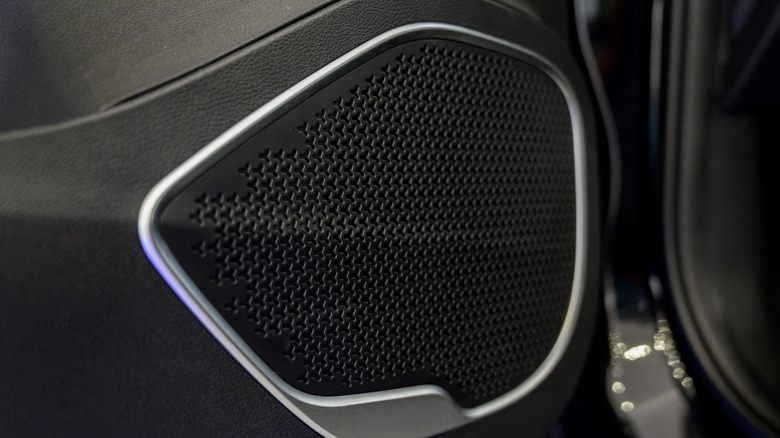
Infotainment software like Apple CarPlay and Android Auto makes it easy to stream albums, artists, and playlists with just a smartphone and Bluetooth. While the music may come from your phone or another source, you still rely on your car's audio system. They're one of those consumer tech categories where the sky is the limit, and dropping thousands of dollars on a premium speaker setup isn't unheard of. But even a brand-new vehicle with factory speakers can experience issues, including the chief speaker offender: crackling. Specifically, we're talking about the kind of crackling that occurs when turning up the volume.
This usually happens because your vehicle's speakers are tied into the built-in stereo receiver of your car's infotainment system. That receiver has a built-in amplifier that dishes out a limited amount of power to your car speakers. If the factory-installed sound system isn't able to supply enough power to each channel, the result is often a crackling, distorted sound from one or several speakers.
Overusing your car speakers may actually cause physical damage to them, and a torn cone or busted voice coil can definitely introduce crackling. That said, if you love blasting tunes at max volume, it might be time to invest in an aftermarket amplifier and a dedicated subwoofer.
Speakers can only handle a finite amount of power, and car speakers are no exception
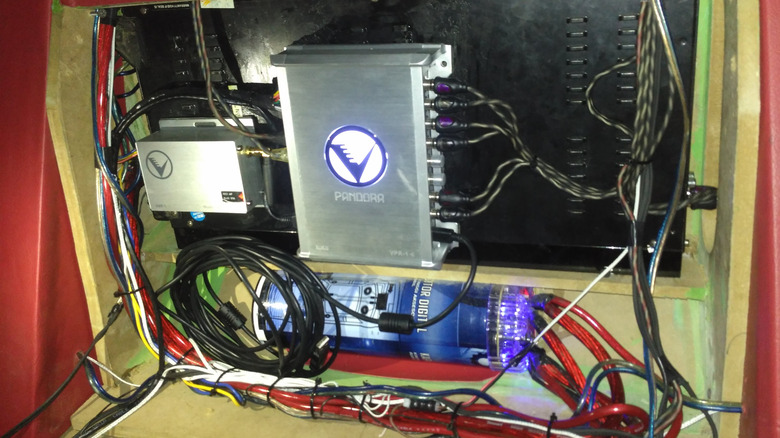
Much like the speakers of a home theater system, your car speakers are only designed to accept a finite amount of wattage. If drivers are pushed too hard and too frequently, it generates a lot of unnecessary heat. Excess heat is no friend to batteries or other electronics, so you want to avoid it as much as you can. But when your car is equipped with a proper amplifier-subwoofer combo, your speakers aren't tasked with handling as much low end — that's what the dedicated woofer is for.
Installing an aftermarket amplifier will also allow you the flexibility to add higher-wattage speakers down the line. This might actually be necessary if you purchase an amplifier that delivers more wattage than your car's factory speakers can handle. Fortunately, higher-wattage audio isn't just a guaranteed boost in the volume department; you can also expect more dynamic playback (more highs and lows), on top of less or zero distortion.
Overworked speakers are one of the main causes of crackling at higher volumes, but that doesn't mean you should rule out other variables. Faulty speaker wiring and lackluster car acoustics can also introduce this type of audible abnormality. Far and away, though, if the crackling happens as soon as you raise the volume past a certain threshold, underpowered speakers are more than likely your culprit.